Metallic yarns are not one material. They are three construction families that happen to glitter: film ribbons cut from metalized polyester, wire drawn from real metal, and spun blends carrying short metal fibers. The family decides how a knit runs, how it washes, and how long the shine lasts.
When a designer asks for a metallic knit, the mill has to figure out which family fits: a film-type yarn where an aluminum-layered polyester film is cut into ribbon, a wire-type yarn drawn from actual metal, or a spun blend where short metal fibers are mixed into a conventional spun yarn. The choice decides how the knit behaves in production, how it survives cleaning, and how long the shine lasts on the shelf.
This guide separates the three families, compares them on the criteria that matter for knitwear programs, and lists the checks we run at our Wenzhou mill, which has been weaving and knitting metallic blends on 300+ looms since 1995, before a metallic program is allowed into bulk.
The three constructions, mechanically speaking
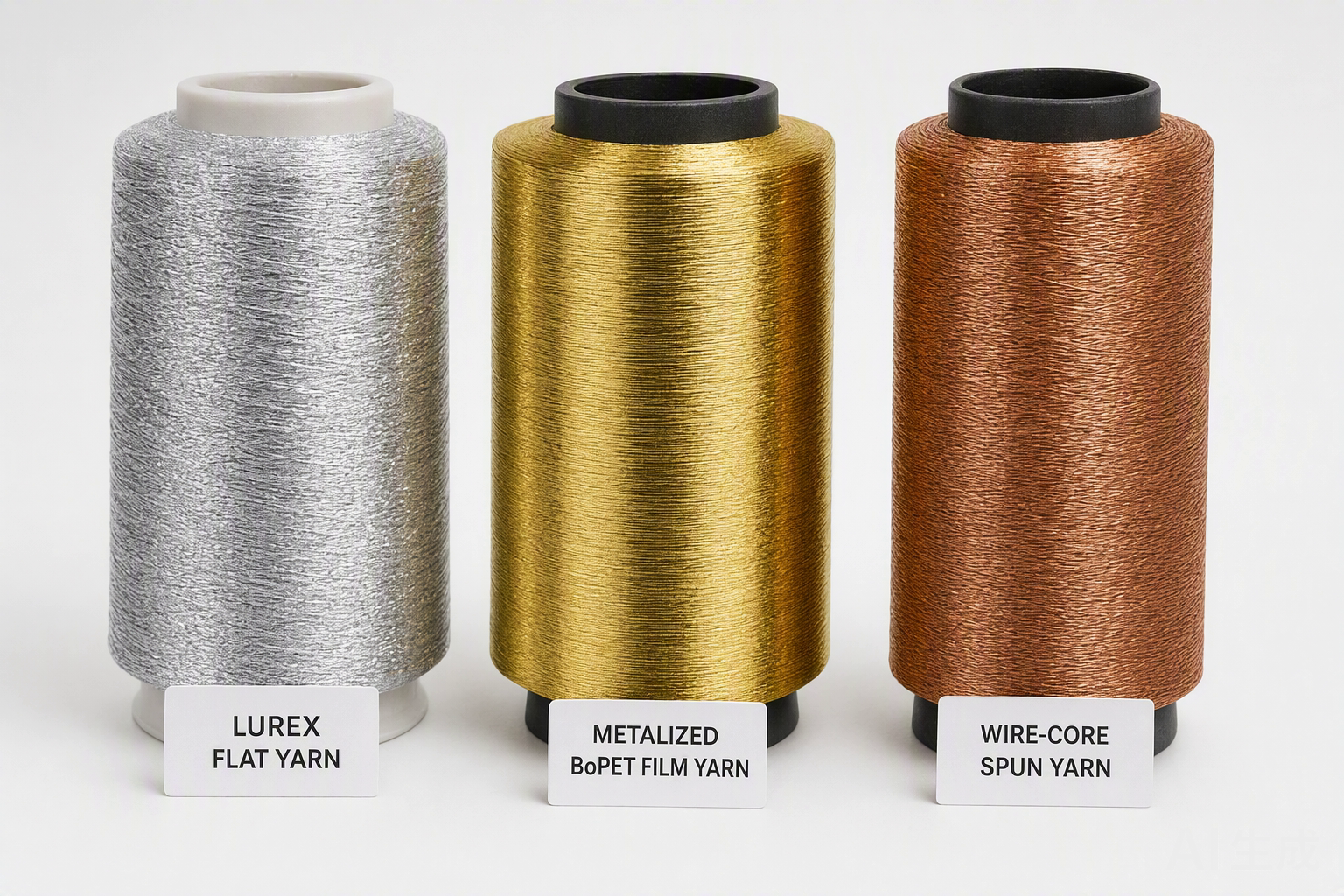
The film family is the one most people mean when they say Lurex. Lurex is a registered brand name that has become the generic shorthand for yarns made by metalizing a BoPET polyester film, slitting it into narrow ribbon, and supporting it on a carrier yarn, and the brand’s own technical pages describe exactly this layered construction. Mylar is the DuPont trademark for the BoPET film itself, so “Lurex versus Mylar” is really “branded finished yarn versus the raw film that feeds a whole class of look-alike yarns.” Mills that buy metallized film yarn from non-brand suppliers are still in the same construction family; what differs is film thickness, the metal deposition quality, and how tightly the carrier supports the ribbon.
The wire family draws fine metal filament, usually stainless steel or copper alloy, alone or wrapped with textile yarn. Wire does not pretend to be a fashion effect only: it holds shape, conducts, and resists abrasion in ways film cannot. The spun family works differently again, short metal fibers are blended into a spun staple yarn so the metal is distributed through the yarn rather than riding on its surface. General textile references such as Textile School cover all three under metallic yarn constructions, and the practical sorting question for a buyer is simply: is the metal on the surface, inside the yarn, or the yarn itself?
| Egenskap | Film type (Lurex-style) | Wire type | Spun metal blend |
|---|---|---|---|
| Surface brilliance | Highest, mirror-like | Medium, directional | Soft, subdued sparkle |
| Bending endurance | Lowest, film creases and dulls | High, wire work-hardens | High, metal is protected inside |
| Håndfølelse | Crisp, slightly stiff | Firm, springy | Close to normal spun yarn |
| Knitting behavior | Needs plied or supported versions | Limited to coarse gauges | Runs closest to standard yarn |
| Cleaning tolerance | Mild wash, low iron | Very tolerant | Tolerant, follows base fiber |
| Typical use | Fashion knits, tweed effects | Structural and technical knits | Uniforms, subtle sparkle knits |
What each family does in a knit structure
In knitted fabric the yarn has to survive looping, and looping is where film yarns earn their reputation for trouble. Every loop forces the ribbon around a tight radius, and the metalized layer micro-cracks a little at each bend, which is why high-quality film yarns are supported on a polyester or nylon carrier and often twisted with a fine companion yarn to spread the load. A 12-gauge sweater knit with unsupported film ribbon will show dull patches after a handful of wear cycles; the same design with a supported, plied metallic runs for seasons. Wire yarns have the opposite problem, they are so strong that they punish the knitting machine instead of themselves, so wire programs live at coarse gauges, 3 to 7, in structural knits and sculpural panels. Spun blends behave almost like ordinary yarns on the machine, at the cost of a glow rather than a glitter, and they are the family we specify when a knit has to pass repeated industrial laundering.
Care labels and what they admit
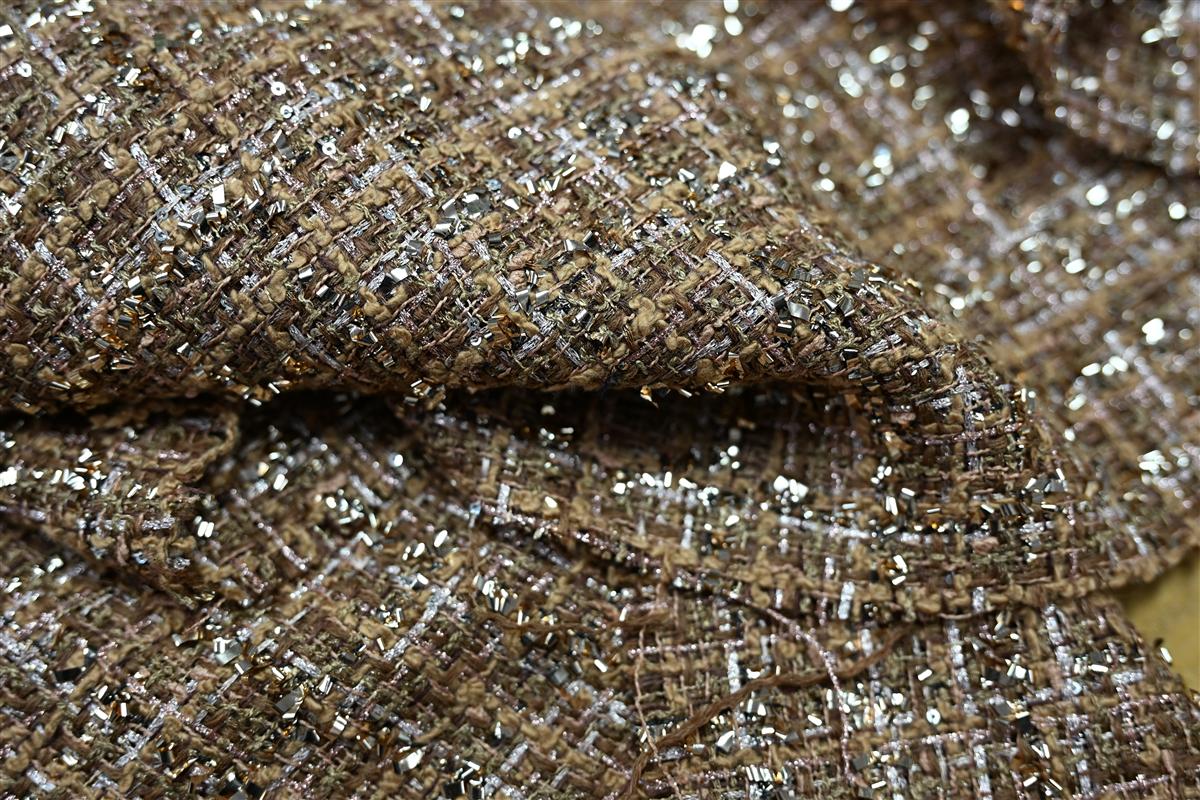
Care behavior follows construction, and a buyer can read the label like a confession. Film-based metallics that specify cool hand wash and no tumble dry are admitting that the metalized layer will craze under heat and agitation. Wire-containing knits that tolerate machine wash are relying on the metal’s real endurance but usually cap the temperature to protect the companion fibers. Spun blends inherit the base fiber’s care card, so a wool-spun metal blend washes like wool. The commercial point is that care restrictions travel all the way to the retail floor, a garment that cannot be ironed at normal settings generates returns in exactly the segment, eveningwear and occasion knits, where metallics sell. When we quote metallic programs for the Chanel-style tweed collection, the care-card conversation happens before the price conversation, because it decides which of the three families is even eligible.
Five checks before committing a metallic knit order
One, ask the mill to declare the construction family in writing, film, wire, or spun, because “metallic yarn” on a spec sheet is not a specification. Two, request a crease-flex reference: a small knitted panel that has been flexed and rubbed, so you can see the dulling behavior of the exact yarn lot, not the supplier’s best sample from an earlier batch. Three, confirm the carrier and support structure, unsupported film ribbon in a fine gauge is a defect waiting for its schedule. Four, match the cleaning regime of the end use to the family before pricing, an occasion knit and a hotel uniform cannot share a yarn choice. Five, insist on per-lot shade control on the metallic itself, film lots drift warmer or cooler between production runs and the drift is visible on the rack when panels come from different rolls. Custom metallic development in our skreddersydde produksjonsprogram starts at a 1,000-meter MOQ with a 7-day sampling cycle, which is enough yardage to run the crease-flex and wash panels before bulk money is committed, and metallic styles that already exist can ship from ferdiglager within days.
Ofte stilte spørsmål
Is Lurex a fiber or a brand?
It is a brand name for a family of metalized-film yarns. Mylar is the trademark for the BoPET film used as the glittering layer, so Lurex-type yarns and Mylar-film yarns are the same construction family.
Which metallic yarn is safest for machine washing?
Wire and spun-metal constructions tolerate washing best. Unsupported film ribbons dull fastest under heat and agitation, so they carry restricted care labels.
Why does my metallic knit lose shine at elbows and cuffs?
Film layers micro-crack under repeated bending. Plied or carrier-supported film yarns spread the bending load and hold their shine far longer.
Can metallic yarns run on standard knitting machines?
Spun blends run like ordinary yarns, supported film yarns need tension and gauge care, and wire is limited to coarse gauges because of machine stress.
Relaterte innsikter

Hva er ratiné-stoff? Løkke-garnstruktur og bruksområder
Ratiné er et teksturert ullstoff hvis overflate er dekket av tette, krøllede løkker av...

Tweedstoffblandinger: Hva ull, polyamid og akryl hver tilfører
En tweedblanding blandes med polyamid, akryl, eller begge deler for å balansere kostnad, holdbarhet og...

Stretchtweed for moderne skreddersøm: elastaninnhold og gjenoppretting
Tradisjonell tweed beveger seg ikke med kroppen. En jakke kuttet fra 100% ull tweed...