evaluate tweed quality is the first checkpoint buyers should lock before they approve a supplier, budget, or production slot. A sourcing manager opens a shipment of bouclé and finds the loop structure inconsistent across the roll. The real damage isn’t the fabric cost—it’s the 2,000 units already cut, the idle sewing line, and the shipment window you just blew. That’s why you evaluate tweed quality before a single meter gets on the boat. Rejecting a substandard 500-meter roll can chew through $2,000–$5,000 in wasted labor and material before anyone catches the defect. A structured technical check upfront cuts that exposure by more than half.
Most competitor guides stop at visual texture. They won’t tell you to run a wet rub test under AATCC 8, or to check loop uniformity with a 10x loupe, or to demand a Martindale abrasion score above 20,000 rubs. A 30-minute rub test catches pilling risk in 90% of cases. Skip it, and you’ll hear about it from your returns department six months later. This checklist walks you through the five checks that separate a supplier who understands commercial quality from one who just ships yardage. It’s not about being difficult—it’s about cutting a PO that doesn’t come back as a chargeback.
Step 1: Check Weave Density & GSM
GSM alone won’t catch a failing weave.
Start by confirming the stoffengewicht. For tweed destined for structured jackets, target 350–450 grams per square meter (GSM). For bouclé used in coats, a slightly lower 300–400 GSM typically provides enough body without turning the garment into dead weight. Use a GSM cutter on the swatch or request a mill-issued density report alongside the sample. If the mill can’t produce a documented GSM for the specific batch, move on—that’s a red flag for process control.
- Weight gate: Tweed below 350 GSM often lacks the drape needed for tailored jackets; above 450 GSM, you risk stiffness that kills the ‘Chanel-style’ hand feel. For bouclé, anything under 300 GSM tends to press open during seaming, exposing the backing.
- Transparency test: Hold two swatches from different batches or suppliers side-by-side against a light source. If you can see the underlying weave structure or backing through the pile on one sample, reject it immediately. Consistent opacity signals dense yarn packing and proper loom tension.
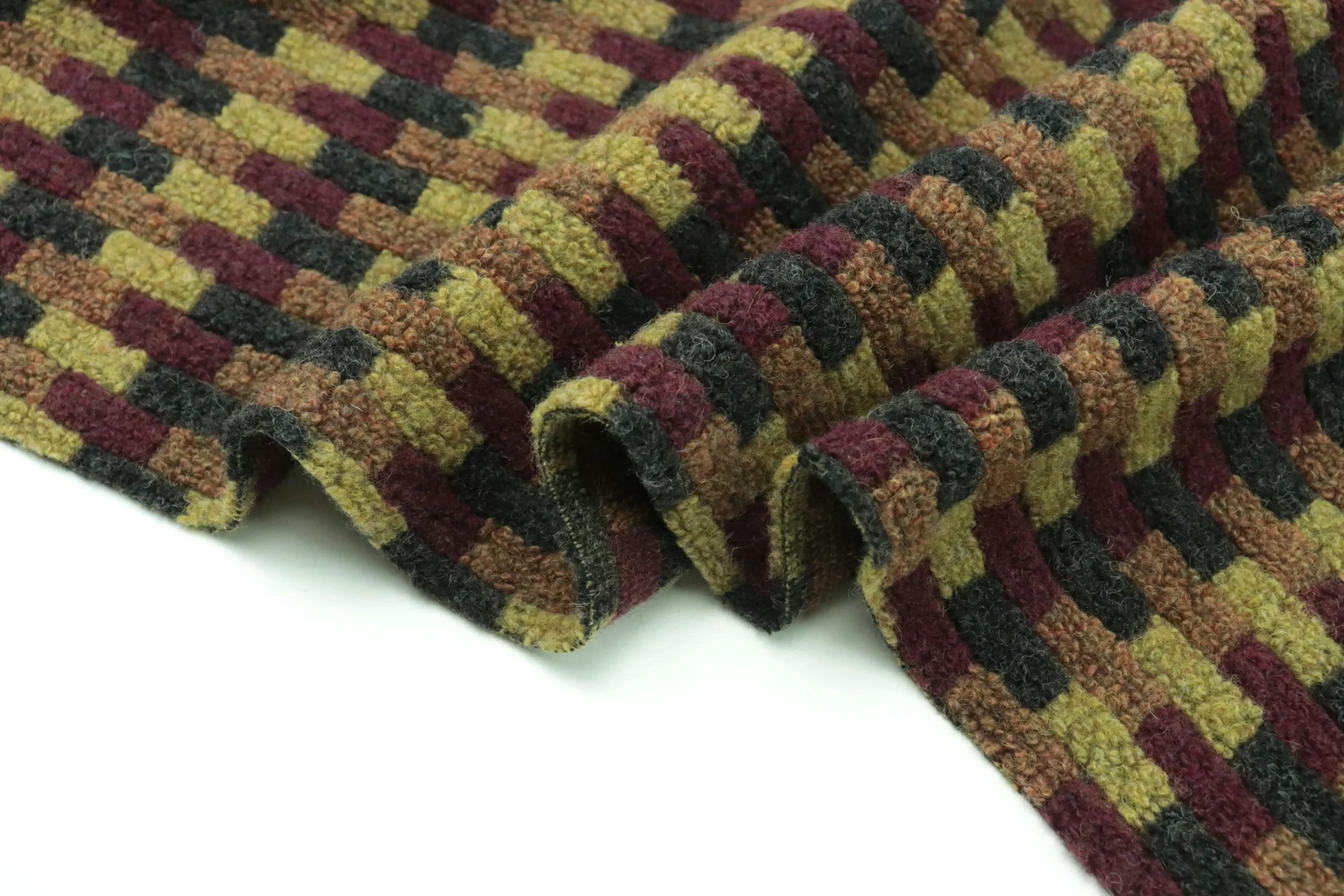
Most buyers stop at weight. That’s a mistake. Grab a 10x loupe—the kind used for inspecting print registration—and examine the loops. On a quality bouclé, individual loops should be uniform in height and spacing. Irregular, squashed, or missing loops indicate worn shedding needles on the knitting machine or inconsistent yarn tension. If you spot gaps where the ground weave peeks through, the fabric will fray along cut edges during production, driving up your defect rate.
When comparing tweed options, pay attention to the float length of the fancy yarns. On a well-constructed tweed, metallic or slub yarns should be anchored at regular intervals, not running loose across the face. Pull gently on a protruding fiber; if more than a centimeter slides out without resistance, expect snagging on retail hangers. Document your findings with a phone macro shot—suppliers who object to you photographing their samples through a loupe are usually hiding something.
Step 2: Fiber Content & Yarn Certification
Many mills claim “even loops” in their bouclé but never check uniformity under magnification.
A mill that can’t tell you the exact percentage of wool in their tweed by weight doesn’t control their own blending floor. Demand a fiber composition breakdown before you ever touch a swatch. For premium tweed, expect 30–50% wool for warmth and drape, 20–30% nylon for tensile strength, and the remainder reserved for textural yarns like slub, bouclé, or metallic variants. If the wool content drops below 25%, you’re holding an acrylic-heavy imitation that will pill in 10 wears.
- Wool (30–50%): Provides natural crimp, moisture management, and the structured drape that defines a classic Chanel-style jacket. Merino or crossbred grades are the floor; anything less and the fabric loses shape after a single pressing cycle.
- Nylon (20–30%): Adds abrasion resistance and dimensional stability. Without it, a tweed coat cuff frays within 90 days of retail use. This is the engineering margin that prevents returns.
- Textural Yarns (remainder): Slub, chenille, or metallic lurex. These shouldn’t exceed 30% unless the garment is purely decorative. High-percentage novelty yarns introduce irregular tension and increase seam slippage under Martindale testing.
Bouclé with a polyester content above 60% is a ticking complaint engine. The loops abrade against each other, and because polyester is thermoplastic, the fuzz melts into pills rather than shedding. A 70% poly bouclé can drop from an AATCC 8 rating of 4 to 2 in under 15,000 rubs—half the jacket threshold of 20,000+ Martindale cycles. Ask your supplier for the exact synthetic percentage and correlate it with their most recent pilling test report. If they can’t produce both numbers in the same email, you’re speculating.
If sustainability is part of your brand’s margin or marketing, you need the exact recycled content percentage—not “blended with recycled fibers.” Request a GRS (Global Recycled Standard) transaction certificate for the specific lot. The certificate must trace the recycled input from spinner to finished fabric. OEKO-TEX Standard 100 alone doesn’t prove recycled content; it only screens for harmful substances. For any eco claim, pair it with GRS or an ISO 14021 self-declaration that states the percentage by weight. A supplier that hesitates to share certification codes is protecting a blending shortcut you’ll pay for later in a retailer audit.
The yarn-dyeing process directly impacts colorfastness and fiber integrity. Ask whether the mill holds in-house yarn certification for their dye lot consistency—specifically for multi-tonal melange effects common in tweed. A single batch shift of 2% in dye uptake will create a shade band visible across a 500m roll. The fix isn’t re-dyeing the fabric; it’s rejecting the roll before it lands in your cutting room. Insist on a dye-house audit report or, at minimum, a lab-dip approval record with a gray scale rating of 4 or higher per AATCC 8. Anything less and you’re absorbing the cost of customer chargebacks for color mismatch.
Step 3: Colorfastness & Dye Stability
Dry rub alone misses the dye bleed that ruins garments after first wash.
- Dry Crock Test: Rub the swatch with a dry white cotton cloth using a 900 g weighted finger. Compare color transfer to the AATCC 8 gray scale. Accept nothing below a 4.0 rating—Grade 3 or lower means visible staining on neighboring panels in production.
- Wet Crock Test: Soak the test cloth in distilled water, squeeze to 65% pickup, then rub. Most fading barely shows dry but bleeds immediately wet. If the wet grade drops 2 steps below dry, the dye bond is weak and will fail during consumer laundering.
- Supplier Wash Test (ISO 105 C06): Demand the mill’s internal wash fastness report for each yarn lot. Look for shade change and staining on multi-fiber adjacent fabric—Grade 4–5 is table stakes. Cross-check with a third-party lab if this is a high-volume program.
- Risk of Skipping: A single lot with poor colorfastness can cross-contaminate cutting tables, stain linings during pressing, and trigger chargebacks. One 500 m roll that bleeds mid-production can cost $2,500+ in wasted cut-work and delay penalties.
Step 4: Pilling & Abrasion Resistance
Pilling is the №1 durability killer—and most buyers never test for it.
You can visually inspect weave density all day, but if the yarns break under friction, your tweed jacket becomes unwearable within a season. The standard you need is the Martindale abrasion test (ISO 12947). For heavy-use items like jackets and structured coats, demand a rating of 20,000 rubs or higher before pilling becomes visible. Many mills will only share a generic ‘good’ result. Ask for the actual rub count and the lab name that ran the test. If the supplier hesitates, walk away.
- Quick Field Check: Rub the fabric surface 20 times with your thumb, using moderate pressure. If visible fuzz or tiny fiber balls appear, the fabric will pill after 10–20 wears. This is not a substitute for a lab report, but it filters out the worst candidates instantly.
- Third-Party Reports: Vraag een Martindale test certificate from an independent lab (e.g., SGS, Intertek). Do not accept in-house only. A 20,000+ rub rating is entry-level for suiting and outerwear; budget wovens often crater below 10,000.
- Why Competitors Miss This: Most sourcing guides stop at hand feel and fiber content. They omit abrasion resistance because it requires testing equipment. That omission is why 90% of buyers skip pilling evaluation—and then deal with end-consumer returns. You can’t afford that gap.
Step 5: Supplier Quality Guarantees
A defect-rate promise without a signed PSI report is worthless.
The difference between a sample swatch and a 1000-meter bulk order is where sourcing careers are made or broken. You’ve tested weave density, pilling, and colorfastness on a 10cm square. None of that matters if the full rolls arrive with inconsistent dye lots, hidden slubs, or edges that unravel on the cutting table. This is why Step 5 exists: supplier quality guarantees that turn promises into contractual obligations.
First, nail down the return and replacement policy. Ask directly: What happens if a roll exceeds the defect threshold? Industry standard for tweed and bouclé is replacement of any roll with more than 5% continuous or scattered defects. Anything less than that, and you’re absorbing the cost of splicing or re-cutting. The acceptable defect rate per roll should be below 2%—meaning in a 50-meter roll, no more than 1 meter total of defects. This isn’t a suggestion; it’s the line between profitable production and a cut-and-sew disaster.
- Target defect rate: <2% per roll by length. If you’re ordering 500 meters across 10 rolls, the total accepted defective length should not exceed 10 meters.
- Roll rejection threshold: Any single roll with >5% defects must be replaced at the supplier’s expense, including freight. Insist this clause is in the purchase contract, not just a casual email.
- Return window: Define the time from delivery to inspection. 14 days is common for bulk orders. After that, many mills consider the fabric accepted, so open and inspect immediately.
- PSI must include: Roll numbers inspected, defect mapping (location and type), color shade assessment (Delta E ≤1.0 if using spectrophotometer), and photos of any flagged issues.
- Timing: Request the PSI report at least 48 hours before the container is sealed. This gives you time to review and halt shipment if results are unacceptable.
- Third-party vs. in-house: If using the supplier’s own inspection team, verify their training and calibration. Better: pay for an independent inspector like SGS or Bureau Veritas for the first few orders.
The final non-negotiable is a Pre-Shipment Inspection (PSI) certificate. Before your fabric leaves the mill, an inspector—either third-party or an internal QA team you trust—should verify random rolls against your approved sample. The PSI should document GSM, color shade under standard light, any identified defects, and pass/fail for critical tests you specified earlier, such as wet rub colorfastness. Without this document, you are effectively accepting a container load of fabric sight unseen.
A competent mill will not flinch at these requirements. In fact, factories already supplying European fashion houses will hand you a PSI report with your first sample because it’s baked into their process. If a supplier resists providing a PSI or refuses to accept a <2% defect standard, walk. The cost of a failed delivery—rushing replacement fabric, idle cut-and-sew lines, and brand reputational damage—dwarfs any per-meter savings you might think you’re getting.
Conclusie
A 5-step inspection framework replaces supplier guesswork with hard thresholds. GSM for drape and durability, a 10x loupe on loop uniformity, a wet rub for color bleed, and a Martindale target of 20,000+ rubs turn an aesthetic decision into a compliance checklist. That structured upfront audit catches the $2,000–$5,000 failure before it hits your cutting table and keeps the defect rate under 2% per roll.
With those technical benchmarks in hand, you can shortlist mills that already build documentation into their offering. Compare pre-shipment test reports, GRS or OEKO-TEX certs, and the factory’s standard return policy for rolls exceeding a 5% defect mark. For a direct mill program that supplies proprietary yarn documentation, 350–450 GSM tweed stock, and a clear sampling timeline, review the sourcing options at fursone.com/services.
Veelgestelde vragen
What’s the difference between tweed and bouclé?
Tweed is a flat woven fabric with a rough texture created by pattern, while bouclé gets its bumpy surface from looped yarns rather than weave structure. Misidentifying them can cause you. Test hand feel and yarn structure side-by-side before committing to bulk.
What are the qualities of bouclé fabric?
Quality bouclé fabric has uniformly sized loop yarns that resist pilling and maintain color after washing. Inconsistent loops or easy snagging signal poor durability and loss of texture. Check loop uniformity under magnification and perform a wet rub test.
Gebruikt Chanel tweed of bouclé?
Chanel uses both tweed and bouclé; its iconic jackets combine a tweed weave with bouclé yarns for that signature soft, textured hand. Pure bouclé without a woven base would lack the. Request swatches that blend both elements to match the Chanel aesthetic.
How can you tell good quality velvet?
Good velvet has a dense, even pile that snaps back after pressure and doesn’t shed excessively. Cheaper velvets often flatten permanently or show marks from handling. Press your palm into the fabric and check rebound; persistent marks signal poor resilience.
Wat zijn de nadelen van bouclé?
Bouclé’s looped surface is prone to pilling, especially when synthetic content exceeds 60%, and loose loops can snag during wear or cutting. Its open structure complicates tailoring and seam finishing. Choose a high-wool blend and request pill-test reports before ordering.

Gerelateerde inzichten
Fabric Shrinkage Testing: How Custom Knits Hold Up After 10 Washes
You run a knit fabric shrinkage testing protocol on a 500x500mm swatch, condition it at...
What to Do If Your Bouclé or Tweed Fabric Fails Quality Check
fabric quality inspection failed is the first checkpoint buyers should lock before they approve a...