
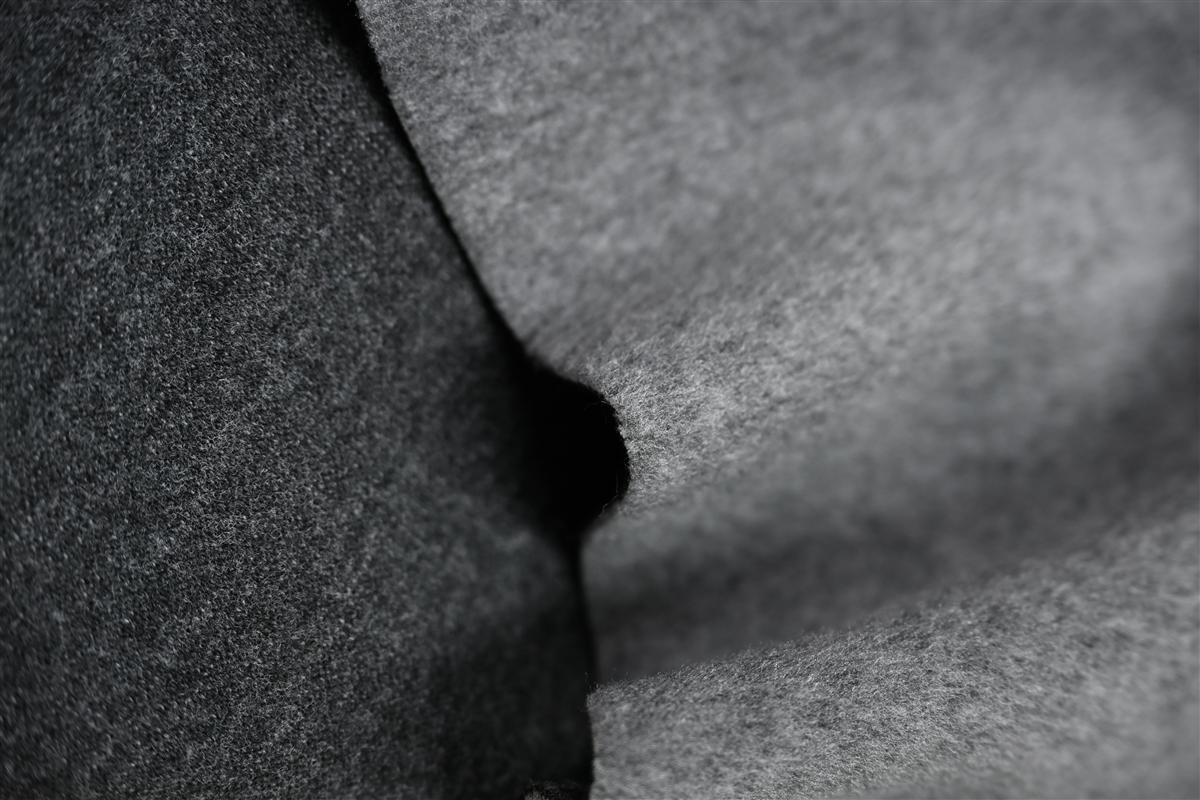
What the mill should show you is not a sample box. It is a trial length woven on the production loom, from the yarn batch it intends to allocate to you, sampled at the head, the middle and the tail and from more than one beam if your order needs more than one, finished and pressed the way your cloth will be finished and pressed, and judged against an effect standard that puts numbers on the flecks instead of adjectives. Alongside it you want a yarn allocation letter: which batch, how many kilos, how many metres that covers, and what happens at the point where it runs out. A donegal effect can be repeated. What cannot be repeated is an agreement that was never made specific.
What a Sample Box Cannot Prove
A mill’s sample box is a collection of the best pieces the mill has made, from different yarns, different looms and different years. It shows what the effect can look like. It does not show what your order will look like, because your order will be woven at your sett, on whatever loom is free, from whatever yarn is allocated, in the batch size you asked for, and finished on whatever range is running that week. Every one of those variables touches a flecked cloth more than it touches a plain one, because the whole appeal of the cloth is the distribution of small events across the surface, and distribution is exactly what changes when sett, yarn count or finishing pressure changes.
The proof you want is production-loom trial yardage. Not a hand sample, not a swatch cut from a stock line, not a photograph of a jacket made by a designer the mill worked with last season. A trial length woven with the yarn that will be used on your order, on the machine that will weave it, at the sett that will be used, and taken as a continuous piece so the head, the middle and the tail can be compared with each other. If the effect only appears in the middle of a piece, you have found the most useful thing that trial can tell you.
Where the Fleck Comes From, and Why the Route Sets the Odds
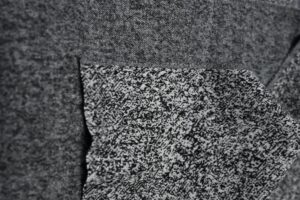
A donegal style effect is usually made by spinning coloured material into the yarn, so that the contrast sits inside the thread and shows as a fleck wherever the thread comes to the surface. The coloured material may be dyed fibre blended in before spinning, or a prepared fleck or nep bought in ready to be introduced at the carding or spinning stage. It can also be made by twisting in a contrasting yarn, or by weaving or printing the effect at a later stage. Each route repeats differently, and the mill’s answer to one question tells you how much of the effect is under its control.
Dyed fibre or prepared fleck blended before spinning is the most stable route, because the colour is in the material rather than on the surface, and the distribution is set by the blend and the carding rather than by a pattern. A twisted in contrast yarn is also repeatable, but the effect tends to be more regular, and it behaves differently when the cloth is milled. A woven or printed effect is a different product with a different repeat and a different care story. Ask which route the stock yarn uses, and ask whether the coloured component is a stock item the mill buys continuously or a batch it bought once. The second question decides what happens when the original material runs out.
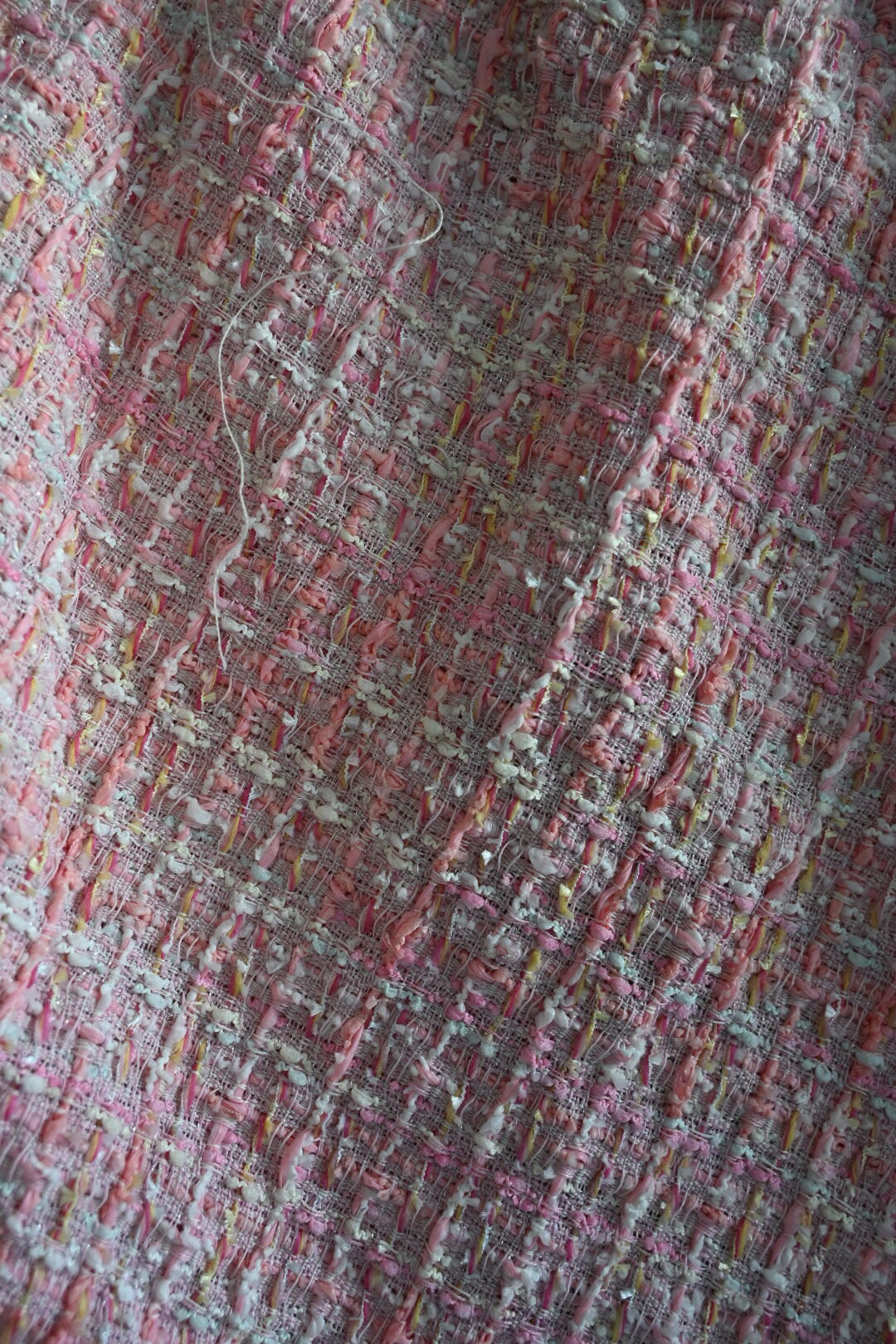
The principle is not specific to donegal. A fleck, a nep, a slub, a boucle and a metallic are all effect yarns, and each one is a separate identity that has to be proved separately if it appears in the same cloth. A mill that can describe the build of one effect and not the others has described part of your cloth.
Counting the Flecks: An Effect Standard You Can Approve
Written tolerance is the thing everyone agrees a small brand needs and almost nobody defines. The way to define it is to count. Fix an aperture, a distance and a light, and record what is inside the aperture. A card with a square opening of a stated size laid on the cloth at a stated distance from a stated lamp gives you a repeatable reading, and the same card used by the mill and by you makes the reading comparable. A camera on a fixed mount, at a fixed height, with the same light and a grey card in frame, does the same job for the record and lets two pieces be compared months apart without arguing about the photograph.
Inside the aperture, count three things. The number of flecks, so that density becomes a number per unit area rather than an impression. The size distribution, graded into two or three bands that both sides agree to name, because a cloth with many small flecks and a cloth with a few large ones read differently at a distance. And the colour mix, meaning how many distinct fleck colours are present and roughly in what proportion, since a batch that loses one of three fleck colours has changed the design even if the total count is unchanged.
Take those readings at defined positions rather than one flattering spot: head, middle and tail of the trial piece, and across the width from selvedge to centre to selvedge. If the order will need more than one beam or more than one yarn batch, take a set from each. Then write the acceptance as a range per position, and state what happens when a position falls outside it. A fleck count that varies by a noticeable amount between head and tail of the same piece is the mill telling you something about its blending, and it is better learned on trial yardage than on delivered cloth.
The Ground Shade, the Shade Band and the Distance Rule
The flecks are only half the effect. The ground shade carries the look at arm’s length, and it moves for its own reasons, because the ground yarn and the fleck material are often dyed by different routes. Fleck material may be dyed in the fibre, in a batch bought in advance, while the ground is dyed later as yarn or as piece. When the ground shifts and the flecks do not, the cloth reads as busier or quieter without a single fleck having changed, and that is a real quality failure that no fleck count will catch.
So the standard needs a ground clause: the ground shade judged against the sealed physical standard under an agreed light source, assessed visually against a grey scale or measured and expressed as a colour difference calculated to ISO 105-J03, with the tolerance written down rather than assumed. If the ground and the flecks drift in opposite directions, the combined effect can be outside the look even when each part is inside its own tolerance, so add a clause that judges the finished face as a whole at the distance a garment is seen. Read the trial at close range for construction, and again at a metre and a half for the effect. Both readings belong in the standard, because both are how the cloth will actually be judged, by you and then by a customer.
Judge It After Milling and Pressing, Then Again After Care
A flecked woollen cloth changes substantially in finishing. Milling and washing felt the surface, which can soften or swallow small flecks. Brushing and raising lift fibre and change how the flecks sit. Pressing flattens the face and can make a fleck read darker or lighter depending on how the cloth is handled. A trial judged in greige has told you about the yarn and almost nothing about the cloth you are buying, so the trial length has to go through the real finishing route, on the real range, and then be pressed the way your garments will be pressed before it is judged.
Then run a care cycle on part of it. A wool jacket is usually dry cleaned, and if that is what your care label will say, the retest should follow the dry cleaning procedure the label names. Look for fleck loss, migration of colour from the fleck into the ground, and any change in the surface that pressing cannot recover. Keep the pressed piece and the cared piece alongside the standard, because the difference between them is part of what you are agreeing to, and it belongs in the file with the trial length rather than in somebody’s memory of how it looked in the mill office.
When the Stock Covers Part of the Order: The Transition File
The awkward case is the common one. The batch that produces the effect you approved covers 80 metres and the order is 120. There are three honest ways through it and one dishonest one. The dishonest one is to weave the whole length and hope the boundary is invisible in the cutting room. It usually is not, and it surfaces as a garment with a visible band across one panel, discovered by a customer rather than by you.
The first honest route is to split the order into two drops and treat them as two colourways with two standards. That is clean for the mill and honest for the customer if the range is designed to live with it, but it costs you the consistency you were buying and it needs the lookbook to say so. The second is a single run with a declared transition: the boundary is marked, the rolls either side are labelled with their batch, and the marker plan carries a rule that no panel crosses the boundary. That rule has to be written, because a busy cutting room will not invent it. Add a statement that a garment cut across the boundary can be rejected, and name who pays for the remake.
The third is to buy the second batch before the run starts and weave a trial length that deliberately includes the join, so the transition is measured rather than hoped for. If the two batches sit inside the shade band you agreed, the whole length is one standard with a documented join. If they do not, you have found out at trial cost instead of at garment cost. In all three routes the same facts go on paper: batch identity, metres available from each batch, the marking rule, which panels may come from which band, the inspection point at the boundary, and the remedy.
The Three Signatures, and the One Thing That Stays Unwritten
Three documents close this question. The first is the effect standard, with the fleck count and size bands, the ground clause, the light source, the reading positions and the acceptance ranges. The second is the sealed trial length, signed by both sides, dated, labelled with yarn batch, beam and finish batch, and kept as the arbiter for the life of the reorder window. The third is the yarn allocation letter, which states the batch, the quantity held against your order, and what happens when it is exhausted.
What usually stays unwritten is the mill’s own recourse. If the stock runs short mid run, or if the batch is withdrawn, the mill may substitute without asking unless the document says it cannot. Write the sentence: no substitution of the fleck material or its build without written approval, and no weaving past the allocated batch without a new trial. It is a short sentence and it is the one that decides whether the fourth document you receive is a delivery note or an apology.
What the Word Donegal Does and Does Not Guarantee
Donegal describes a style of flecked yarn and cloth, not a protected designation, so the word on a sample card proves nothing about how the effect is made or how consistently it repeats. Compare that with a name that is policed: the Harris Tweed Authority controls the use of the Harris Tweed name and its Orb mark through a published labels policy and active enforcement. That protects the origin and the making of the cloth, and even so it does not tell a buyer what the next batch will look like. Your protection is never the name. It is the standard, the sealed length and the allocation letter, and the willingness of the mill to put the fleck count on paper. How the colour gets into the yarn is the technical background to that conversation, what a substitution file has to prove is the same discipline applied to a yarn change, and what a mill visit should look at is where you verify that the batch on the letter is the batch in the store.

Relaterede indsigter
Shrink vs Stretch Returns: Separating Cloth From Care
A shrink-versus-stretch attribution is a controlled comparison that separates cloth change from care change on...
Lab Dip Close to Pantone: What to Sign Before Bulk Dye
A lab dip approval is a signed colour standard that freezes dye recipe, substrate, illuminant,...
Merino Is Not a Fibre Name: Labelling a Wool Coat for Two Markets
A wool coat sold in both markets needs two different fibre lines, and the words...