
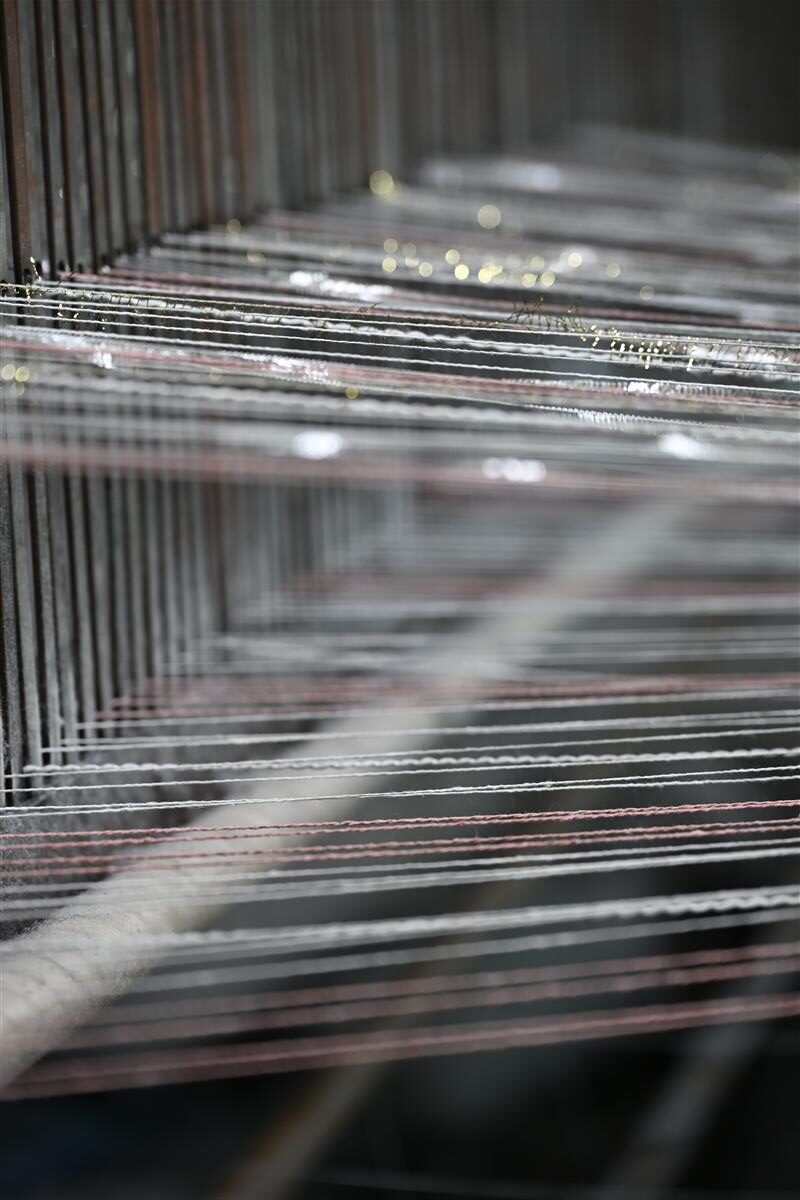
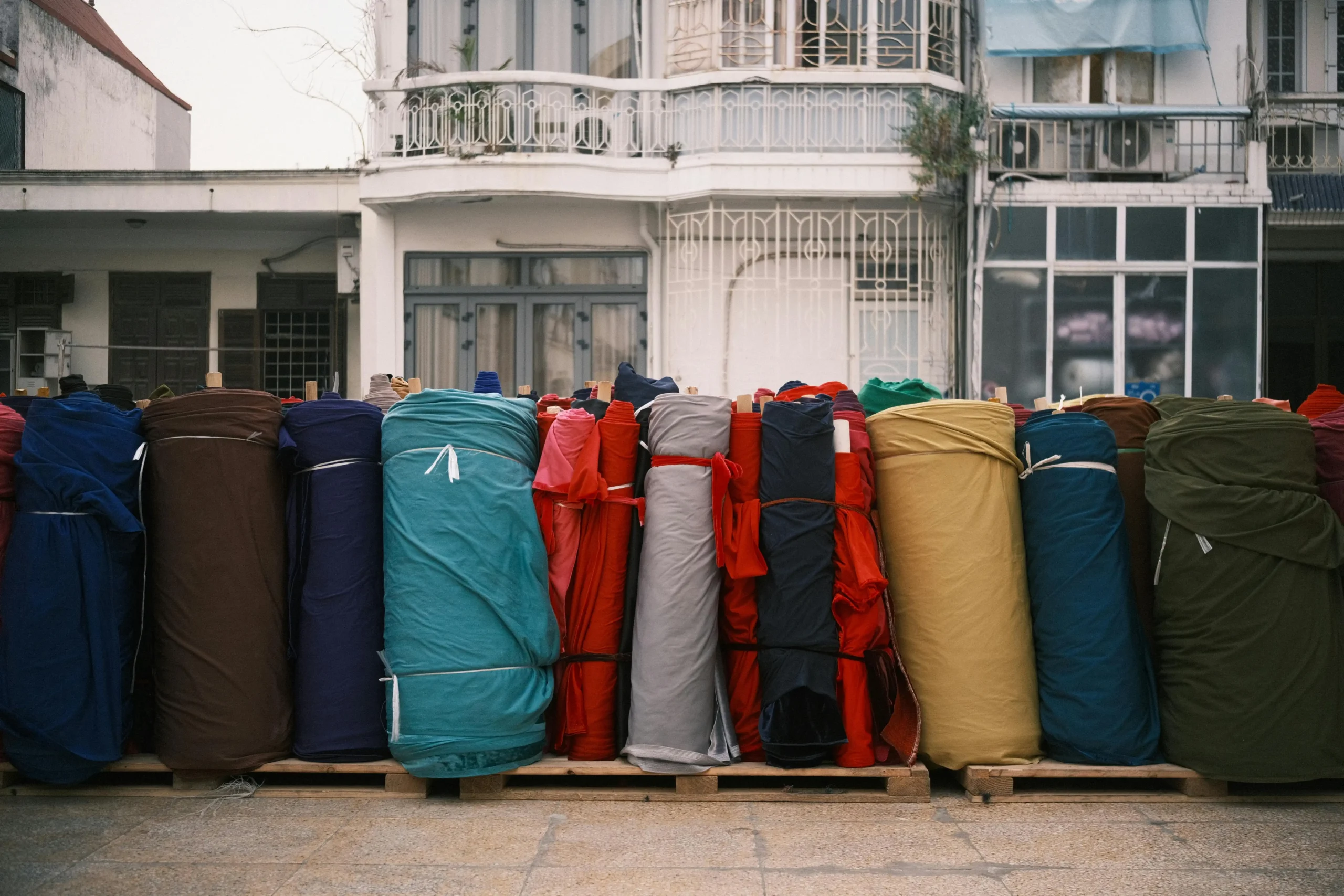
Rolls standing on end, still inside the mill’s plastic, on a workshop floor for six weeks is a storage method rather than an accident, and it produces exactly the faults you are describing: rust spots where the end of the roll met moisture and a metal source, and soft creases where the weight of the roll pressed into its own end. The corrective action belongs in two places. The mill’s packing instruction should say what the wrap is for and how long the cloth may stay in it, and the garment maker needs a storage sheet that says how the rolls are to stand, on what, for how long, and what to check while they wait.
What went wrong, mechanically
Three separate mechanisms, and they are worth separating because each has its own fix. The first is moisture: a roll wrapped in plastic while carrying its own residual humidity holds a microclimate, and any temperature change condenses water inside the wrap, which is the same physics that makes humidity such a persistent problem in textile logistics. The second is contact: the end of a roll standing on a concrete floor or against a metal stillage puts the cloth in contact with materials that rust or transmit damp, and the cloth is hygroscopic, so it takes up that moisture and holds it against the contaminant. The third is pressure: cloth left on end carries the weight of the whole roll on the bottom few centimetres, and six weeks is long enough for that to become a set that pressing will not remove.
The rust spots are diagnostic. Rust on the end of a roll comes from a metal source in contact with damp cloth, and the candidates are the roll’s own end fittings or staples, the stillage or shelving it stood on, and the nails in a pallet. Finding which one matters, because the remedy is to remove the contact rather than to clean the cloth afterwards.
The storage sheet the goods should travel with
Four instructions cover most of the risk. Store the rolls horizontally on a clean, dry pallet or rack, never standing on end, and never directly on a concrete floor or against a wall. Keep the wrap intact during transport and open it on arrival for inspection, then leave the cloth to equilibrate in the workshop’s own atmosphere rather than leaving it sealed for weeks. Keep the storage area dry, ventilated and away from exterior walls, with the cloth not touching metal. And observe a first-in, first-out rule, so that a roll does not sit at the back of the rack while newer cloth is cut first.
Two supporting habits make the sheet enforceable. A simple environmental record: a temperature and humidity logger in the storage area, checked weekly, because a reading is what turns an argument about a damp workshop into a fact. And a visual inspection at defined intervals, with photographs, so that a rust spot or a crease is discovered while the cloth can still be re-rolled or re-steamed rather than when it is about to be cut.
The arrival inspection, which is where the clock starts
Six weeks in storage is a period during which nobody looks, and the way to shorten it is an arrival inspection with a checklist. The rolls are counted against the packing list. The wrap is opened on one end of each roll and the selvedge inspected for rust, oil or damp staining. The end of the roll is checked for the crease that standing on end produces. The roll ticket is verified against the delivery documents, which links the physical roll to the mill’s record. And a photograph of any finding is sent to the mill within the first days rather than at cutting, because the earlier a storage fault is reported, the more of it is recoverable.
That inspection is the buyer’s protection in a different sense as well: it establishes the condition of the cloth at the moment of receipt, which is what distinguishes a transport or storage fault from a mill fault when a claim is eventually made. The discipline is the same one that governs moisture and mould prevention in shipment, applied at the receiving end rather than at the packing end.
The stillage, the pallet and the wall
Where cloth rests decides what it picks up. A steel stillage transmits both damp and rust, a timber pallet can carry moisture and nails, and a concrete floor is cold, slightly damp and often the source of the condensation that appears inside a wrap. The storage instruction should therefore say more than “keep dry”: it should name the surface, and the practical answer is a clean dry pallet with the roll lying along it, a gap from the wall, and nothing metal in contact with the cloth. Where the workshop has racks, the same rule applies horizontally, with the roll supported along its length rather than at two points.
It is also worth checking the rolls’ own packing at arrival, because the mill’s protection is part of the storage chain. End caps, staples, strapping and the wrap’s own closure are the metal and plastic that touches the cloth for the whole journey, and a roll that arrives with a rusted staple at the end has a mark waiting to appear if the cloth there stays damp.
Re-rolling as a routine
Cloth that sits for weeks takes a set from its own weight and from the shape it is stored in, and the cheapest prevention is re-rolling rather than re-storing: rotate the roll a quarter turn and rest it, or re-roll it on a clean tube so the pressure point moves. In a workshop where cloth waits for a cutting slot, a weekly rotation is a five-minute job per roll and it removes the class of crease that only appears in the bottom few metres of a bale.
The same routine gives a second benefit: a person who handles the roll weekly is a person who notices a damp patch, a rust mark or a smell early, which is exactly the inspection cadence that turns a storage fault into a re-rolled roll rather than a written-off length.
Fixing what has already happened
The rust spots are the priority, because they are contamination rather than shape. Their extent should be established before any cleaning: how deep the spots sit, whether they are on the surface or through the cloth, and how many metres are affected. A spot on the surface may lift with careful treatment, but iron staining in a woollen cloth is difficult to remove completely, and a piece that has been treated can reappear later when the cloth is damp, which is a reason to cut around it if the pattern allows rather than to promise a repair.
The creases at the end are usually recoverable, and the sequence matters: re-roll the cloth so that the pressure is redistributed, then steam the affected length on a frame or table rather than pressing it flat, and let it rest before cutting. What should be avoided is a heavy press, which sets a different problem into the cloth; the same restraint applies here as in the note on steaming and mending, where the finishing pass exists to relax the cloth rather than to flatten it.
Who is responsible while the cloth waits
The period between delivery and cutting is the least governed part of a fabric order, and it is worth one clause in the order: the buyer states the storage conditions required, the mill states the period for which the packing is designed, and both agree that an inspection on arrival is part of the delivery rather than the start of a complaint. That clause also creates the record that decides responsibility: if the cloth arrived sound and was stored on end for six weeks, the fault is a storage fault; if the end of the roll was already creased at arrival, the mill’s records and the arrival photographs say so.
Two practical consequences follow. The mill should send its packing and storage instruction with the goods, in the language of the destination workshop, rather than on request. And the workshop should be able to show, when a claim arises, where the cloth was kept, on what and for how long, which is a shelf label and a log rather than a memory.
What to put in the order and the handover
Five lines. The packing specification: the wrap material, the end protection, and the maximum period for which the cloth may remain wrapped. The storage instruction for the workshop, supplied with the goods rather than on request. The arrival inspection checklist, with the requirement that findings are reported within days. The environmental record for the storage area, kept and reviewed. And the responsibility clause, which names the storage conditions and makes an arrival inspection part of delivery.
None of it is expensive, and all of it is administrative: a sheet, a pallet, a logger and a habit of looking at the cloth before it is cut. The alternative is the situation you have now, where six weeks of storage has produced a claim, and the useful question is not who is to blame but how much of the cloth can still be used.

Relaterede indsigter
Tweed Collar Fray: Check Construction Before Changing Cloth
When a tweed jacket collar frays after a month, customers often blame the cloth first....
Merino Is Not a Fibre Name: Labelling a Wool Coat for Two Markets
A wool coat sold in both markets needs two different fibre lines, and the words...
It Feels Thin: Turning a Complaint into Five Specification Rows
A hand-feel gap is the distance between a measured property and a customer’s report. The...