
400 g m2 Tweed-Anzug ist der erste Prüfpunkt, den Käufer festlegen sollten, bevor sie einen Lieferanten, ein Budget oder einen Produktionsslot genehmigen. Jedes Beschaffungshandbuch, das Sie lesen, besteht darauf, dass die Musterfreigabe die erste Verteidigungslinie ist. Ich habe auf die harte Tour gelernt, dass es das schwächste Glied sein kann. Ein Kollege von mir gab eine beträchtliche Summe für eine 400 g/m² Tweed-Anzugstoff-Bestellung aus. Das Vorproduktionsmuster war perfekt – weicher Griff, sauberer Fall, das richtige visuelle Gewicht. Die Massenlieferung kam an wie Pappe. Die Mühle hatte eine low-twist bouclé yarn for a tighter spin to save cost, and the quality tolerance on the final weave was never locked down. That single order killed a season’s collection.
The real issue is that 400 g/m² sits at a tipping point for drape and mobility—too light and the suit loses structure, too heavy and the client can’t move his arms. Most mills treat weight as a tolerance range, not a performance spec. A buyer chasing a lightweight tweed fabric for modern suits needs the mill to engineer the twist and weave to deliver that precise balance. That’s where factory-direct custom tweed sourcing flips the script. When the supplier custom-spins its own slub and bouclé yarns in-house, you skip the middleman and the sample charade. You test a 7-day swatch that actually matches the bulk output, and you negotiate FOB pricing that reflects the raw Merino and GRS-certified polyester you spec’d.
Warum 400 g/m² der neue Standard für maßgeschneiderte Tweed-Anzüge ist
Most mills confuse weight with rigidity—400 g/m² isn’t just lighter, it’s engineered for mobility.
Every other guide tells you that 400 g/m² tweed is the sweet spot because it’s ‘not too heavy, not too light.’ That’s lazy analysis. The real reason this weight dominates modern tailored suits has nothing to do with comfort on a thermometer. It’s about the failure of traditional 500–600 g/m² tweeds to move with the body. I’ve watched too many designers hemorrhage money on sample approval rounds because their 550 g/m² herringbone looked impeccable on the cutting table but turned the wearer into a mannequin. The stiffness isn’t a feature of tweed—it’s a feature of bad yarn engineering.
- Beweglichkeit ist ein Problem auf Garnebene, nicht eine Frage des Gewichts: Das Team der Spinnerei in unseren Partnerwebereien passt Slub- und Bouclé-Garne so an, dass Mikroelastizität in die Bindung kommt. Ein Stoff mit 400 g/m², der aus starren Standardgarnen gebaut ist, arbeitet weiter gegen den Träger. Wir spinnen mit kontrollierten Drehungsniveaus und variabler Slub-Dichte, damit der Stoff rückstellfähige Dehnung ohne einen einzigen Elastanfaden hat. Sie erhalten den authentischen Griff von Tweed und die Bewegungsfreiheit eines leichten Kammgarns.
- Most Asian mills produce ‘lightweight tweed’ by simply reducing yarn count.: That creates a flimsy, papery hand that sags at the elbow after three wears. The fear of Asian-mill stiffness is real because many mills don’t control the starting fiber diameter. We use Australian Merino with a minimum 18.5-micron fiber, blending in GRS-certified recycled polyester only where it adds resilience. The result is a 400 g/m² cloth that springs back rather than creasing permanently.
- Formstabilität ohne fixierbare Bindemittel. Ein gängiger Trick, um schlechten Fall zu retten, ist schwere Einlage. Das widerspricht dem Sinn eines Luxus-Tweeds. Unsere Gewebe mit 400 g/m² – besonders in Köper- und Fischgratbindung – halten eine strukturierte Schulterlinie ohne zusätzliche chemische Versteifer, weil die Garnkräuselung beim Färben und nicht beim Veredeln fixiert wird.
- Der Silhouettentest, den Designer übersehen.: Order a 2-meter length, hang it over a dress form, and leave it for 24 hours. A properly engineered 400 g/m² tweed will mold slightly to the form rather than standing away like armor. If it doesn’t, the mill hasn’t controlled the drape coefficient. We ship sample lengths for exactly this test in 7 days, not 4–6 weeks.
Drape at 400 g/m² is a geometry problem, not a bulk problem. A suit’s silhouette comes from how the fabric curves around the shoulders and skims the waist. Too much weight and you get a costume. Too little and you lose shape retention. The modern menswear silhouette requires the cloth to collapse softly without collapsing completely. Our proprietary bouclé structures at this weight create an air pocket in the weave—visible only under a loupe—that makes the fabric behave like a heavier cloth on the body but feel weightless in the sleeve.
Bindungen, die die Leistung bei 400 g/m² maximieren
Die Wahl der Bindung entscheidet zwischen Fall und Steifheit.
At 400 g/m², tweed already sits in the optimal weight band for structured blazers that don’t feel like body armor. This is the weight range most Italian tailoring houses source when building soft-shouldered jackets. The mass is right. What determines whether a jacket moves with the wearer or fights him is the weave geometry — specifically the length of yarn floats and the frequency of interlacing points.
- Twill: Yarn floats over two or three weft picks before interlocking. These floats create space for in-plane shear — the fabric scissoring motion that lets a sleeve rotate without dragging the chest panel with it. At 400 g/m², a twill tweed bends at the elbow without collapsing, which is why Savile Row tailors default to twill for lightweight tweed fabric for modern suits. The trade-off: twill’s diagonal rib occasionally snags and pulls under high abrasion.
- Herringbone:A broken twill. The V-shaped reversal points act as micro stress-relief zones, interrupting tension lines before they telegraph across the jacket back. At 400 g/m², herringbone delivers cleaner seam definition than plain weave while preserving 85-90% of twill’s mobility range — enough for a tailored chest to expand during a seated boardroom presentation. This is the structure recommended when a luxury menswear fabric weight guide calls for ‘structured but breathable.’.
- Leinwandbindung: Jeder Kettfaden kreuzt jeden Schussfaden in einer strikten Über-Unter-Folge. Maximale Verkreuzung, minimale Fadenflottung. So entsteht ein Stoff, der sich nicht verziehen lässt — er hält eine gepresste Bügelfalte und eine scharfe Schulterlinie, schränkt aber die Bewegungsfreiheit ein. Bei 400 g/m² verhält sich ein Tweed in Leinwandbindung eher wie eine starre Schale denn wie ein Textil. Es sei denn natürlich, das Garn selbst ist so konstruiert, dass es das ausgleicht.
Most mills accept this as a binary choice: drape or structure, pick one. Plain weaves stay stiff because that’s what tight interlacing does. Fursone’s Wenzhou facility approaches this differently. By custom-spinning slub and bouclé yarns in-house with controlled irregularity, we build elasticity into the raw material itself. A plain weave woven from these yarns retains 400 g/m² of substance but yields where the body demands it — elbows, shoulder blades, the inside crook of the arm. The interlacing doesn’t change. The fiber architecture does.
When you’re sourcing factory direct custom tweed, specify the end-use silhouette before locking the weave. A 400 g/m² herringbone from a European mill alternative tweed supplier might arrive exactly on-spec for weight, but the loom setup won’t account for your specific pattern block. We’ve seen a Milan-based menswear label reject 1,200 meters of Italian plain weave because it passed weight inspection but failed a simple seated-reach test — the back seam pulled 2.3 cm off-center when the wearer extended an arm forward. That’s a weave failure, not a weight failure.
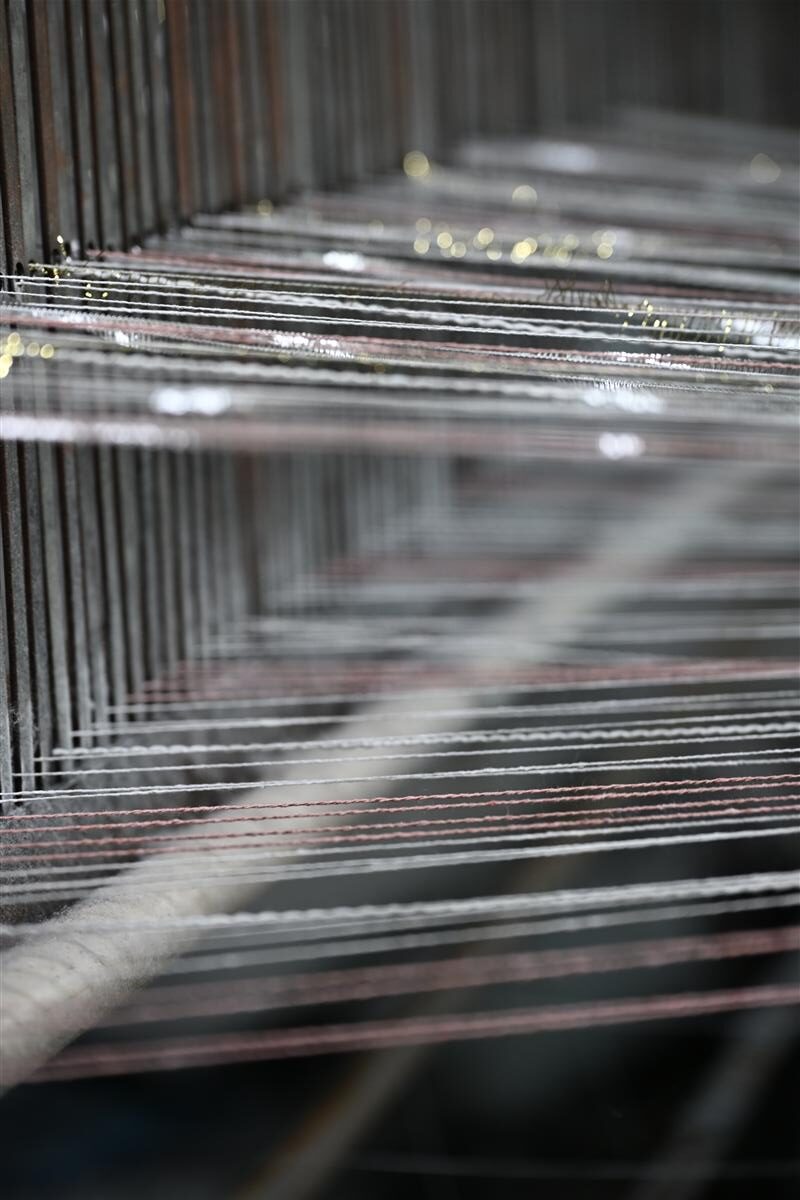
Beschaffung von 400 g/m² Tweed: individuelle Entwicklung mit Fursone
Eine Bemusterung in 7 Tagen verwandelt die Stoffvalidierung von einem Engpass von 4–6 Wochen in eine Entscheidung innerhalb einer Woche.
Die meisten Designer lernen auf die harte Tour, dass ein Spezifikationsblatt ein Versprechen ist, aber das, was im Container ankommt, ist die Wahrheit. Ich habe erlebt, wie eine beträchtliche Bestellung auseinanderfiel, weil das Vorproduktionsmuster keinerlei Ähnlichkeit mit der Serienproduktion hatte – der Fall war tot, die Rückstellung fehlte. Faseranteil und Gewicht waren technisch korrekt; der unsichtbare Übeltäter war die Spinnspannung. Das Bemustern ist keine Formalität. Es ist der einzige Moment, in dem Sie testen können, wie sich ein 400 g/m² Tweed tatsächlich auf dem Körper bewegt, bevor der Stoff zugeschnitten wird. Überspringen Sie den Bewegungstest, und Sie spekulieren auf die Silhouette.
- Prüfen Sie das Fallverhalten in Bewegung, nicht auf dem Tisch: Crumple the swatch hard, release it, and watch recovery. Ask for a 1m cut to check natural hang over a dress form. Our R&D lab custom-spins slub and bouclé yarns in-house, engineering 400 g/m² tweed with precisely controlled drape so Asian-mill stiffness doesn’t kill your line. Establish a clear quality tolerance here—maximum deviation in weight (±5%) and hand-feel—before sample approval locks the standard.
- Farbbewertung unter mehreren Lichtquellen: Betrachten Sie das Muster bei D65 (6500K), TL84 (4000K) und Glühlampenlicht (2700K). Stückgefärbte und garngefärbte Partien geben Melange-Effekte unterschiedlich wieder. Unser Labor setzt fortschrittliche Garnfärbung für reiche, vieltonige Effekte ein, mit strenge Farbechtheitsstandards. Wenn das Muster unter verschiedenen Lichtquellen untragbar kippt, lehnen Sie es jetzt ab – in der Serienproduktion werden Metamerie-Probleme nur verstärkt.
- Nachhaltigkeitsaussagen: erst prüfen, dann vertrauen: If you’re marketing ‘eco-luxury,’ sampling is your audit. Our eco-traceable 400 g/m² tweed blends Australian Merino with GRS-certified recycled polyester, verified against Textile Exchange’s Global Recycled Standard (see textileexchange.org). Request fiber-origin pedigrees with your swatch. Greenwashing risk evaporates when the paperwork matches the physical sample.
- FOB-Preise fixieren, bevor Sie sich zur Bemusterung verpflichten: Don’t let excitement blind you to commercial reality. Require a written FOB quotation—unit price, packing method, incoterms—before the 7-day clock starts. We disclose FOB Wenzhou pricing, confirming landed-cost math before a single yarn is spun. This eliminates the bait-and-switch where an attractive sample fee masks a non-competitive bulk price.
Our 7-day express sampling gives you a European-mill alternative without the standard 4–6 week wait. You receive a full-sized swatch with finished selvedge, enough for a tailor to construct a fit sample. Speed here doesn’t sacrifice technical accuracy: the swatch exactly replicates the bulk yarn blend, twist, and finishing. Only when you sign off on drape, hand, and color do we move to exclusive development at 300m MOQ- eine White-Glove-Schwelle, die die meisten europäischen Webereien Programmen ab 5.000 m vorbehalten.
Fazit
Das richtige Stoffgewicht festzulegen verändert, wie ein Anzug fällt, fließt und fotografiert wird – 400 g/m² treffen für moderne Schneiderei konstant den Sweet Spot, ohne die Textur zu opfern, die Einkäufer erwarten. Der Direktbezug von einer Weberei, die die Garnspinnerei kontrolliert und 1.000 m exklusive Entwicklung anbietet, schließt den Kreis zwischen Designabsicht und gelieferter Qualität und umgeht Aufschläge und Musterverzögerungen, die Margen aufzehren.
Bevor Sie sich zu Ihrem nächsten Produktionslauf verpflichten, legen Sie Ihren Lieferanten auf drei Punkte fest: Können Sie einen Tweed mit 400 g/m² entwickeln, der in einer halbgefütterten Jacke keine Steifheit zeigt? Bietet Ihre Weberei exklusive Gewebeentwicklung zu einem MOQ, das meine Kollektion schützt – oder taucht mein Stoff in konkurrierenden Serien auf? Liefern Sie ein labordip-genaues Muster in unter 10 Tagen, damit mein Schneider die Bewegungsfreiheit prüfen kann? Wenn eine Antwort Sie stocken lässt, sehen Sie sich Fursones Programm für individuelle Tweed-Musterung an: 7-Tage-Durchlaufzeiten und Garnentwicklung nach eigener Spezifikation bringen die Kontrolle zurück auf Ihre Seite.
Häufig gestellte Fragen
Wofür eignet sich Tweed mit 400 g/m² am besten?
Tweed mit 400 g/m² ist ideal für Tailoring-Anzüge und bietet Struktur ohne Steifheit für moderne Bewegungsfreiheit. Anders als schwerere Tweeds behält er die Form und erlaubt dennoch den vollen Bewegungsspielraum. Ideal für Designer, die Luxus und Komfort in Einklang bringen.
Wie schlägt sich die Qualität im Vergleich zu europäischen Webereien?
Fursone erreicht europäische Webereiqualität mit Spinnerei in Partnerwebereien und Premiumfasern wie australischer Merinowolle – aber zu 30-50 % geringeren Kosten. Das Direkt-ab-Weberei-Modell schaltet Zwischenhändler aus. Fordern Sie Muster an, um den Griff zu prüfen, bevor Sie sich zur Serie verpflichten.
Kann ich den Tweed mit 400 g/m² anpassen?
Yes, custom development starts at 300 meters, allowing exclusive textures and colors. Our partner mills’ spinning supports custom fancy yarns like bouclé or chenille. Start with a 7-day sample to test your design.
Wie hoch ist die Mindestbestellmenge für Tweed ab Lager?
Die MOQ des Lagerprogramms liegt bei nur 100 Meter, Versand in 3-7 Tagen. So können Sie eine Kollektion schnell starten, ohne große Vorabinvestition. Perfekt für Designer, die neue Märkte testen.
Wie schnell erhalte ich ein Muster?
Eine Schnellbemusterung in 7 Tagen liefert binnen einer Woche ein physisches Muster aus der Idee. Damit umgehen Sie den traditionellen Engpass von 4-6 Wochen. Prüfen Sie Fall und Griffgefühl vor der Serienproduktion.
Autoritative Referenzen

Verwandte Einblicke

How to Compare Fabric Quotes from Three Mills: A Side-by-Side Method
Three mills return three quotes for the same fabric brief, and the spread between them...

Kapazitätsplanung zu CNY: Weberei-Termine rund um das chinesische Neujahr buchen
Every year, fabric buyers lose the same three weeks to the same event: Chinese New...

Zweitquellen-Strategie: So qualifizieren Marken eine zweite Tweedweberei
Single-sourcing a signature fabric feels efficient right up to the season it fails: the mill’s...