
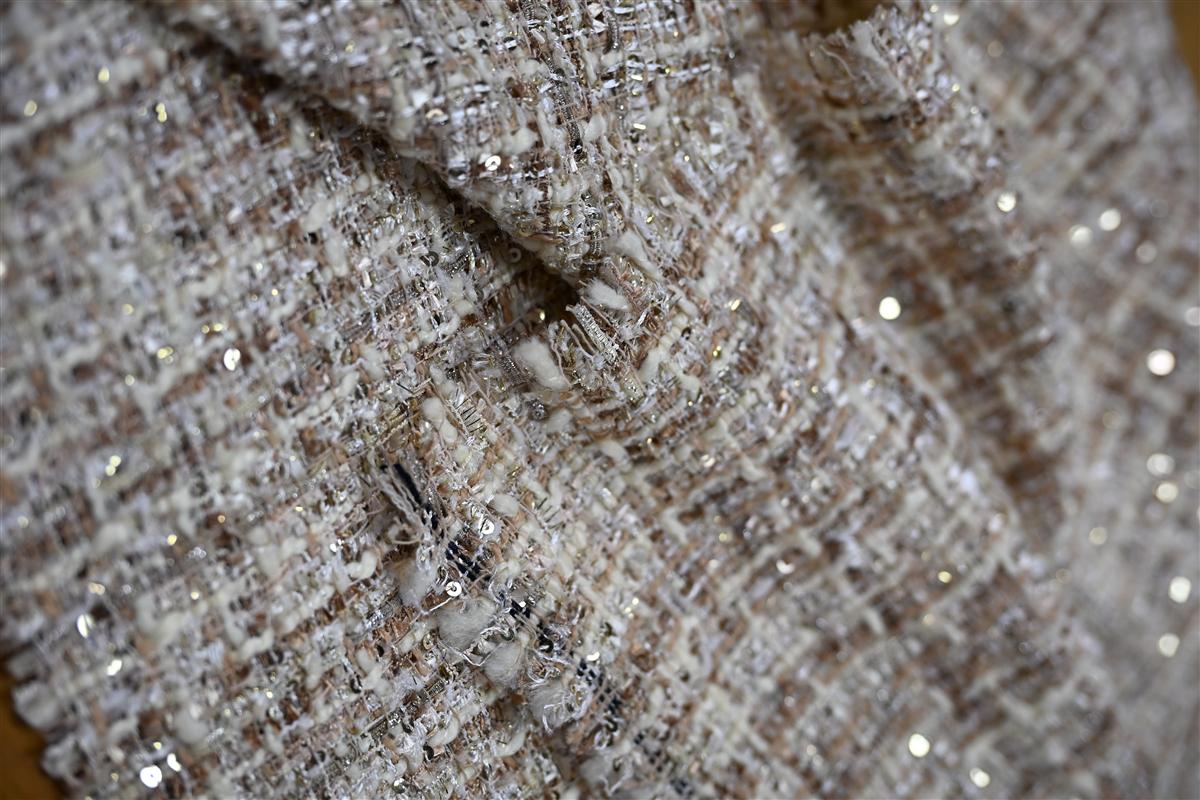
A hand-feel gap is the distance between a measured property and a customer’s report. The test sheet is usually accurate. The complaint still arrives. According to the Woolmark Company, wool absorbs up to 35% of its weight in moisture before the wearer senses wetness, so a woolen is judged through a fibre that keeps moving with the room. Mass, thickness and cover are three separate measures, and the customer feels one combined object. In our own sampling files through 2026, a complaint logged as thin has rarely traced back to mass below the agreed nominal. The complaints trace to thickness under load, to the air held inside the cloth, and to what the finishing route did to both. All three are specification problems rather than weaving problems, and all three can be written into an order. The repair is five specification rows, each carrying a method, a pressure and a tolerance, plus a test order that fits inside two metres of a sixty-metre run. Those rows turn an adjective into something a mill can actually fail.
Why Does a Sheet That Passes Still Feel Thin to the Customer?
A passing sheet means every property landed inside its own tolerance. A thin complaint means the combination did not. According to ISO 139, textile tests run at 20 °C and 65% relative humidity, and a woolen needs hours in that air before a reading settles. The customer meets the garment in a shop, at whatever the room happens to be. Load is the second difference, and the larger one. ISO 5084 defines thickness as the distance between two plates under a stated pressure, so the sheet’s figure belongs to one load, applied slowly. A thumb presses harder and releases in under a second, reading recovery rather than thickness. Nobody has lied. The sheet answers a narrower question. In 2026 that narrowness is the whole dispute, because the customer judges a garment and the mill judges a specimen.
What Does the Word Thin Actually Describe?
Thin is not a property. Thin is a report on one of four properties a customer cannot separate, and the report rarely names the right one. The first is loft, the air filling roughly 80% of a finished woolen’s volume; according to the Woolmark Company, natural crimp holds that air in place. The second is cover, the light the construction blocks, which depends on colour as much as on weave. The third is mass against expectation, judged beside a coat already in the wardrobe. The fourth is stiffness, which makes a light cloth feel papery instead of soft. A complaint logged in 2026 usually names the first and means the second. For example, a pale oatmeal at 420 g/m² shows a lining seam through a sleeve, while a navy at the same mass hides the seam completely.
Which Five Rows Should the Order Carry?
A specification row is a number with a method, a condition and a tolerance attached. A row earns a place in the order when three tests pass. The mill can measure the property. The buyer can repeat the measurement. The number changes a decision. Five rows pass for a woolen or tweed. First, mass per unit area; second, thickness at a stated pressure; third, compression recovery; fourth, cover on the colourway being ordered; finally, loft retention after finishing. A number without a method is not a specification, because 420 g/m² on loom-state cloth and 420 g/m² after pressing describe different garments. A number without a tolerance cannot be failed. According to ISO 139, both sides should measure in the same air, at 20 °C and 65% relative humidity, and a 2026 order should say so in writing.
Row One: Mass per Unit Area on a Conditioned Basis
Mass per unit area is the weight of one square metre of cloth, measured to ISO 3801 on a conditioned basis. The row is the most likely to be correct and the least likely to explain a complaint. Wool moves with humidity. According to the Woolmark Company’s 2018 fact sheet, absorption reaches up to 35% of fibre weight before the cloth feels wet, so a roll weighed in a dry room and the same roll weighed in a monsoon differ by a couple of percent with nobody cheating. The row still earns a place, because mass sets the floor for every other property. Write the nominal, the method, the conditioning and a tolerance. The tolerance method sits in our notes on roll weight tolerance, and the conditioning clause is what makes a retest possible at all.
Row Two: Thickness at a Stated Pressure
Thickness, according to ISO 5084, is the distance between two plates under a stated pressure, and for woolen cloth the pressure belongs beside the number because the reading moves with the load. The standard exists because that variable is unavoidable. A light load leaves the surface fluff standing. A firm load presses the fluff flat. Each reading is honest at its own load. For coating and jacketing weights, 1 kPa is a workable reference — enough to reach the body of the cloth, not enough to crush the structure. A 2026 sheet printing thickness without a pressure cannot be repeated. Thickness is also the row separating two cloths of identical mass. A 420 g/m² woolen at 1.6 mm holds roughly 80% air by volume; the same 420 g/m² calendered to 1.1 mm holds about 71%. The second reads thin in the hand and cold on the arm.
Row Three: Compression Recovery After a Set Load
Compression recovery is the share of thickness that returns after a load is released. The figure explains why two cloths of equal mass feel different under a thumb. A woolen straight off the milling range can measure 1.5 mm and spring back. The same cloth over-pressed at finishing can measure 1.5 mm and stay flat, because the press has set the fibres rather than the air. Measure thickness. Hold a stated load for a stated time. Release, then read again at the same points. For example, a cloth pressed from 1.5 mm to 1.1 mm that returns to 1.4 mm has recovered 75% of the thickness lost. According to ISO 5084, the gauge reading is defined only at the stated load, so the recovery figure belongs beside a pressure. A 2026 recovery clause without a stated delay cannot be reproduced.
Row Four: Cover on the Real Colourway
Cover is the amount of light the construction stops. No single ISO figure settles the customer’s version of the question, so the row has to be written as a method rather than a number. According to ISO 7211-2, thread count is read under a stated magnification and counted in both directions. That count is the half of cover a mill will put on paper. The other half needs a camera. Photograph the cloth over a black card and again over a white card, in daylight, at the same exposure, on the colourway being ordered rather than a stock shade. A pale oatmeal at 420 g/m² shows a dark lining seam that charcoal hides at the same mass. If a light meter reads 12% transmission against 4% on the same weave, the difference is described in a way an adjective cannot manage, and a 2026 order should tie that reading to a sealed reference piece.
Row Five: Loft Retention After Finishing
Loft retention is the thickness a cloth keeps after milling, raising and pressing, measured against the thickness carried before the finishing route. The row catches a mill that finished for appearance rather than for hand. Milling felts the surface and adds cover. Raising lifts a nap that adds apparent thickness. Heavy pressing flattens both. Ask for the finishing route in writing — milled, raised, pressed, decatised — and for a thickness reading taken before and after pressing. The arithmetic is blunt. Pressing 420 g/m² from 1.6 mm to 1.1 mm removes about 39% of the air held per square metre, and a customer reads the loss as thin even though no gram has moved. According to the Woolmark Company, the crimp that traps the air is a fibre property, so only raising restores the hand once pressing has collapsed the structure, and a 2026 order should ask for the raising step by name.
The Five Rows on One Page
| Row | Method to name | What the order says |
|---|---|---|
| Masa por unidad de área | ISO 3801, conditioned | Nominal 420 g/m², tolerance stated |
| Thickness | ISO 5084 at 1 kPa | Minimum reading, five points per roll |
| Compression recovery | Same gauge, stated load and delay | Recovery share and delay |
| Cover | ISO 7211-2 count plus light reading | Sealed reference and light condition |
| Loft retention | Thickness before and after pressing | Finishing route with raising step named |
Why Does the Cloth Feel Thinner After a Season?
Thickness loss in wear is a slow compression, and a test report never records it. A bag strap rests on a shoulder. An elbow sits on a desk. A sleeve is pressed flat at the cleaner. Each load does what the lab press does, compressing the structure and leaving part of the compression behind. Wool helps and hides the effect, because the crimp holding air recovers slowly. A cloth reading 1.5 mm in the morning can read 1.3 mm after a day of wear. A sleeve losing 0.2 mm of 1.5 mm has lost 13% of thickness while the mass is untouched. So a complaint logged in 2026 is sometimes a report on a cloth that has already come back. According to ISO 6330, care is defined by a procedure and a temperature, so write the care route into the order: a cleaning finish that flattens the nap is a finishing decision the buyer pays for.
In What Order Do You Test on Sixty Metres?
The sequence is a rule about cloth, not about science: order the tests by how much material each one consumes. First, condition the whole order for 24 hours at 20 °C and 65% relative humidity, since every later number inherits that air. Second, cut one 30 cm square per roll and read mass according to ISO 3801. Third, take five thickness readings per square at 1 kPa, then set the compression and recovery readings on the same squares. Fourth, photograph cover on two colourways if the order contains two. Fifth, run one wash trial to check loft after care. The first four stages use under 2 metres of cloth, roughly 2% of a hundred-metre order in 2026, and that sample becomes the sealed reference for both the panel and the next reorder — the same logic as our sixty-metre trial design.
Which of the Five Rows Cannot Be Tested at That Size?
A test that needs a large specimen is a test a short run cannot carry, and two of the five rows fall there. Abrasion and pilling need a Martindale instrument and hundreds of rubs to mean anything. According to ISO 12947-1, results are reported in rubs to a defined end point. So sixty metres cannot buy a wear prediction, and the honest substitute is a written statement that wear stays unproven until the first production run has been worn. Full instrumented handle measurement — the Kawabata suite of tensile, shear, bending, compression and surface — is priced per sample and reads best on larger specimens. That puts the whole suite out of reach at 100 metres in 2026. What remains is not a compromise. Mass, thickness at 1 kPa, recovery, cover and loft after one wash all read from the same 2 metres, about 3% of a sixty-metre order.
How Do You Run the Panel Without Leading It?
The panel is a comparison, not an opinion survey, and the fastest way to ruin one is to hand people the cloth expected to win. Seal the reference piece. Label the reference. Condition the reference in the same room as the samples, for the same period. According to ISO 139, the conditioning atmosphere is 20 °C and 65% relative humidity, and the reference belongs in that atmosphere too. Give each judge pairs, reference against sample, with the order of pairs randomised and no label saying which is which. Ask one comparison at a time: thicker or thinner, then how far on a five-point scale. Never ask whether a cloth feels good, because a woolen that feels good to a tailor can feel thin to a customer who expected a coat. Repeat the panel with the same people in 2026 so drift is measured against a fixed reference rather than a memory.
What Goes Into the Order Confirmation?
An order confirmation is a list of numbers with methods attached, and for hand feel the list is short. Carry five rows and, beside each row, the method, the condition and the tolerance — the same discipline our sampling record uses for colour and handle, applied here to properties instead of adjectives. According to ISO 5084, a thickness figure means nothing without a stated load, so print the pressure beside the minimum. Add the finishing route by name, the sealed reference identification, the panel date and the care route. Then add the reopening clause: any change of yarn batch, finishing chemistry or pressing pressure reopens the approval. A fresh sample is judged against the sealed reference before bulk. That paragraph turns an argument about adjectives into a comparison of numbers taken the same way in 2026 and in the season after. A good woolen is 80% air by volume, and the paperwork is what keeps the air in.

Perspectivas relacionadas
Tweed Collar Fray: Check Construction Before Changing Cloth
When a tweed jacket collar frays after a month, customers often blame the cloth first....
Shrink vs Stretch Returns: Separating Cloth From Care
A shrink-versus-stretch attribution is a controlled comparison that separates cloth change from care change on...
Lab Dip Close to Pantone: What to Sign Before Bulk Dye
A lab dip approval is a signed colour standard that freezes dye recipe, substrate, illuminant,...