Buyers often ask how much stretch wool tweed has before they commit to a bulk order. The short answer: very little in the warp and weft directions, but significantly more on the bias. The exact numbers depend on yarn type, weave structure, and finishing. Getting this wrong leads to garments that pull at the seams or feel restrictive across the shoulders.
At our 300-loom mill in Wenzhou, we test every bulk roll for stretch and recovery before it ships. In this article, we share the data we collect and the decisions it drives for tailoring brands.
Why Wool Tweed Has Low Mechanical Stretch
Wool tweed is a woven fabric, typically in plain weave, twill, or herringbone constructions. Woven fabrics stretch far less than knits because the yarns interlock at right angles rather than forming loops. A 2/2 twill tweed at 380 GSM usually shows 2–5% stretch in the warp and 3–7% in the weft under manual tension.
Compare this to a jersey knit at similar weight, which can stretch 30–50%. The difference matters enormously for pattern makers who need to predict how a jacket will move with the body.
Warp Stretch vs Weft Stretch: What the Numbers Mean
In a standard tweed, warp stretch is lower because warp yarns sit under higher tension on the loom. We measured warp stretch at 2.8% and weft stretch at 5.1% across a batch of 12 rolls in 380 GSM herringbone tweed. The weft has more give because the weft yarns are inserted with slightly less tension to allow the shuttle or rapier to pass cleanly.
For tailored jackets, the critical direction is usually the weft, because the garment wraps around the body horizontally. A 5% weft stretch means the jacket gives about 2.5 cm across a 50 cm chest panel before the yarns reach their limit.
Bias Stretch: Where the Real Movement Happens
Cut on the bias (45° to warp and weft), wool tweed stretches considerably more — typically 15–25%. This is why bias-cut panels appear in curved areas like princess seams and collar stands. The bias allows the fabric to curve around body contours without darts.
However, bias stretch comes with a trade-off: the fabric loses recovery. A bias-cut panel that stretches during wear may not return to its original shape, leading to sagging over time. Pattern makers compensate by adding interfacing or lining to bias sections.
How Yarn Composition Changes Stretch
Pure wool tweed has natural crimp that gives it slightly more stretch than a wool-polyester blend at the same weight. We compared three constructions at 380 GSM:
- 100% wool herringbone: warp 2.8%, weft 5.1%
- 80% wool / 20% polyester: warp 2.3%, weft 4.2%
- 70% wool / 30% nylon: warp 2.0%, weft 3.8%
The polyester and nylon reduce stretch because they have lower crimp recovery than wool. If your garment needs more give, specify higher wool content. If it needs to hold shape under stress, a blend performs better.

Recovery After Stretch: The More Important Metric
Stretch alone tells only half the story. Recovery — how well the fabric returns to its original dimensions after stretching — determines whether a jacket keeps its shape through a day of wear. We measure recovery per ISO 13937-2 using a strip test at 10% extension.
Good recovery means 95% or higher return after 1 hour. Our pure wool tweeds typically hit 96–98%. Blends with over 25% synthetic fibers can drop to 90–93%, which means the garment may bag at the elbows or knees after repeated wear.
What This Means for Garment Comfort
A tailored jacket in 380 GSM tweed with 5% weft stretch gives roughly 2–3 cm of ease across the chest without strain. For most wearers, this is sufficient for normal movement. If the garment needs more stretch for active use, consider these options:
- Add 2–5% elastane to the weft yarn (uncommon in traditional tweed but technically possible)
- Use a lighter weight — 280–320 GSM tweed stretches more proportionally
- Cut key panels on the bias for directional stretch
- Include a stretch lining such as Bemberg cupro with mechanical give
How We Test and Report Stretch Data
Every bulk order from our mill ships with a test report that includes warp stretch, weft stretch, bias stretch, and recovery percentage. We test three specimens per roll per AATCC TM 99 standards. This data helps buyers validate that the fabric matches their pattern expectations before cutting begins.
If you need stretch data for a specific construction, request a quote and we will include test results with the swatch card.
Preguntas frecuentes
Does wool tweed stretch more than cotton twill?
Yes. Wool’s natural crimp gives it 2–3% more stretch than cotton twill at similar weight. Cotton twill typically shows 1–3% warp stretch and 2–4% weft stretch.
Can I add elastane to tweed for more stretch?
It is possible but unusual. Elastane changes the hand and drape of tweed significantly. Most brands achieve comfort through lighter weight constructions or bias cutting instead.
How does GSM affect stretch?
Heavier tweeds (450+ GSM) stretch less because the denser weave restricts yarn movement. Lighter tweeds (280–320 GSM) show proportionally more stretch in all directions.
What is the best stretch test method for tweed?
ISO 13937-2 (strip test) measures tensile properties. For everyday stretch, AATCC TM 99 gives a practical growth-and-recovery percentage that correlates well with garment performance.
Understanding stretch and recovery in wool tweed helps you specify the right construction for each garment. For swatch cards with full stretch test reports, contacte a nuestro equipo or explore more technical guides in our fabric knowledge library.

Perspectivas relacionadas
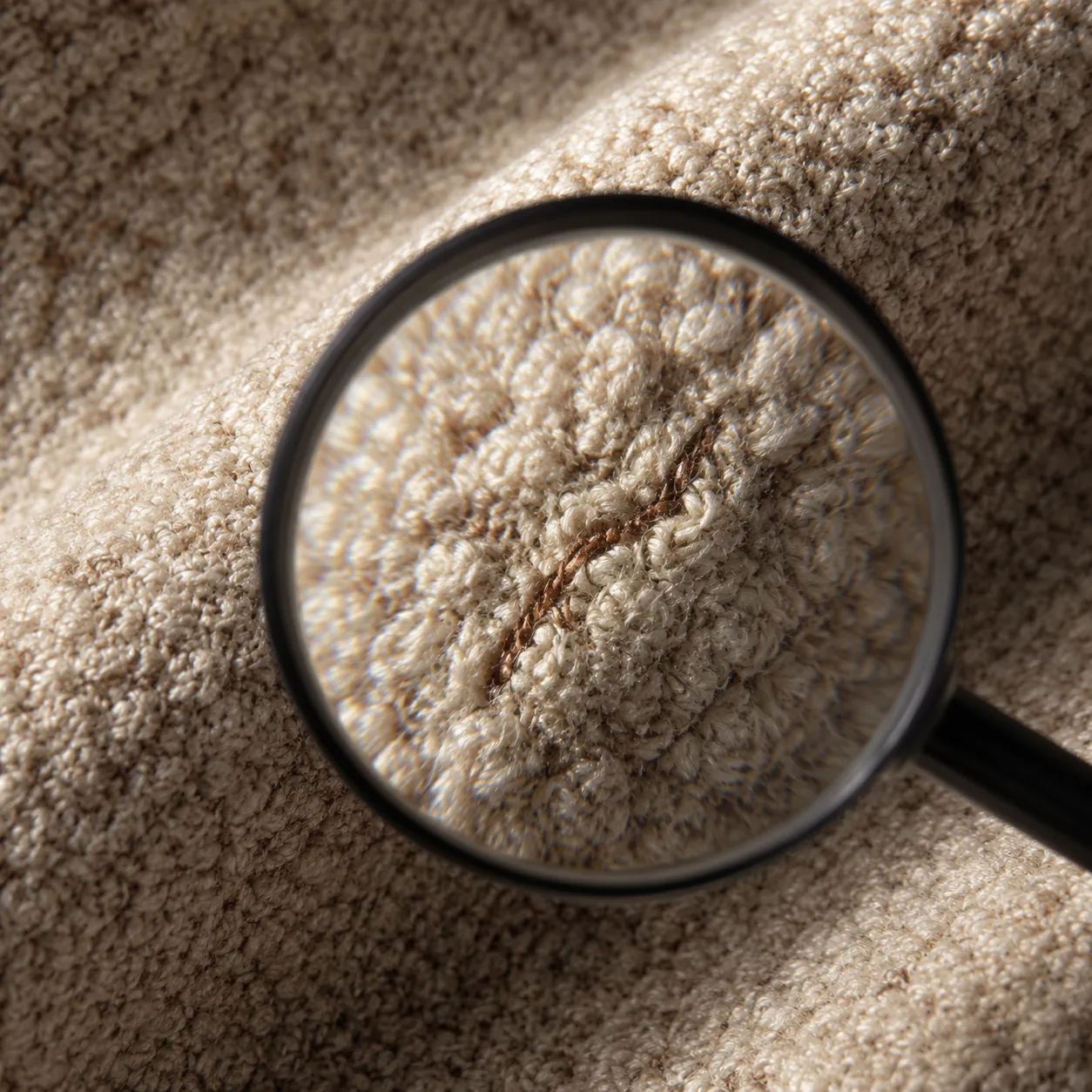
How to Identify Wool vs Polyester Tweed: Burn Test and Microscopy
How to tell wool from polyester tweed: burn test, microscopy, and dissolution methods for fabric...

Boucle for Coats vs Jackets: GSM and Loop Density Guide
Choosing boucle fabric for a coat versus a jacket is not just a matter of...

Cable Knit vs Aran Knit: Stitch Structure and Weight Differences
Two rolls sit side by side on a knit buyer’s table. Both are chunky, cream-colored...