
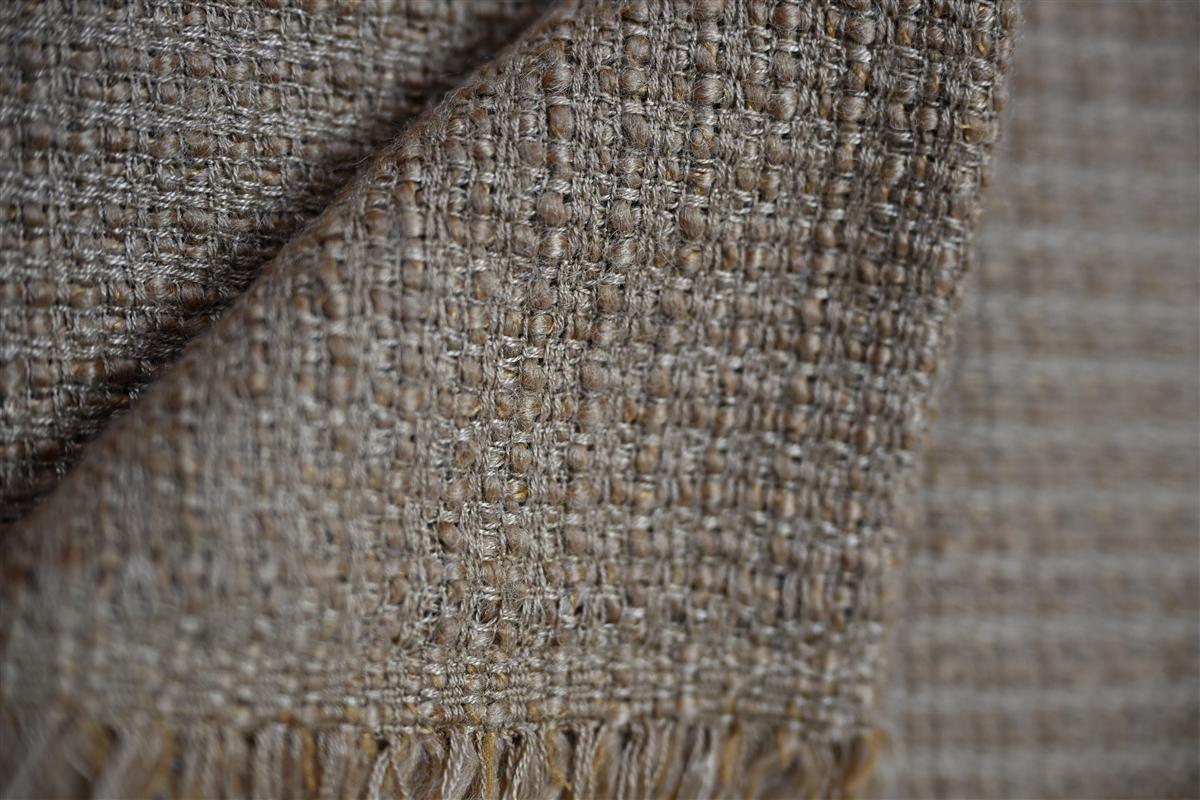
Before the rest is finished, ask the mill for three pieces of evidence and produce one of them yourself. Yours is the skew map: lay a piece from this lot flat and relaxed, draw a line along a weft check row, and put a square against the selvedge at three places along the piece, photographing each one. Theirs are the finishing record for the piece, a measurement of how far the weft deviates from square at those same places, and a trial on a cut panel showing whether the cloth can be straightened or has to be cut around. The check pattern you are looking at is the reason the problem is visible at all: on a plain cloth the same skew would arrive as twisted garment panels instead.
Know which defect you have
Woven cloth has two directions of yarn, and they are meant to cross at right angles. The warp yarns run the length of the piece under tension while the weft is drawn across them, which is what the reference on warp and weft describes, and the geometry between the two is what decides whether a rectangle cut from the cloth stays a rectangle. Two failures look similar on a table and behave differently in a cutting room. Skew is the weft running at an angle: the check looks like a parallelogram, and a panel cut on the grain becomes a parallelogram when it is pressed, which is exactly the twist your garment maker reports. Bow is the weft curving rather than angling: the middle of the piece is out of square while the ends are close, and a straightedge laid along a weft line shows a gap in the centre.
So the first photograph has a square in it and the second has a straightedge. Take both at three places along the piece, at the head, the middle and the tail, because skew often changes along the length: a piece that was straight at the loom can be pulled out of square by one end of the finishing range. Write the three readings down with their positions, and you have a map of the piece rather than an impression of it.

Where skew comes from, and what fixes it
Three stages can put a piece out of square, and the fix differs for each. The loom can insert the weft at an angle if the tension across the width is uneven. The wet finishing can pull the cloth out of square, particularly if the piece is dried under tension with one selvedge held tighter than the other. And the handling afterwards can set the distortion in place if the cloth is dried or steamed without being allowed to lie flat. Ask the mill which stage they believe it came from, and what the record shows: the loom’s weft tension notes if they exist, the finishing recipe, and how the pieces were dried and rested.
Correcting a skewed piece is possible in some cases and not in others. A mill can re-tension and steam a piece to pull the weft closer to square, and the evidence that the correction worked is the same square against the same check line, photographed before and after on the same piece. What a mill cannot do is unbend a piece whose yarns have been permanently distorted, and it cannot make the correction invisible: re-tensioning changes the hand slightly and can leave a piece narrower or with edge marks. If the mill proposes a correction, ask for the trial piece and measure it yourself, because the correction is only useful if it survives the garment finishing that follows.
Test it the way the cutter will
The complaint is not about a table measurement; it is about panels that twist after cutting. So the acceptance test has to reproduce that. Ask for a square panel to be cut from a piece of this lot, on the grain as a cutter would align it, pressed or steamed the way the garment maker finishes, and photographed against a square. A panel that stays a rectangle has passed; a panel that has become a parallelogram has failed in the same way the garment maker described. This is the test that ends the argument, because it uses the same operations that produced the complaint.
Where the mill wants to prove that the balance is fine, ask for the same panel test on a piece from the corrected production, plus the skew map on that piece. Two panels and two maps, before and after, are a complete answer. Where the cutting room can work around the problem by re-aligning the marker to the weft rather than to the selvedge, that is a legitimate route with a cost in width, and the two sides should agree who carries it before the balance is cut.
The commercial side of a crooked piece
Skew costs fabric even when the cloth is usable. A cutting room that aligns to the weft has to allow for the angle, which usually means a wider marker and more waste at the edges, and that waste is a real number in metres. Ask the mill to quote the balance of the order against that reality: either the pieces are straightened and measured, or the cutting room absorbs a known loss and the price reflects it. Half of the arguments in this family are about who discovered the problem; the useful half is about who pays for the metres.
Where the skew is small and consistent, the honest answer is often to accept it with a documented plan: align the marker to the weft, cut slightly wider, and inspect the first garment for twist. Write that plan down with the measured angles, because the next order will be argued from the same numbers. Nothing in this conversation should stay verbal, since a twist in a finished garment is expensive to discover and impossible to argue about without measurements taken at the mill.
What to do with the cloth you have
Map the delivered pieces before cutting. Take one piece from each bale or roll, lay it flat, and record the skew and bow at three positions as described. Pieces that are within the range the cutting room can handle go forward with the marker aligned to the weft; pieces that are worse go into one group and are held. Keep one piece from each group, with its map and its cut-and-press panel, as the record. The piece you hold is also what lets a second mill or a laboratory verify the measurement if the mill disputes it.
Do not let the cutting room start on a piece whose map has not been taken, because a marker cut on the selvedge of a skewed piece produces panels that are all slightly different, and the differences show up after pressing when it is too late to re-cut. The ten minutes per piece that the map costs is the cheapest part of this problem, and the site’s notes on relaxation before cutting cover why the piece has to lie flat before either the map or the marker is made.
Ask what the piece was doing before it was finished
One more question is worth asking, because it explains how a piece that was square at the loom became crooked later: how the cloth was held between the loom and the finishing range. A piece that rests rolled and tensioned for days, or that is stored on one selvedge under weight, can take a set that the wet finishing then freezes. Ask how the pieces from this order were stored and for how long, and whether they were relaxed flat before the finishing step. The answer is often the difference between one crooked piece and a whole lot that will arrive the same way.
Where the mill cannot answer, the map you take on delivery becomes the whole record, and the pattern in it matters: if the crooked pieces come from one storage position or one end of the range, the numbers will say so. Ask the mill to keep the piece tickets attached to the maps you take, so that any pattern can be traced to a machine or a day rather than to the order as a whole.
Write the hold the same day
Send one message to the mill. Name the order and the piece. Say the sample was square and the check on this delivery runs crooked against the selvedge, and state the hold in one sentence: no further lengths finished or packed until the skew is measured and the correction is proven. Name what you need. First, the skew map from three positions along a piece from this lot, photographed with a square and a straightedge. Second, the finishing record for that piece, with the answer on where the mill believes the distortion came from. Third, a square panel cut from the piece, finished the way the garment will be finished, photographed against a square. Fourth, if a correction is proposed, the same map and panel on a re-tensioned piece. Fifth, the plan for the balance stated in metres, so the cutting loss is known before the order is cut.
A release is your note that a panel from the corrected piece stays square after finishing and that the map shows the measurements. A promise to check the weft tension, a claim that all cloth has some skew, and a sample of a plain fabric cut square do not release the hold.
Keep the maps, the two panels and the finishing record in the order folder with the piece tickets. Skew is invisible in a folded piece and obvious in a pressed garment, and the panels from this order are what make the next delivery checkable with a square and ten minutes.
Lectura relacionada: Dye Lots and Colour Consistency in Wool Tweed

Perspectivas relacionadas
Shoulders That Collapse After Two Wears: Spec the Cloth
A coat that holds its line on a hanger and folds at the shoulder after...
Eighty Metres Against Two Hundred: Which Route Keeps the Colour
The shortest route to the same colour is not a new dyeing. It is the...
Repeating a Donegal Effect From Stock Yarn: Fleck Count, Shade Band, Transition
What the mill should show you is not a sample box. It is a trial...