
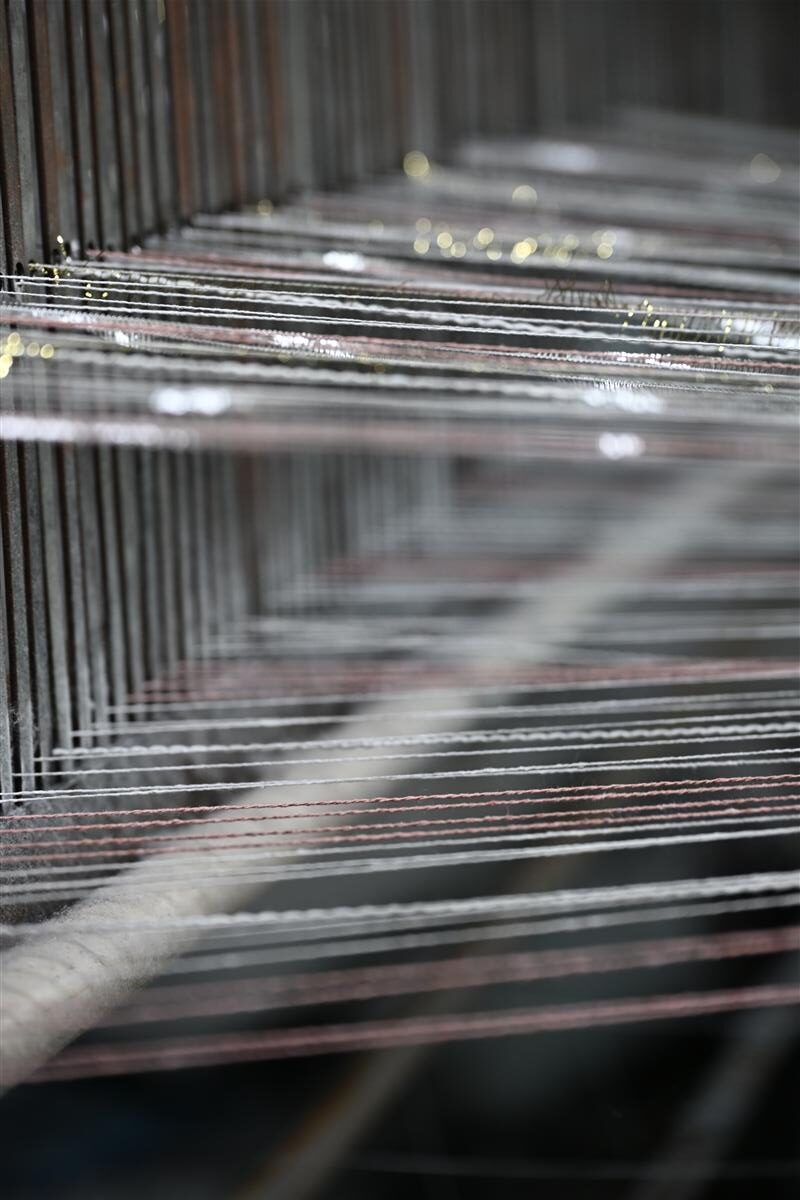
Shorter sleeves after the first press is a specification gap before it is a mill defect: wool cloth relaxes when it meets steam, and nobody wrote down who was responsible for stabilising it. Fix three things before the rest of the order is finished. First, name the pre-shrinking step in the order, mill-sponged or sponge-before-cutting at the garment factory, and choose one, because when both sides assume the other did it, the suit pays. Second, put the residual shrinkage into the batch report: change in warp and weft after a steam and press cycle, measured on marked panels from the head, middle and tail of each roll, not from one swatch. Third, number the rolls so that when one jacket moves more than its neighbour, you can find out whether a roll behaved differently or the pressing did. None of this is exotic, and all of it is cheap while the cloth is still in rolls.
What actually moves in the press
Wool yarns carry strain from spinning, weaving and the finishing line, and steam gives that strain somewhere to go. The fabric relaxes: length and width change, and they change by different amounts, which is why a sleeve (cut along the length) moves differently from a chest panel that also carries the width. Two effects stack on top of each other in a tailoring room. Relaxation shrinkage is the fabric coming to its natural, relaxed dimensions during steam treatment. Pressing shrinkage is the additional change the pressing operation itself drags out under heat and pressure, including how the piece is pulled on the table. A fabric that reports one number called “shrinkage” is not answering the question your cutter is asking, because the two mechanisms are fixed in different ways, and a second press cycle can move a piece yet again after the first one has already been measured.
This is standard wool behaviour, not a fault. The industrial answer has been the same for a century: finish the cloth so it will not move later, the process known as decatising, and where the mill does not do it, sit the cloth in steam before the knife touches it. What the sample garment proved is simply that its own piece of cloth had been relaxed somewhere along the way. Its calm posture is not evidence about the bulk.

The line the order is missing
Write the responsibility into the purchase documents, and write it as a choice rather than a hope. One route: the mill sponges or decatises the bulk before packing, and the batch report carries the residual shrinkage after a steam cycle, so the garment maker starts from stable cloth. The other route: the mill delivers a stated, tested residual, and the garment factory sponges before cutting, which is the traditional tailoring habit for woolens and the reason old workrooms steamed cloth for a day before laying a marker. Both routes work. Orders fail when the clause is silent, and each side believes the other performed the step.
Whichever route is chosen, the numbers belong in the test report that travels with the shipment. The site’s notes on what a mill test report actually certifies cover the general discipline, and the shrinkage line slots into the same table: method, specimen marking, steam condition, press condition, warp and weft change reported separately, and the number of cycles run. Ask for a second cycle, because a cloth that moves again on the second press will find its way into a customer’s wardrobe and move there.
Where to sample, and why per-roll matters
One swatch from one roll cannot describe a bale, and your own complaint already tells the story: two jackets, one roll, two outcomes. The sampling plan that catches this is small and specific. Cut marked panels from the head, middle and tail of each production roll, mark the warp and weft directions on the panel, steam and press them through the cycle you have agreed, and measure the change in both directions, recording which roll and which position each panel came from. A roll that behaves differently along its length points at the finishing line or at how the roll was stored. A roll that behaves differently from its neighbours points at the batch. A set that moves unevenly in warp only suggests the finishing was pulling in one direction, which is the same family of cause as the skew problems that show up on the table, described in the notes on mapping skew and bow on the piece.
The accompanying habit on your side costs one sticker per roll: a number, kept on the roll and written on the cut ticket when the marker is laid. When a finished garment moves unexpectedly, the roll number turns a mystery into a lookup, and the mill gets a specific question, that roll, that position, that measurement, instead of a general complaint about shrinkage. The finishing room’s own last pass, steaming and mending before packing, is the process this test is auditing, and its role is set out in the notes on the mill’s final steam pass.
The suits already cut
For the garments that have already moved, the honest inventory is short. Sleeves that have shortened can sometimes be lengthened by letting out the hem allowance, if the tailor left one; if not, the sleeve is re-cut or the suit becomes a short-sleeve variant nobody ordered. Balance problems across panels mean the garment is remade rather than adjusted, because no press will push the cloth back to its old dimensions reliably. Before any of that, though, take one finished garment and re-press it through the same cycle as a test: if it moves again, treating the affected pieces as the whole problem will undercount it, and the fix needs to cover more of the run. Record the second-press movement and keep the garment as the exhibit.
Then have the conversation with the spec in hand, not the feeling. The cloth met whatever standard existed at the time; the standard is the thing that was missing, and the productive question is which of the two routes the next order takes, with which numbers, on which sampling plan. A mill that sponges and tests will quote it as a finishing line item; a mill that does not will tell you to sponge at the cutting room, which is also an answer, as long as the garment factory plans the time. Either outcome closes the gap that produced the short sleeves, which is what the client actually wants before the next collection.
The cutting room’s part of the deal
A stated residual is only useful if the person laying the marker knows what to do with it. Two habits convert the number into garments that fit. The first is the oversize allowance for the pieces that carry the movement: where the report says the warp will relax by a known amount in pressing, the cutter adds length to the affected pattern pieces and trims after the first press, which is how tailor shops have always handled a cloth with give in it. The second is direction discipline while the marker is laid: every piece with the warp the same way, the sleeve and its pair treated identically, so whatever movement occurs, it occurs in the same direction across the set. The same relaxed stand applies before the knife ever comes out, and the waiting time a cloth needs between arrival and cutting, days rather than hours, is covered in the notes on relaxing fabric before cutting.
One wrong fix deserves naming, because it is common in pressed workrooms: answering shrinkage with harder pressing. Pulling a damp cloth on the table stretches it again by a different amount, which is why some pieces come back long and shiny instead of short. If the first press moved the garment, the next step is measuring and planning, not pressing it back.
Weather, storage and the second summer
Wool exchanges moisture with the air around it, and its dimensions follow. A bale cut in a humid late summer and a bale cut in a dry heated workshop are two different materials to the knife, even from the same production run, and a garment that moved in the first press can move again when a customer wears it through a wet February and a dry July. Two practical steps blunt this: keep the rolls wrapped and off bare floors in a stable space rather than moving them between extremes, and give the cloth its relaxed standing time in the same room where it will be cut, not on a loading dock. For the market the garment ships into, ask the maker which season they cut in, because a suit cut in a dry month and sold into a humid climate will finish its own relaxation on the customer’s back, and no test report can take that back, only a faster second press appointment in the workroom.
What the next order should carry
Four lines, all of them short. The route: mill-sponged with a stated residual, or tested residual with sponge-before-cutting at the maker, named explicitly. The numbers: warp and weft change after the agreed steam and press cycle, two cycles reported, method and specimen marking stated. The plan: head, middle and tail of every roll, identified by roll number. The tracking: roll numbers carried onto the cut ticket so any future movement can be traced to a piece of cloth rather than to a season. A wool programme that writes those four lines stops having this conversation, and the cloth arrives already knowing what it is going to do under the steam, which is the least a suit is entitled to ask of its cloth.

Relaterte innsikter
Tweed Collar Fray: Check Construction Before Changing Cloth
When a tweed jacket collar frays after a month, customers often blame the cloth first....
Merino Is Not a Fibre Name: Labelling a Wool Coat for Two Markets
A wool coat sold in both markets needs two different fibre lines, and the words...
It Feels Thin: Turning a Complaint into Five Specification Rows
A hand-feel gap is the distance between a measured property and a customer’s report. The...