
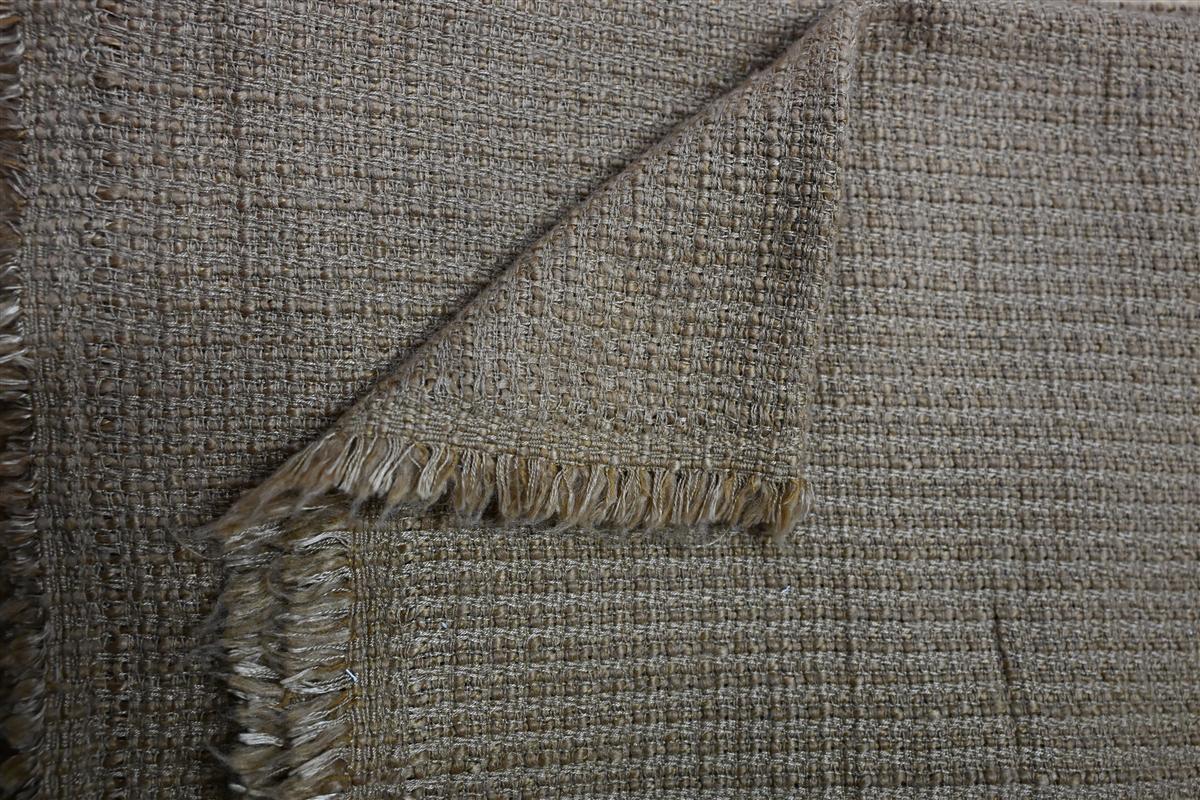
A 10 cm cutting is a record of structure, not a record of process. Count ends and picks, name the weave, read yarn size and twist, and a mill can quote a weave back. Finished width, shrinkage, weight intention, hand and end use arrive as numbers from the buyer or not at all. Historic finish, aged colour and vintage yarn provenance go in as best effort, marked as such. In 2026 a mill’s email still reads like a promise, so sort the enquiry into three columns before sending it. The reply then becomes a document you can hold instead of a favour you hope for.
What Does a 10 cm Cutting Prove About a Cloth?
A 10 cm cutting is a structure record. Structure is weave and interlacing, warp and weft direction, ends and picks, approximate yarn size and twist, fibre class, and the surface left by nap, brushing, milling or shearing. Process is everything a finished square cannot hold: finished width, shrinkage, strength, lot consistency, the finishing recipe.
Ifølge construction analysis published by TextileNotes, construction is written as warp count by weft count over EPI and PPI, plus width and weave. Thread count methods named on the page are ISO 7211-2 and ASTM D3775, and both count in several places, away from the selvedge.
The same page carries the line that decides the negotiation: yarn taken from finished fabric may differ from the original yarn, because dyeing and finishing change the yarn. We covered how to read a swatch in the swatch comparison guide. The guide measures cloth. The page you are reading decides what a measurement can bind a mill to.
Which Column Does Each Property Sit In?
The three-way sort is the document step a first enquiry is missing, and no mill will do it for the buyer. First, a property the cutting proves needs no negotiation, because both sides measure the same piece. Second, a property the cloth cannot give must arrive as a number, or the mill fills the gap with a default. Finally, a property nobody can hold gets one sentence and no number, so nobody argues about the sentence later. The sort costs an afternoon and settles most of what a first enquiry gets wrong.
Two of the three columns belong to the buyer. The third is a writedown, and a writedown is safe only once both sides have read the same wording. Nothing in the sort is a price, a lead time or a quantity, which is why the sort can be done before any mill is approached.
What Does the Sort Table Look Like?
The sort table carries those three columns property by property, and each row names one owner. According to ISO 7211-2, ends and picks are counted in several places, which makes that row the strongest of the six, and even a count in several places is only a band until the buyer states the band to hold.
| Egenskap | What the 10 cm cutting shows | Who acts, and how |
|---|---|---|
| Weave and interlacing | Reads directly on both faces, nothing spent | Buyer quotes the weave name back |
| Ends and picks | Counts in several places, away from the edge | Buyer states the count band to hold |
| Yarn size and twist | Approximate only, twist hard to read | Buyer states yarn ticket or equivalence |
| Finished width and shrinkage | Nothing, no selvedge and already relaxed | Buyer states width, test and limit |
| Colour | Reads the aged piece, not the bulk | Buyer states match as is or interpret |
| Historic finish | Nothing, finish left no record | Best effort, one sentence, no number |
Why Must the Buyer Write the Numbers the Cloth Cannot Give?
A number the cloth cannot give is a number the buyer must write, because no mill reads intent from a 10 cm square. Three numbers carry most of the risk: 1) finished width, 2) shrinkage, 3) weight intention. Finished width comes first. A piece with no selvedge cannot say what width the loom ran, and width decides cutting yield on a coat. Shrinkage comes second. A cutting is already relaxed and finished, so the square will not move the way bulk moves. Weight intention comes third. A buyer who wants a heavier coat has to ask for a heavier coat. Fibre content sits behind all three, because a 100% wool claim needs a lab test and a supplier declaration, never a burnt end. For example, two yarns both sold as 2/28 can sit 12% apart in count, which is why the yarn equivalence annex is signed with the order.
How Do You Spend a One-Off Cutting?
A one-off cutting is a whole-cloth reference, so the order of tests is the method. The square shows face, reverse, edge and the way the weave sits at a size no photograph reproduces. Every destructive test spends part of that reference, and the reference cannot be bought again. First the non-destructive pass, which costs time and nothing else. Second one yarn, which costs one end. Third one burnt end, which costs a strand and a smell. Then nothing, unless the buyer has already decided the piece is spent.

For example, a 2010s coat that arrives with a seam allowance still attached gives a free yarn without touching the face, and that free yarn is the test most buyers skip.
What Is the Order: Read, Pull One Yarn, Burn One End?
The order runs from the cheapest read to the most expensive one, and each step costs more than the last. First, the non-destructive read: photograph both faces at a known scale, mark warp and weft, count ends and picks in three places, measure thickness, read colour under two light sources. Nothing is consumed. Second, pull a single yarn, from a seam allowance when the cutting has one, or from the very edge, and pull one yarn in each direction when warp and weft differ. Third, burn one end only, under extraction, and read ash, smell and residue. Finally, stop. A burn test reads fibre class and never a percentage, so a 100% wool claim still needs paperwork.
When Does the Piece Stop Being a Reference?
A cutting stops being a reference the moment the face is broken in the middle. A slice through the centre, an unravelled block, or a steamed and pressed square all destroy the evidence that mill and buyer are arguing about. Steaming is the quiet one: steam lifts the finish and changes the handle, so the piece then proves a handle bulk will never have. A buyer who steams first and photographs second has spent the only whole-cloth record. Colour and handle belong in one record for that reason, as set out in the sampling record that carries both. Keep the face intact until the mill answers.
Which Two Confirmations Release the Bulk?
A confirmation is a decision with a signature, and two confirmations release the bulk. The structure trial is a woven prototype: it proves that weave, yarn and loom settings produce the cloth the buyer described, and the structure trial may change yarn, sett or finish. The structure trial may not change the weave name or the count band the buyer signed. The colour sample is a lab dip or a dyed piece: it proves shade on the actual substrate, and the colour sample may change depth or recipe. The colour sample may not change the substrate. Neither confirmation releases bulk alone, and a mill that treats a lab dip as a release has skipped the structure question. Sign the dip against a Pantone reference before bulk dye, as set out in the lab dip clause. The pack that carries both confirmations, with every number the buyer supplied, is described in the specification pack guide.
How Do You Write Close So It Never Reads as Identical?
Close is a tolerance statement, not an adjective, and the clause is where a promise becomes a document. The seed sentence is short: closest practical reproduction within agreed tolerances, and not an assertion that the historical fabric can be copied identically. Everything else in the clause is a row. Each property the cutting proved gets a tolerance band. Each property the buyer stated gets a number and a met or not met result. Each best-effort property gets one sentence, no number, no remedy. One more line answers the question nobody asks: what happens when the prototype misses exactly one row. Without that line a single miss becomes a silent acceptance or a dispute nobody priced.
What Belongs in the Clause, Row by Row?
The clause is written in the order of the sort table, and then it stops being an argument. First the proved rows: each gets a tolerance band both sides can measure on the same piece. Second the stated rows: each gets the buyer’s number, a Pantone reference for shade, a width for the loom, and a met or not met result with no averaging between rows. Third the best-effort row: one sentence, no number, no remedy, quoted in the order confirmation. Then the miss rule. When a prototype misses exactly one row, the buyer chooses between a written allowance and one more paid trial. Two misses on one prototype return to the structure question, because a retrial on unchanged settings repeats the fault. Sign before the bulk order.
Whose Pattern, Whose Record, Whose Recipe?
A vintage coat is often another brand’s cloth and sometimes a registered pattern, so a reweave is a rights question before a weaving question. Copyright and design protection vary by country, and no mill can clear them for the buyer. When the cutting carries a print, a jacquard figure or a recognisable check, ask the brand for written permission, or ask for a version close in structure and new in pattern. For example, one check can be protected as a registered design in one market and unprotected in the next. The second question is ownership of what a trial produces: the trial-weave record and the colour recipe. State who holds both, and whether either may be reused. Otherwise a buyer pays for a recipe and meets that recipe again on someone else’s cloth.

Relaterte innsikter
Oil and Mothball Smell in the Bale: What to Do First
An oil or mothball smell on opening a bale is a chemical question before it...
Heat-Set Pleats in Wool Tweed: What Must Be True?
Three conditions must hold before a pleater can set a pleat in wool tweed, and...
Backup Mill: What to Duplicate, What to Skip?
A backup mill is a second plant, not a second development. A buyer who already...