
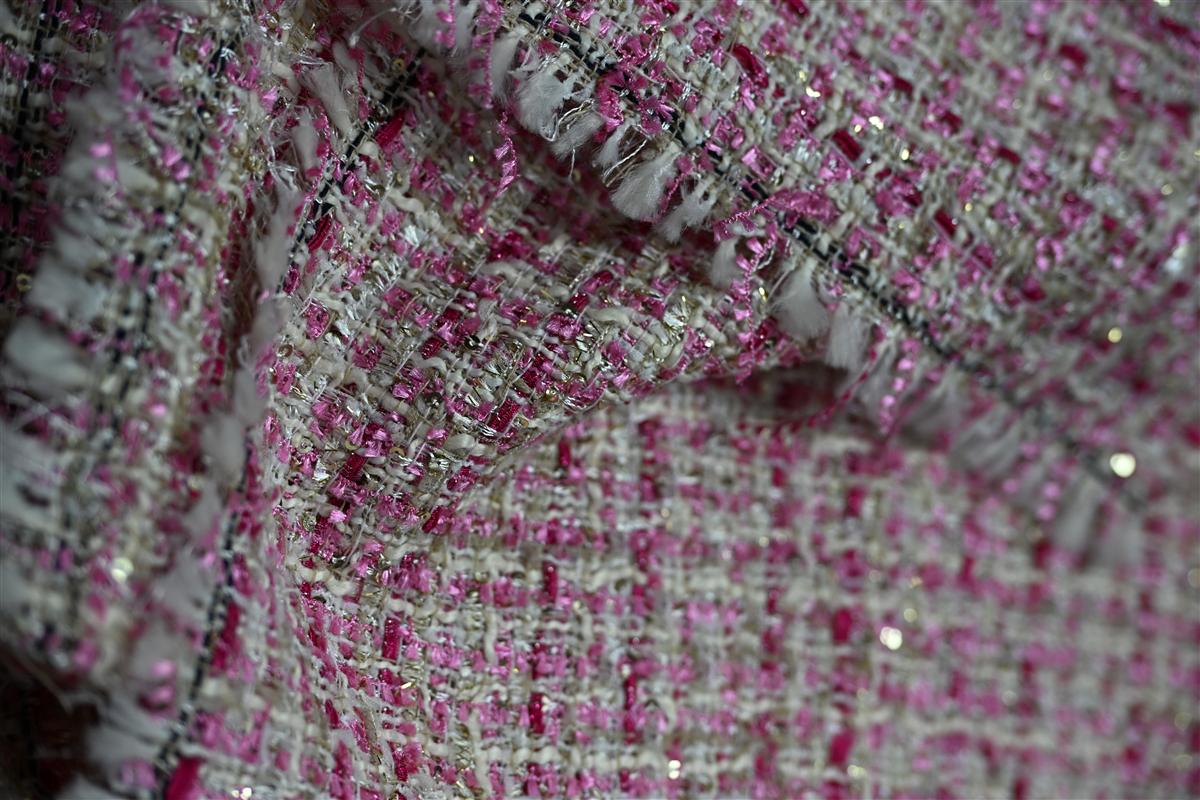
A yarn-dyed tweed does not charge you per colour of cloth. It charges you per colour of yarn. That distinction is why six colourways can cost two or three minimums instead of six: hold the warp set the mill already runs, change one weft or fleck yarn per colourway, and buy the rest of the range out of the mill’s standing yarn palette. Designers who pay six full minimums are usually buying six new cloth qualities when they only needed six new weft colours.
Four routes into a six-colour range
Every route below gets you six colourways. What separates them is which item carries the minimum, and therefore what you own afterwards. The last column matters more than the first, because a range you cannot repeat is a range you cannot build a season on.
| Route | What carries the minimum | What it does to the cloth | Reorder position |
|---|---|---|---|
| Six custom colourways, six cloth lots | One cloth dye lot per colourway | Flat shade; the pattern has to come from the weave alone | Repeats only while that yarn lot or recipe survives |
| One warp set, custom weft per colourway | The weft yarn lot only | Keeps the check, houndstooth or fleck contrast intact | Warp stays banked; weft repeats at yarn-lot length |
| Standing yarn palette, no custom colour | Nothing new; you buy stock | Range limited to shades the mill already carries | Best in the table: repeat while stock lasts |
| Short dye lot against a surcharge | A fee instead of a full lot | Same cloth, higher unit price on the short shades | Repeats only if the mill keeps recipe and yarn |
Why the greige and garment-dye answers do not survive a tweed
Most advice on getting round a colour minimum is written for solid piece-dyed jersey: buy undyed cloth against one minimum and dye small lots later, and the colour minimum disappears. On a tweed that route does not exist, and the wrong answer here costs a season rather than an argument.
In a houndstooth, a glen check or a Donegal fleck, the pattern is made of coloured yarns placed next to each other. The weave decides which colour shows in which stitch, not what the colours are. Piece dye the finished cloth and every yarn takes the same shade, so the contrast that made the pattern disappears. A self-shade herringbone survives piece dyeing with its pattern intact, because that pattern comes from weave direction, but it comes out as a single-colour cloth, which is not a second colourway. The difference between the routes is set out in stock dye, yarn dye and piece dye compared.
Garment dyeing fails for a different reason. It needs an unconstructed garment that can go through an aqueous dye bath, and a tailored wool coat is neither. By the time the garment exists it has interlining, lining, shoulder structure and pressed seams, and wool in hot water felts and shrinks. The coat that comes out is not the coat you sampled.
Printing gets suggested too. On a four-hundred-gram tweed with slub and boucle, ink sits on the high spots and stiffens the handle where it is heaviest. It is a way to put a graphic on a cloth, not a way to make six shades of one.
Strip those three out and the menu left to a tweed mill is entirely at the yarn. That is not a limitation to work around. It is the lever.
Which yarns a colourway actually changes
A tweed is usually built from three or four yarn positions: the ground warp, the ground weft, a contrast weft that forms the check, and a fleck or binder yarn that carries the novelty. A colourway is a decision about which of those positions move.
Take a two-colour houndstooth. The unit is one dark end and one light end in both directions. Keep the dark yarn in the warp and move the light one in the weft, and one warp set serves several colourways, each costing one new yarn colour instead of a whole new cloth. That is the whole mechanism: the colourways in a range are variations on a warp, not six independent cloths.
Ask the mill for the yarn map of a colourway you already buy: four lines, one per position, each with a yarn count, a colour reference and the kilograms per hundred metres. With that sheet you can see which positions you can afford to move and which one is carrying the identity of the cloth. Most ranges hold the warp and the fleck and move the contrast weft, because that is the position that changes the read at three metres without changing the hand.
Count kilograms of yarn, not metres of cloth
The second thing that decides your cost is the unit the minimum is expressed in. Yarn lots are sold by weight. Cloth is sold by length. If you only ever quote your requirement in metres, you are comparing two different quantities and the mill will do the conversion for you, in its own favour. The trading conventions that make wool weight and wool lot identity comparable between mills are published by the Internationale Woltextielorganisatie, and they are the reason a yarn reference means something across two suppliers.
Convert first. Grams per square metre multiplied by width in metres gives grams per running metre, and dividing by a thousand gives kilograms per running metre. A 320 g/m cloth at 150 cm weighs 0.48 kg per running metre, so sixty metres is just under 29 kg of cloth. That 29 kg is then split across the positions that change, which is why a colourway that moves one weft can sit at a fraction of the weight of a colourway that moves the whole face.
- Write the requirement as kilograms per yarn position, not metres per colour.
- Mark which positions are shared across the range and which are unique to a colourway.
- Compare mills on the weight of the unique positions only, since that is the part that can trigger a new lot.
Once the requirement is in kilograms, the conversation changes from “can you go below your minimum” to “which of these positions already exists in your yarn store”. That is a question a mill can answer in an afternoon, and it is the one that produces a real number rather than a discount.
The request that gets a real answer
An enquiry that lists six Pantone references will get six prices. An enquiry that lists one quality and a yarn map will get a range.
- Name one base quality: same construction, same grams per square metre, same finish, same width for all six.
- Ask for the yarn map of the closest colourway the mill already runs, position by position.
- Ask for the standing yarn palette with the shades currently in the yarn store, and the count of each.
- Ask which positions can move without re-approving the handle, and which cannot.
- Ask whether the custom shades in the range can run as a ladder, lightest first, in one bath series rather than six separate recipes.
- Ask for the reorder position per colourway in writing, as a weight and a yarn reference, before you approve anything.
The penultimate item is the one most designers never ask. A shade ladder is a different question from pooling two colours into one bath, which no dyehouse will do for shade control. Running a family of shades in sequence, pale first and building depth in the same vessel, is a normal way to hold a tonal range together, and consecutive shades in a ladder tend to sit closer to each other than six independently matched recipes do. Whether it is available depends on the dyehouse and the yarn, so it belongs in the question, not the assumption.
The last item protects the season after this one. A colourway made from a standing yarn can be repeated at whatever length the yarn store supports. A colourway sitting on a custom yarn lot ends when the lot ends, which is the situation described in dye lots and colour consistency and in the shorter-run case of forty metres against a three-hundred-metre minimum.
Two questions that decide the last ten per cent
Can two colourways share one dye bath?
Not if the shades differ. Two colours in one vessel cannot both be controlled, so the answer is no and it will stay no. What can sometimes be shared is the sequence: one shade family run light to dark in a standing bath, with dye added between shades. The saving there comes from setup and consistency, not from halving the weight. If a mill offers to split one lot across two colours, ask which is dyed second and what happens to the shade of the first, because the second run contaminates the bath.
Is a stock shade cheaper, or just faster?
Sometimes it is neither. A stock shade in a different yarn count, twist or blend is not the same cloth with a different colour, it is a different cloth, and it needs its own approval. Check the count and the blend on the yarn ticket, not just the colour reference. Where count and blend match, a stock shade is the cheapest colourway you will ever buy and it removes the reorder risk entirely. The trade is range: you choose from what exists.
There is a middle position worth pricing explicitly. A short dye lot against a surcharge costs more per metre on that colourway and nothing on the others, which is usually a better structure than raising the quantity on all six to reach a minimum on two. The surcharge arithmetic is the same as any small-lot premium, which is broken down in the small-lot surcharge on ninety metres.
Release the range in two batches, not one
The colour plan and the release plan are the same decision. Six colourways ordered at once locks six commitments before a single garment has sold. Two anchor colourways at full quantity, with four followers held on the same warp and the same yarn references, gives a range that can grow into its own sales data.
Two anchors is the smallest set that lets a buyer see the range as a range, and it is large enough to carry the volume that makes the warp worth beaming. The four followers are then released against that same warp, so their cost is the weft and the making-up, not a second cloth development.

If one anchor sells out and the other stalls, you have learned something before you have paid for four more shades.
The batch structure also fixes the reorder window. A follower released late sits inside the same yarn lot as the anchors only if it was reserved at the same time, so the reservation has to be written when the range is approved, not when the stock sells down. Reserve the yarn weight per position for the whole range, release the cloth in two batches, and the second batch is a production decision rather than a colour decision.
For a fleck or Donegal effect, hold the fleck yarn constant across the whole range. The fleck is what makes the cloth read as one family, and it is the position most likely to be discontinued, so it is the one to reserve first. The relationship between fleck count, shade band and how a mill repeats an effect from stock yarn is covered in repeating a Donegal effect from stock yarn.
Six colourways, then, is a yarn question before it is a dyeing question. Hold what the mill already runs, move the one position that changes the read, buy the rest from the yarn store, and put the custom money where the shelf will actually see it. The invoice will still have six lines. Only two of them will be new.
If your range is stuck between a mill minimum and a shelf that needs six shades, send the yarn map and the weight per position rather than six Pantone numbers. That is the version of the request a mill can price.

Gerelateerde inzichten

The ISPM 15 Mark on Your Crate: What to Check?
The forwarder’s message asks whether the crate holding 120 metres of wool tweed carries the...

Twenty Metres a Month From One Weaving Run?
A blanket order is one total commitment released in parts, and at twenty metres a...

A Name in the Selvedge: What the Edge Can Hold?
A woven name is a construction decision before it is a design decision. On a...