
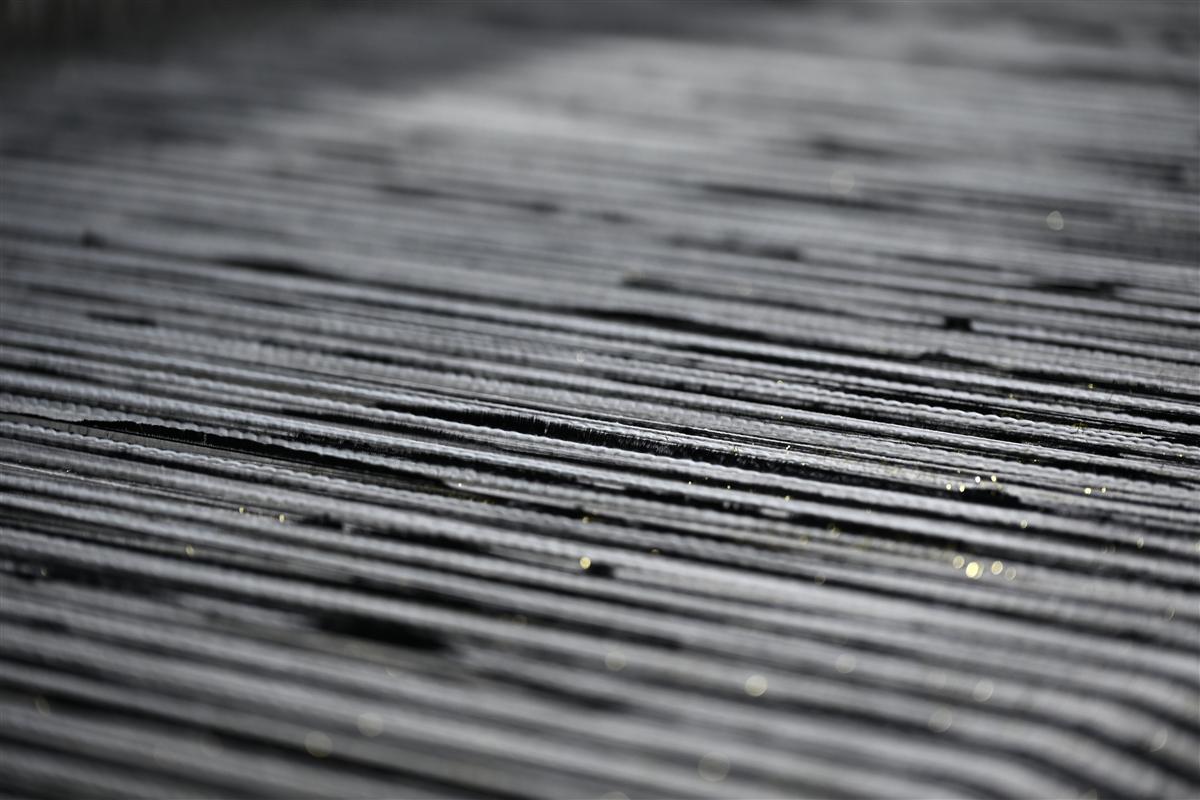
A stiff grey band along the front edge of an unlined coat is the selvedge, and no published figure tells a marker how much of the edge to cut away. The clearances in circulation disagree with each other and none carries a citation. The number is a property of the roll, not a rule of thumb carried between mills. Measure the three things at each edge, take the furthest reach at head, middle and tail on both edges, and block the strip out of the marker. The order then has to fix which width figure it quotes, because the documented failure is subtracting the same edge twice.
The sections below cover why the band behaves like a second material, how the edge zone is measured on a roll, and what the three clauses say. The band is not a stain, and pressing will not take the band out.
Why Does the Grey Band Refuse to Press Out?
A selvedge is the woven edge of a piece of cloth, and the selvedge is not made of the same material as the body it borders. The weft reaches the limit of the cloth, turns, and comes back, so the edge contains no cut thread ends. The outermost warps are doubled or tripled on purpose, and mills often use a stronger, coarser thread at those positions. The strip ends up thicker, stiffer and less elastic than the body. A denser structure also admits dye at a different rate, which is why the band reads pale or grey against the face. According to WaveMAX’s selvedge guide, read in 2026, the edge behaves “like two materials joined along a line” in water, in heat and under tension. Pressing therefore sets the difference instead of relaxing the band, and an unlined front carries no lining to hide the ridge. For example, a platen flattens the thick strip into the face and leaves a hard line where the two materials meet.
What Three Things Sit in That Edge Zone?
An edge zone is the strip at each side of a piece where the cloth has not yet become normal cloth, and three separate things sit in that strip at three different distances. First, the woven edge: the weft turn and the doubled warps. Second, the mill’s printed mark, which Sewing Basics Hub describes in 2026 as a plain white strip with printed dots or text carrying the manufacturer’s name and colour codes. Third, the tenter pinholes, the small holes left where the tenter frame held the piece flat during drying and finishing. The three boundaries rarely coincide. For example, a cut set by the ink band leaves the pinholes behind. A cut set by the pinholes can leave the stiff weave. The working rule is to cut to the furthest of the three reaches on that roll, not to the most visible one. A name woven into the edge is a separate question, covered in what a selvedge name can hold.
How Do You Measure the Edge Zone on This Roll?
Which Points Do You Measure at Head, Middle and Tail?
A roll measurement is six readings rather than one, and the reading that governs the marker is the largest of the six. Unroll the piece on the cutting table under raking light and work one edge at a time.
- Mark the furthest of the three reaches at the head of the roll, first on the left edge and then on the right.
- Repeat the same mark at the middle and at the tail of the piece, so the record covers the length of the roll.
- Write the six figures on the roll ticket, circle the largest figure on each edge, and carry the larger of those two onto the marker plan as a blocked strip.
In practice, hand decides where the stiff zone ends, at the point where the cloth rolls and drapes like the body again. No published standard locates that transition as of 2026. Record the state of the cloth beside the figures, because a relaxed piece measures wider than a piece held under tension.
What Goes on the Roll Ticket and the Marker Plan?
A roll ticket is the record that turns a hand measurement into a marker instruction, and six fields carry that measurement through to the order.
| What is measured | How the figure is taken | What the order carries | Who holds the record |
|---|---|---|---|
| Woven edge | the weft turn, by hand and eye | maximum edge waste distance | mill issues, buyer records |
| Printed mark | distance from the woven edge | mark must sit outside cuttable width | фабрика |
| Tenter pinholes | furthest pinprick on the piece | no-defect line to that distance | buyer at goods-in |
| Cuttable width | measured between the two blocked strips | delivered usable width | фабрика |
| Measurement state | relaxed and finished, or as received | named in the same clause | both parties |
| Tolerance | a distance, or a percent of the quoted width | stated with the width figure | фабрика |
A field left blank on the ticket is read at the marker as an assumption, and an assumption at the marker is what puts a front panel onto the stiff band.
Which Width Figure Is the Order Quoting?
A width figure is either the usable cuttable width between the two edge zones or the total width across the loom, and the two figures are not interchangeable. According to Apparel Diary’s cutting-room guide, read in 2026, selvedges, damaged edges and any agreed clearance “must remain outside the cutting area”, and where the width record already excludes those parts the marker must not “subtract them a second time”. The same guide adds: moving a piece into a blocked edge “does not solve the shortage”. Double subtraction is the documented trap: a width record already excluding the edges, marked down again by a careful marker, spends the same metres twice. For example, the opposite error places the front panel on the band. One question settles which case applies, and the answer belongs in writing before the marker is laid. The loom-width arithmetic behind a half-width order sits in loom width, fold and shade gates.
What Do the Three Order Clauses Say?
How Is the Edge Waste Clause Written?
An edge waste clause states a maximum distance from the woven edge to the first cuttable cloth, and adds a no-defect line covering everything inside that distance. Three details make the clause usable. First, the figure is a maximum per edge, not an average of the two edges. Second, the clause names the state the distance is measured in, because a piece measured relaxed and a piece measured under tension give different numbers. Third, the figure is agreed per quality and revision, and not carried across qualities. A measured property and a located boundary are different things. ASTM D3774 covers the width of a woven fabric and ASTM D1388 covers stiffness, according to ASTM’s textile index read in 2026, and neither method locates the point where the band stops behaving like the body. For example, a clause that quotes a width method in place of an edge limit answers a question nobody asked.
How Are the Ink and Size Clauses Written?
The ink clause defines the mark by position rather than by colour: the printed band must sit outside the cuttable width, and any permanent, dark or heat-set mark on the face is a defect with no cure. Position is the enforceable half, because colour invites an argument about shade under shop light. The size clause carries four items. First, the delivered cuttable width. Second, the state the width is measured in, relaxed and finished or as received. Third, the tolerance, written as a distance or as a percent of the quoted width, with the basis named. Fourth, which of the two width figures the price is quoted on. A clause that names the state and the basis cannot be read two ways. A specification pack built from photographs shows where these rows sit beside the rest, in a quotable wool specification pack.
What Do You Do With the Coat Already Cut?
An unlined front edge that contains the band cannot be pressed, steamed or brushed back, so the choice is a remedy ladder rather than a repair. First, a replacement front panel from the same roll and the same spread, because colour and shade are the constraint and labour is not. Second, a remake of the coat when no matching panel exists. Third, a deliberate design change that puts a structural element over the edge, which is a design decision with its own balance risk. Fourth, disclosure and a markdown where the coat will still sell. For example, recutting the panel inward is not on the ladder, because the grain line and the balance of the front move with the cut. Keep the cut coat, photograph the band in raking light, and use the photographs as the visual standard for the next roll.
What Does Goods-In Do on the Next Roll?
Goods-in is where the next marker line is decided, and the work takes an afternoon per roll. First, measure within a day of arrival, before the roll is stood on end and before the wrapper is discarded. Second, take the six readings, photograph both edge zones with a steel rule in frame and the zero on the woven edge, and file the photographs with the roll ticket and the shipping documents. Third, hand the largest figure on each edge to the marker as a blocked strip, and hand the same figure to the buyer as the basis for a credit claim if the edge waste exceeds the agreed maximum. In our QC records, the roll ticket rather than the invoice is what a claim rests on. The hand complaint that becomes a row of specification is covered in five specification rows from one hand complaint.

Связанные статьи
Is ‘Quality 6501’ a Specification? What to Get in Writing
“Quality 6501” is not a specification. A specification is a document with four parts: an...
Press Shine on the Lapel: Cloth Fault or Press Fault?
A shine on a lapel is a press fault until the cloth is proven otherwise,...
If You Own the Yarn, Who Carries the Weaving Loss?
When the yarn is yours, the mill’s invoice no longer carries the loss. Nothing is...