

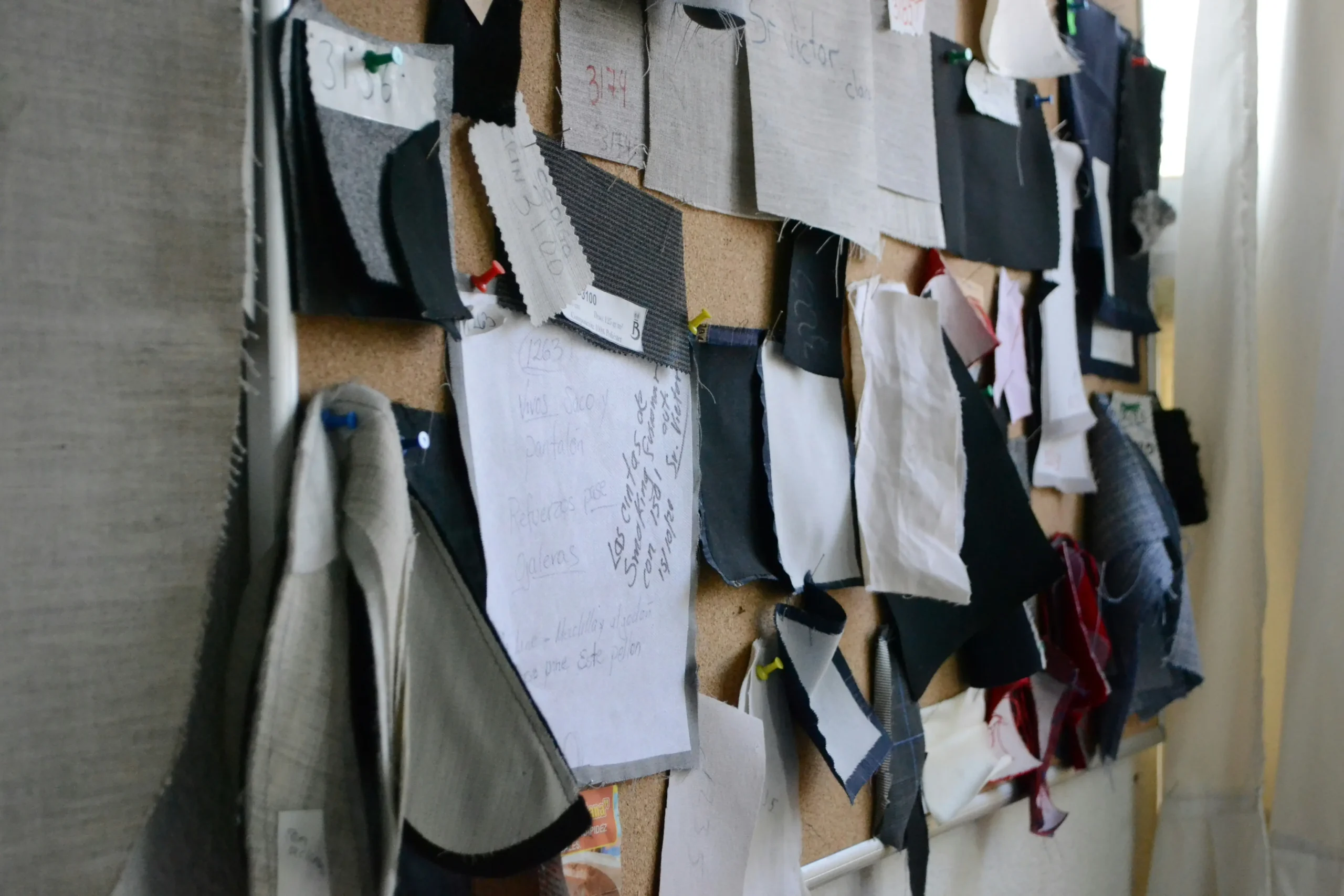
les échecs de test d'échantillon de tweed sont le premier point de contrôle que les acheteurs doivent verrouiller avant de valider un fournisseur, un budget ou un créneau de production. Vous avez coché toutes les cases de votre liste de sourcing : prix FOB verrouillé, délais confirmés, validation d'échantillon signée avec une main qui respire le luxe. Puis l'expédition en série arrive, et en trois jours de coupe vous découvrez que l'échantillon de pré-production ne correspondait pas au lot de production. Cette commande de 50 000 $ en tweed style Chanel présente désormais des panneaux qui rétrécissent irrégulièrement, des bords qui s'effilochent sous le couteau mécanique, et une surface bouclé qui bouloche après un seul essai de port. Le seul point que personne ne vérifie — l'intégrité structurelle du fil — est la cause de la plupart des réclamations après livraison.
Après avoir piloté des audits fournisseurs dans douze pays, une évidence s'impose : le toucher et la validation des couleurs ne suffisent pas à protéger une marque. La différence entre un échantillon qui tient ses promesses et un autre qui échoue tient à cinq tests de laboratoire précis que la plupart des usines contournent ou falsifient. Ces tests couvrent la stabilité dimensionnelle selon l'ISO 6330, les notes de boulochage Martindale au minimum grade 3-4, la solidité à la lumière sur l'échelle Blue Wool, la résistance à la traction par préhension supérieure à 200 N et le comportement à l'effilochage des bords sur de vraies machines de coupe industrielles – pas aux ciseaux à main.
Nos usines partenaires de Wenzhou répondent à ces points de défaillance en filature sur mesure de fils slub et bouclé chez nos usines partenaires, avec dix pour cent de torsion au pouce de plus que les mélanges du commerce. Cela verrouille les fibres entre elles, si bien que la coupe nette devient la routine et non un pari. L'article qui suit passe en revue chaque mode de défaillance, avec les seuils exacts de réussite ou d'échec qu'un responsable de sourcing chevronné doit exiger avant d'approuver un échantillon de tweed pour la production.
Le piège du retrait : pourquoi la taille de l'échantillon compte
A 10x10cm swatch can hide up to 5% shrinkage — you won’t see it until your garment panels don’t match.
Here’s a scenario seen repeat across three continents: a designer approves a 15x15cm swatch, the bulk fabric arrives, the first garment is cut, and the sleeves come up 3cm short after the first wash. The mill blames ‘laundry variance.’ The brand eats the cost. The root cause? The swatch was pre-washed and pre-tenterframed to look stable, while the production roll relaxed differently after dyeing.
Protocole ISO 6330 face aux raccourcis des usines chinoises
La norme internationale ISO 6330 prescrit trois cycles de lavage complets à 40 °C, avec agitation mécanique et séchage en tambour. Cela simule ce qu'un consommateur fait en six mois. Beaucoup d'usines bon marché l'ignorent totalement — elles trempent un échantillon cinq minutes dans de l'eau à température ambiante et le font sécher à plat à l'air libre. Ce test ne détecte peut-être que 1 % des défauts réels le retrait. We run three cycles at 40°C with mechanical action per ISO 6330, measuring warp and weft deviation after each cycle. Our threshold: under 3% total shrinkage in both directions. Anything higher means you’ll be redrafting patterns after production.
Demand the full wash report showing <2% warp and weft deviation from your supplier before approving any custom tweed program. If they can’t produce one, that’s your red flag.
Rouleau de production contre échantillon pré-lavé : la tromperie
A common trick: mills over-tenterframe or compact the yarns before cutting your approval sample, so the swatch appears dimensionally stable but relaxes post-bulk dyeing. You approve a perfect square; six weeks later, production panels shrink unevenly because the fabric wasn’t allowed to settle in its natural state.
Notre approche : nous découpons les échantillons directement dans des rouleaux de grège non traités, avec les mêmes réglages de largeur et de tension que votre commande finale. Pas de prélavage, pas de stabilisation artificielle — ce que vous testez est exactement ce qui part. Demandez une photo côte à côte du numéro de rouleau inscrit sur la lisière et de votre identifiant d'échantillon, pour vérifier la traçabilité jusqu'au stock de production.
| Swatch Size | The Problem | The Root Cause | The Solution | Our Guarantee |
|---|---|---|---|---|
| 10cm x 10cm | Hides true shrinkage; pattern pieces don’t match after wash | Les miniatures pré-lavées masquent la détente après production | Exigez un échantillon prélevé sur le rouleau de production (min. 30 cm x 30 cm) | Échantillons découpés dans de vrais rouleaux écrus ; <3 % de retrait selon ISO 6330 |
| Pre-Washed Sample | Fausse la stabilité dimensionnelle ; le tissu rétrécit en grande série | Les usines surétirent les fils sur rame avant de découper les échantillons d’approbation | Demandez le numéro de rouleau inscrit sur la lisière, à comparer directement avec la référence de l’échantillon | Échantillons de rouleaux écrus non apprêtés avec rapport de lavage complet |
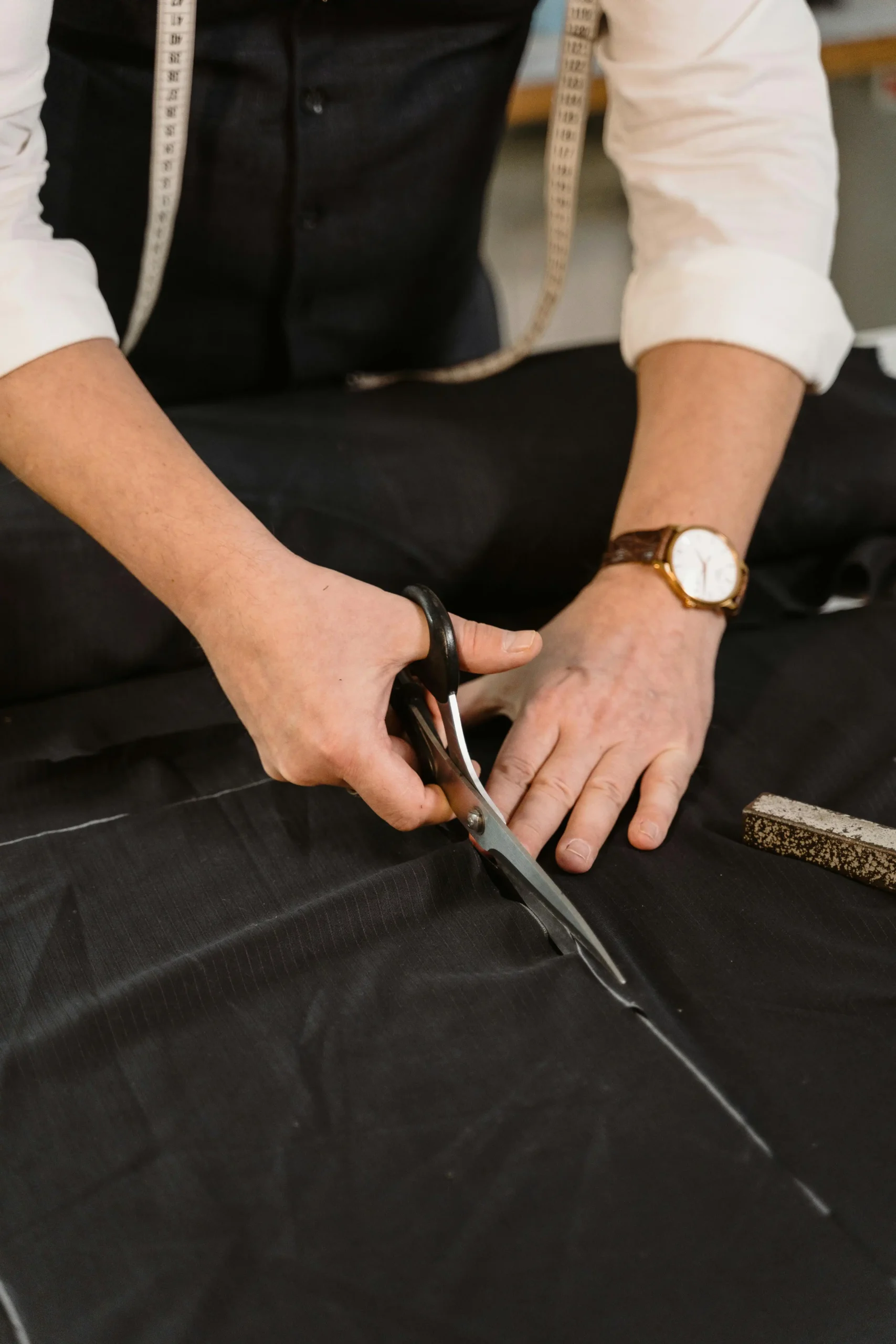
| Hand-Scissor Cut | Masque l'effilochage des bords ; se défait sur les machines de coupe industrielles | Les fils standards manquent de structure de retordage pour une coupe nette | Exigez une preuve vidéo de l’échantillon sur machine de coupe industrielle (3000 tr/min) | Filés de nos usines partenaires avec 10 % de TPI en plus ; testés sur les machines de coupe de production |
| Single-Wash Test | Omet le retrait cumulé après 3 cycles ; les panneaux du vêtement se déforment | Le test de trempage à température ambiante ignore l'agitation du séchage en tambour | Exigez un test de lavage ISO 6330 sur 3 cycles à 40 °C avec action mécanique | Rapport complet sur 3 cycles indiquant < 2 % d’écart de chaîne et de trame |

Le mensonge des bouloches : comment repérer une fausse durabilité du bouclé
25 000 cycles Martindale est le minimum pour la durabilité d'un bouclé de qualité habillement.
Bouclé fabrics look expensive on the hanger. But after fifty wears, that collar and those cuffs turn fuzzy. The root cause is almost always a low Martindale grade — a number most mills won’t share unless you ask.
Décoder les classes Martindale : pourquoi 25 000 cycles ne se négocient pas
La différence entre un bouclé de Grade 2 qui bouloche après deux nettoyages à sec et un tissu de Grade 3-4 qui tient plusieurs saisons réside dans la construction du fil. Précisément : la torsion par pouce et la longueur de fibre. Notre usine partenaire obtient un Grade 3-4 régulier en filant des fils à effet bouclé à partir de mélanges de laine longue fibre dont les longueurs dépassent 85 mm, puis en les verrouillant par 80 tours supplémentaires par mètre de torsion d’âme filamenteuse. Cette torsion additionnelle empêche les boucles de surface de se libérer sous la friction.
When you request a Martindale report (ISO 12945-2), look for the grade and the cycle count together. A mill that reports ‘Grade 3’ without specifying cycles may have stopped at 5,000 cycles — not the full 25,000 required for apparel certification. Demand the full curve showing pilling progression from 5,000 to 25,000 cycles.
Le test de brossage : simuler l'usure liée à l'essayage en magasin
Standard Martindale testing rubs flat felt against the fabric face — it doesn’t replicate what happens when a customer’s stubble or necklace drags across a collar or cuff. That’s why we run a proprietary brush test alongside the ISO method. We use a circular nylon bristle head at constant pressure for exactly five minutes, then visually grade pilling against the same ISO reference scale.
L'effilochage des bords : le tueur silencieux de la production
Les fils à effet du commerce ont belle allure, mais se défont aux vitesses de coupe en production.
You run a $50K tweed order through the cutting room. The Eastman straight knife hits a bouclé loop at 3,000 RPM. Within seconds, warp ends spring loose along the cut edge — a ravel line that ruins every panel in that ply stack. That’s not a cutting problem. That’s a yarn twist problem.
Ingénierie du retordage des fils contre mélanges slub du commerce
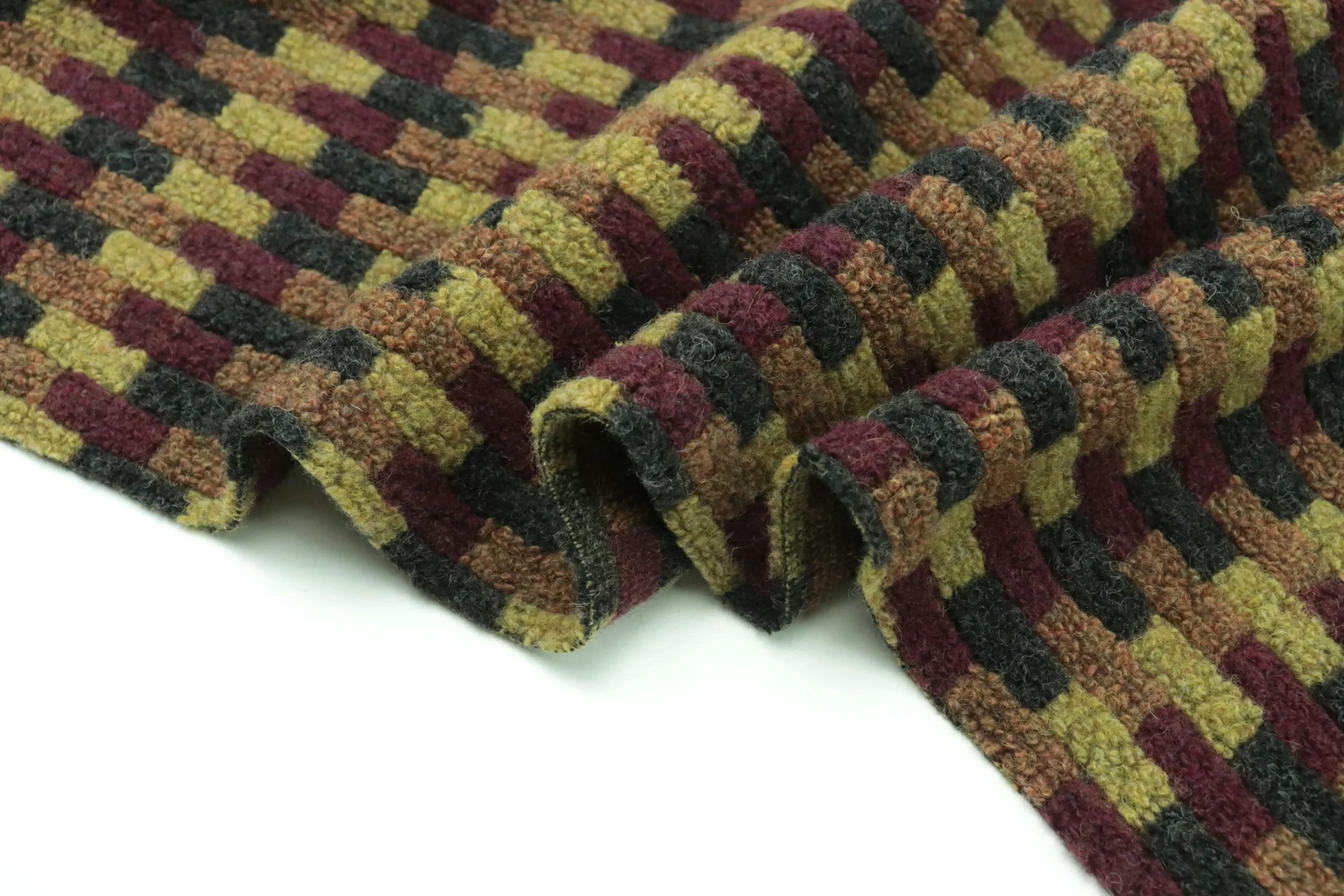
La plupart des usines achètent leurs fils d'effet slub et bouclé à des sociétés de négoce. Ces fils sont filés pour la texture visuelle — profils épais-fins, hauteur de boucle, contraste de couleur — avec un souci quasi nul de cohésion structurelle lors de la coupe à grande vitesse. Le secret du secteur : ces fils portent en général 10-15 % de tours par pouce (TPI) en moins que ce qu'exige un tweed de qualité production.
We custom-spin those same effect yarns inside our partner mills in Wenzhou. Our bouclé and slub yarns get exactly ten percent more TPI compared to regional averages. That microscopic increase locks the fibers together so the loop doesn’t snag and pull free when the blade passes through. The result: clean edges on stacks up to forty plies high.
Preuve vidéo sur machine de coupe industrielle
Les tests aux ciseaux à main ne vous disent rien du comportement réel en production. Une paire de cisailles coupe une seule couche à faible vitesse, sans aucune vibration. Une lame industrielle verticale alternative frappe plusieurs points d'intersection de tissage simultanément, sous choc thermique et mécanique.
That’s why we tester chaque échantillon sur une véritable machine de coupe de production — même vitesse de lame, même hauteur de plis, mêmes réglages de tension que ceux qu'utilisera votre usine. Nous documentons toute la séquence de coupe en vidéo et la joignons à votre rapport d'échantillon. Si un fil de chaîne se détache de plus de 2 mm du bord net dans les dix secondes de séquence, nous mettons ce lot au rebut avant expédition.
Solidité des coloris à la lumière : pourquoi votre tweed personnalisé se décolore
Une note Blue Wool inférieure à 4 signifie que votre tweed se décolorera visiblement en une saison de vente.
I’ve seen a $50,000 custom bouclé program scrapped because the deep navy panels on a storefront mannequin turned purple after three months of Florida sunlight. The buyer approved the swatch by hand-feel and color match alone. They never asked for the ISO 105-B02 report. That is an expensive way to learn that not all dark dyes are built for UV exposure.
Pièges de la lampe à arc au xénon face à la simulation solaire
La lumière naturelle du soleil varie selon la latitude, la saison et la composition du vitrage. Tester un échantillon de tweed derrière une fenêtre de bureau à Oslo ne vous dit rien de son comportement sur un portant à Dubaï. La norme du secteur – ISO 105-B02 – utilise une lampe à arc au xénon dans une enceinte contrôlée (souvent une machine Q-SUN ou Atlas) qui reproduit tout le spectre UV du soleil d’été à midi en Floride. Nous réalisons nos tests de solidité des coloris ISO 105 B02 sur tweed pendant 20 heures par cycle, ce qui correspond à environ trois mois d’exposition continue en vitrine.
The trap: some mills substitute a carbon-arc lamp or simply leave fabric on a windowsill for two weeks and call it “lightfastness tested.” Carbon-arc lamps emit a different UV distribution than sunlight — they over-emit in short wavelengths and miss the longer UV-A that causes fading in disperse-dyed shades. A windowsill test is seasonal gambling. If your supplier cannot produce a Xenon-arc report with a specific Blue Wool scale grade, assume the fabric will fade.
Les secrets de la chimie des teintures à haute solidité pour les teintes foncées
Deep blacks, navy blues, and burgundy reds are the worst offenders for light fading. Standard reactive or disperse black dyes absorb UV energy intensely at the fiber surface, which breaks the chromophore bonds over time. The result: that rich charcoal turns brownish-gray, and your “Chanel-style” navy becomes a washed-out periwinkle.
Conclusion
Un échantillon qui ne passe que le test du toucher est un pari. Les cinq défauts que nous avons évoqués — retrait, boulochage, effilochage des bords, décoloration à la lumière et faiblesse à la traction — sont les défauts cachés qui transforment une commande de 50K $ en expédition refusée. Chacun d'eux est évitable avec les bonnes données de laboratoire.
- Exigez des rapports de lavage ISO 6330 montrant un retrait inférieur à trois pour cent.
- N'acceptez qu'une résistance Martindale de grade trois-quatre ou plus après 25 000 cycles.
- Exiger des résultats d’essai au xénon (arc) d’au moins 4-5 sur l’échelle des laines bleues.
Questions fréquemment posées
Quels sont les 5 échecs aux tests des échantillons de tweed ?
Les cinq défauts sont un retrait supérieur à 3 % après lavage, un boulochage sous 25 000 cycles Martindale, l'effilochage des bords à la coupe, une mauvaise solidité à la lumière sur l'échelle Blue Wool et une faible résistance à la traction aux essais grab. Exigez ces cinq rapports de laboratoire avant d'approuver toute production de gros.
Comment tester le retrait d'un tissu en tweed ?
Utilisez le test de lavage ISO 6330 à 3 cycles pour confirmer que le retrait reste sous 3 %. Beaucoup d’usines contournent cette étape en envoyant des mini-échantillons pré-lavés qui masquent le comportement réel après production. Testez toujours sur un échantillon découpé dans un roulé de production, jamais sur un échantillon pré-lavé.
Combien de cycles Martindale faut-il pour le tweed ?
Le tweed bouclé qualité habillement exige au minimum 25 000 cycles Martindale pour réussir la résistance au boulochage. En dessous de ce seuil, le tissu montrera un duvet visible après quelques ports. Demandez le rapport ISO 12945-2 avant de vous engager sur un programme personnalisé.
Pourquoi le tweed s'effiloche-t-il lors de la coupe ?
Les fils slub standards se défont aux vitesses de coupe de production, faute de torsion propriétaire assurant la stabilité des bords. Les fils filés sur mesure dans nos usines partenaires éliminent ce défaut par conception. Vérifiez l’effilochage des bords sur un échantillon de rouleau de production avant de passer à 1000 m.
Comment testez-vous la solidité à la lumière du tweed ?
Utilisez l’essai à la lampe au xénon selon l’ISO 105-B02 et vérifiez la note sur l’échelle des laines bleues. Une note inférieure à 4 signifie que le tissu se décolorera visiblement en vitrine. Exigez une note minimale de 4 sur l’échelle des laines bleues pour tout tissu de collection.

Aperçus connexes

Largeur de tissu et lisières : planifier le rendement de coupe avant de commander son tweed
Buyers compare tweed by weight, color and price, and then discover at the cutting table...
Reading Fabric Selvedge: Markings, Width and Quality Signals
The selvedge, the finished edge running along both sides of a fabric roll, is the...

Titres de fil dans le tweed : ce que 2/8 NM signifie pour le toucher, le poids et le coût
Ask three suppliers to quote “a 400 gsm tweed for overcoats” and you will often...