
A fabric wholesaler’s swatch book is not a catalog, it is a sourcing strategy printed on card. Every swatch position carries a decision about what runs from stock, what runs to order, and where the margin lives, and the wholesalers who build the most resilient tweed programs read their books that way: as a layered inventory system, not a list of pretty cloths. This article walks through how to structure a tweed swatch book in layers, from no-MOQ stock program anchors to custom exclusives, and how to keep the book honest as seasons turn.
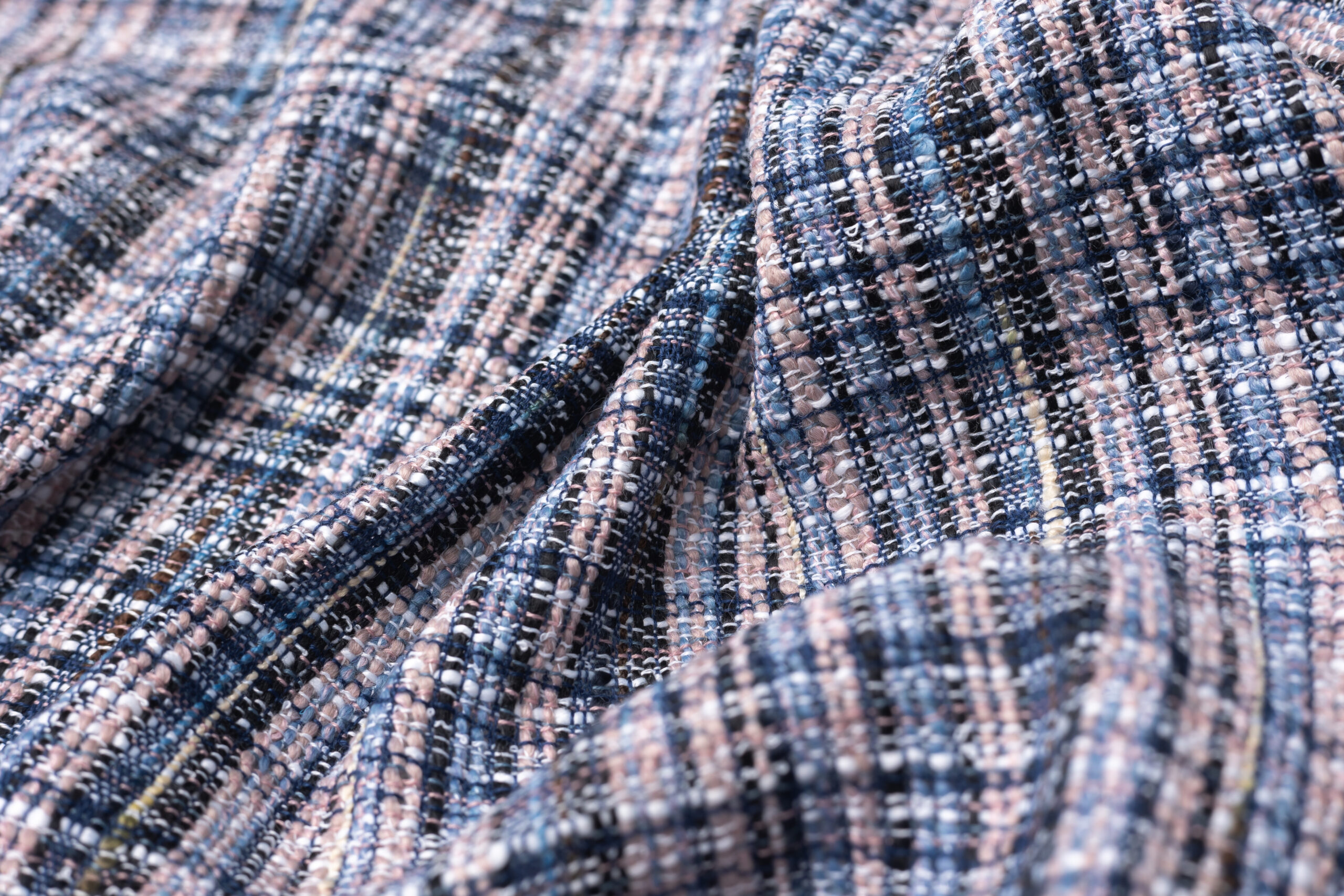
As três camadas de um livro de tweed funcional
Layer your book by how each cloth is supplied. The anchor layer is stock program fabric: qualities the mill weaves continuously, available with no minimum, shippable in days, the cloths you show to every customer because you can always deliver them. The program layer is running-but-made-to-order cloth: constructions the mill will weave on a 1,000-meter basis, in your choice of the mill’s existing colorways, where lead time is measured in weeks. The exclusive layer is custom development: your own composition, weight and colorway, built on the same looms but committed to your brand alone. A healthy book holds all three, roughly in a pyramid, wide at the stock layer and narrow at the top, because the stock layer is what keeps promises while the exclusive layer is what builds the brand’s reason to come to you. Our case study of a wholesaler who built a Linha de tweed com 12 referências totalmente a partir de 100 m em stock shows the pyramid’s base doing all the early work.
O que cada camada lhe custa e lhe rende
The layers trade speed against margin in predictable ways. Stock anchors earn the least per meter but carry zero inventory risk beyond holding the swatch book itself, and they win you the customers who need cloth this month. Made-to-order program cloth earns more and binds customers to you across a season, at the cost of a 1,000-meter commitment per colorway and a development calendar. Exclusives earn the most and differentiate hardest, and they carry real risk: a development that misses the market is 1,000 meters of your brand’s capital learning a lesson. The practical rule is sequencing: prove demand on stock, promote proven colors into the program layer, and reserve exclusives for qualities with wholesale sell-through data behind them, which is exactly the two-phase logic in our estudo de caso de quantidade mínima de encomenda (MOQ): stock e depois personalizado.

Ler uma amostra como um comprador
Todas as amostras do livro são julgadas com a mão antes de o serem no papel, por isso o livro tem de conter os dados que a mão não consegue transmitir. Para cada qualidade, registe a composição com percentagens, o peso em gramas por metro quadrado, a largura útil e a estrutura de tecelagem em linguagem simples; os dados sobre fibras e a terminologia específica da lã estão suficientemente normalizados por organismos do setor como A Empresa Woolmark that a book using their vocabulary travels across markets without translation. Note which layer each quality belongs to and what the reorder terms are, because your sales team needs to know instantly whether a customer’s quantity is deliverable. And keep the physical truth honest: swatches fade and oils from hands change hand feel, so set a refresh cycle, at minimum annually, and pull qualities that the mill has discontinued before they disappoint a customer. The difference between a swatch and a sample length matters here too; our guide to metros de amostra versus amostra explica quando uma cartela é suficiente e quando o cliente precisa de drapear um metro.
Keeping the Book Aligned with the Mill’s Program
A swatch book is a promise that the mill’s program still contains what your book shows. Align it on a fixed cycle: quarterly, reconcile your book against the mill’s current stock list and running programs, mark additions and retirements, and update reorder terms where pricing or minimums have moved. When you visit or video-audit the mill, walk the book physically, confirm the anchors on shelves, and review which program qualities are closest to promotion into your exclusive layer. This is also the moment to negotiate: mills will often hold a running colorway for a wholesaler who commits to it across seasons, and those commitments are what turn a generic stock cloth into your program’s signature. The underlying supply logic, why a mill’s stock service exists and how it prices, sits inside the wider economics we covered in why tweed prices move.
Perguntas Frequentes
Quais são as camadas de um livro de amostras de tweed?
Três: artigos âncora de stock disponíveis sem mínimo, tecido de programa por encomenda com compromissos de cerca de 1.000 metros e exclusivos personalizados únicos para a sua marca. Um catálogo saudável é uma pirâmide, mais largo na camada de stock.
Com que camada deve começar um novo grossista?
Stock. É entregue de imediato, não acarreta risco de desenvolvimento e gera os dados de escoamento que mais tarde justificam promoções de programa e promoções exclusivas.
Com que frequência se deve atualizar um livro de amostras?
At minimum annually for physical condition, and quarterly for program alignment: reconcile against the mill’s current stock list, retire discontinued qualities, and update reorder terms.
Que dados deve conter cada amostra?
Percentagens de composição, gramagem em gramas por metro quadrado, largura útil, estrutura do ligamento, a camada de aprovisionamento a que pertence e as condições atuais de reencomenda.
Quando é que uma amostra não basta a um cliente?
Quando a decisão depende do cair do tecido, do toque em escala ou da cor em toda a largura. Envie metragem de amostra; um cartão mostra a superfície, um metro mostra o tecido.
Vídeo: Seleção de tecidos do ponto de vista do designer
A criar ou a reconstruir um programa de amostras de tweed? A nossa wholesaler program envia conjuntos de amostras de stock com os dados da camada preenchidos e realiza desenvolvimento personalizado quando a sua rotação de vendas justifica o topo da pirâmide.
Leitura relacionada: Roll Ends and Remnant Stock: Buying Mill Leftovers Safely

Insights Relacionados
Three Seasons Same Cloth: Yarn Shade Finish Locks
Running the same cloth for three seasons like a larger brand means locking yarn, shade,...
Free Swatches, Paid Yardage: What Sampling Should Cost
A free A4 swatch is the mill’s marketing. Paid sample yardage is a small production...
A 40 Metre Sample From the Same Beamed Warp: What to Ask the Mill
The 40 m is not something you take out of the lot; it is a...