

Die meisten schleppenden, unklaren Stoffangebote gehen auf dieselbe Ursache zurück: In der Anfrage fehlte etwas, das die Weberei braucht, um den Auftrag zu kalkulieren. Ein knappes Stoff-RFQ-Vorlage behebt genau das. Senden Sie die zwölf Felder unten und Sie erhalten vergleichbare Zahlen in Tagen statt einer Woche Nachfass-E-Mails, egal ob Sie Tweed-, Boucle- oder Strickprogramme kalkulieren.

The twelve fields
One: fabric type and construction, named precisely – boucle, cable knit, double-cloth tweed – with a reference photo attached. Two: composition, with percentages, because a wool-rich blend and a wool-look acrylic price a world apart. Three: weight in GSM, measured not estimated; if you are unsure, name the garment it is for. Four: usable width. Five: colour, as a Pantone reference or a physical lab dip you already hold. Six: finish requirements, from anti-pilling to water repellency.
Seven: quantity, split into sampling quantity and production quantity, because the two price differently. Eight: target price if you have one, and the basis – per metre FOB, CIF, or DDP. Nine: test requirements, citing the methods you need, since colourfastness and fibre analysis follow AATCC-Testmethoden in den meisten Einkaufshandbüchern. Zehn: Lieferzeiterwartungen für Muster und Serie. Elf: Compliance-Anforderungen, zum Beispiel GRS Scope Certificate oder OEKO-TEX-Klasse. Zwölf: Versandziel und Incoterms, damit das Angebot die Frachtrealität enthält statt einer Schätzung.
Warum jedes Feld seinen Platz verdient
The fields that slow quotes down most are weight, colour and quantity. A mill cannot quote a knit without knowing whether you mean a 300 GSM cardigan fabric or a 550 GSM coat fabric, and the difference is not linear. Colour given as “camel-ish” invites a conservative price with a buffer. Quantities that move between the first email and the third restart the pricing exercise entirely. Twelve fields feel like homework until you compare the response times: a complete RFQ comes back priced in days, and our own Workflow der kundenspezifischen Fertigung verwandelt vollständige Anfragen aus genau diesem Grund in Muster innerhalb von 7 Tagen.
A worked example
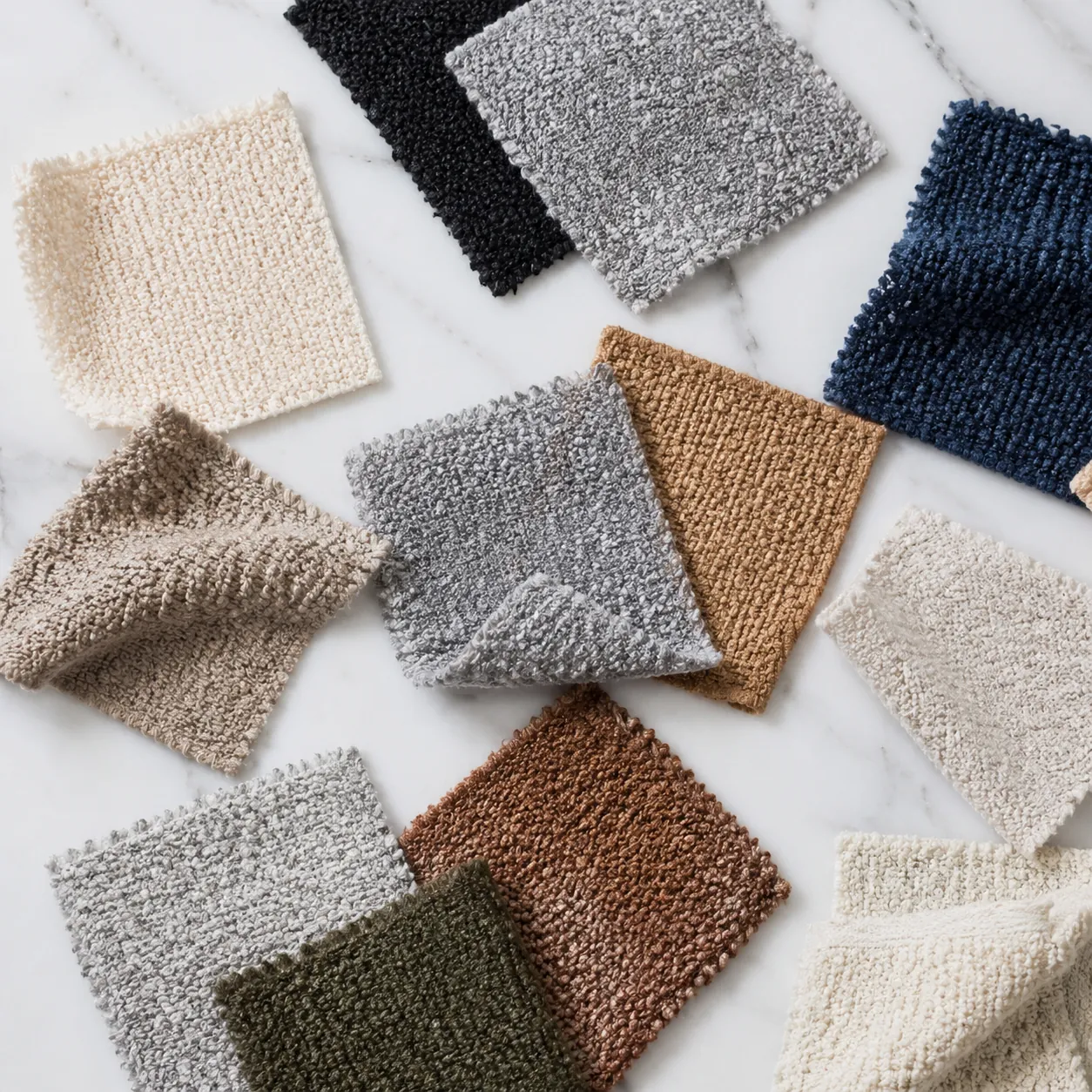
Take the same boucle asked for two ways. Version one: “Please quote your nice cream boucle, around 400 grams, for a jacket program.” The mill assumes a wool-nylon blend at a stock weight, quotes a safe number, and three emails later you are still agreeing on width. Version two: “Boucle, 62% wool / 36% nylon / 2% other, 420 GSM at 150 cm usable, Pantone 12-0605 TCX lab dip to match, anti-pilling finish, sample 20 metres then 800 metres production, FOB Ningbo, colourfastness to AATCC methods, sample in 15 days.” One email, one quotation, one sample round. The second version is not longer because the writer is thorough; it is longer because the twelve fields give every detail a slot.
Die Vorlage dauerhaft verankern
A template only works if it survives the reply-all chaos of a real sourcing inbox. Save it as a form with one field per line, attach it to every new enquiry, and refuse to forward quotes internally until the twelve lines are filled. Teams that enforce this report the same side effect: half the questions they used to ask suppliers get answered by their own form, because writing “weight: measured” forces someone to actually measure. The template also becomes your onboarding document – a new sourcing hire who can fill all twelve fields knows what matters in a fabric specification.
Häufige Fehler, die die Vorlage verhindert
The most expensive mistake is asking for “something like this photo” with no composition. The mill assumes a construction, quotes it, and the sample arrives heavy or limp. The second is skipping test requirements, which surfaces at the buyer’s third-party inspection as a surprise failure. The third is mixing incoterms across quotes, which makes a higher unit price look cheaper once freight lands on your account. Compare quotes on identical terms, and our checklist on Angebote von Lieferanten jenseits des Preises vergleichen zeigt die vollständige Vergleichstabelle.
Wenn Sie eine neue Weberei testen, halten Sie die erste RFQ klein und überprüfbar. Unser dreistufiger Ansatz in sample-first sourcing lässt sich gut mit dieser Vorlage kombinieren, und die Prüfpunkte für Warenmuster finden Sie in worauf man bei einem Stoffmuster achten sollte sagen Ihnen, was beim Eintreffen des Musters zu bewerten ist.
Video: RFQ-Vorlage für Stoffe
Speichern Sie die zwölf Felder als einseitiges Formular und senden Sie es bei jeder neuen Anfrage mit, und Angebots-Turnaround wird ein Prozess statt einer Verhandlung. Fursone betreibt Fancy-Stoffentwicklung aus Wenzhou seit 2020 auf über 300 Webstühlen; senden Sie eine ausgefüllte RFQ an info@fursone.com und wir senden innerhalb von zwei Werktagen ein bepreistes, aufgeschlüsseltes Angebot zurück.
Weiterführende Lektüre: Strickstoff für Athleisure: Worauf Marken achten müssen

Verwandte Einblicke

Ein Musterbuch wie eine Strategie lesen: Lagerware und kundenspezifischen Tweed kombinieren
A fabric wholesaler’s swatch book is not a catalog, it is a sourcing strategy printed...

How Long Does a Custom Fabric Order Take? The 5-Stage Timeline Buyers Can Negotiate
A custom fabric order takes 30 to 60 days from confirmed spec to ex-factory, and...

What Certifications to Ask a Fabric Supplier For
Asking a fabric supplier for certificates is not paperwork ritual; it is how a brand...