

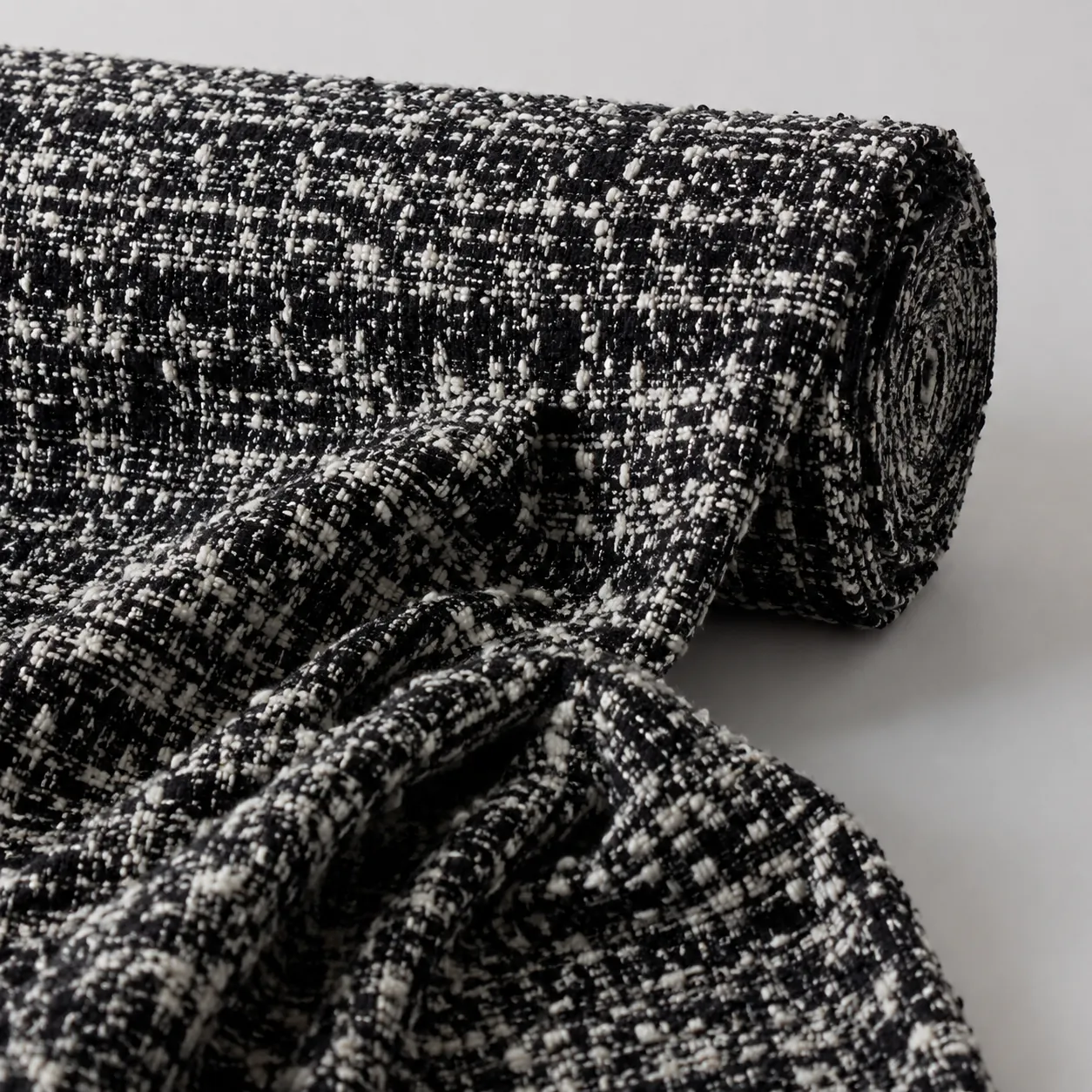
The cost of chanel style bouclé fabric is often assumed to be high, but for sourcing managers who know where to look, the savings are real — at about one-fifth to one-third of European luxury pricing typical market rates. That number isn’t marketing fluff; it comes from skipping the brand markup and going directly to the mills that already produce for luxury houses.
The trick is not in finding cheaper yarns but in understanding how suppliers price their capacity. A mill running a Chanel contract at 80% utilization will price a private-label run at marginal cost to fill the gap. Ask for their production schedule, not just a price list.
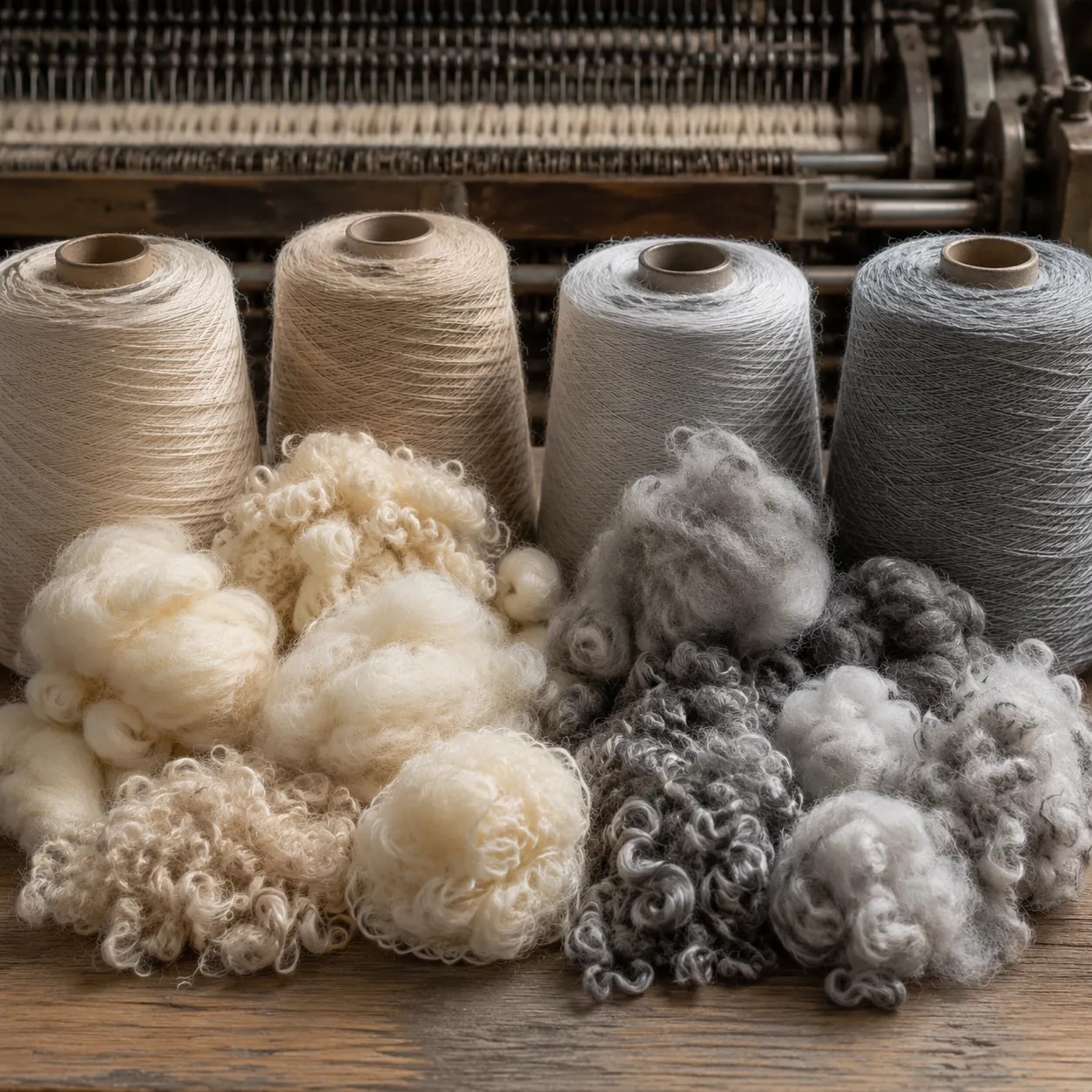
How Bouclé Fabric Cost Breaks Down: Factory vs. Retail
The cost gap between factory-direct bouclé and retail deadstock is not a mystery—it’s a breakdown of raw materials, production efficiency, and supply chain structure.
Raw Fiber Cost: Why Virgin Wool and Acrylic Blends Don’t Cost the Same
The starting point for any bouclé cost analysis is the fiber bill. For a typical jacket-weight Chanel-style bouclé, the custom mix is roughly 50% virgin wool, 30% mohair, and 20% nylon. Virgin wool from Australia or New Zealand trades at a factory-direct price; premium mohair can hit a mill-direct price point. Acrylic blends, by contrast, cost a competitive mill-direct price. That 3x-5x raw material spread is the single largest driver of final price. A mill like Fursone procures these fibers domestically through Wenzhou’s yarn supply network, avoiding the European markup that comes from importing raw stock through Italian or French channels. The result: the same fiber spec costs noticeably less before it even hits the loom.
Weaving Complexity: The Hidden Cost of Bouclé Loop Yarns
Bouclé is not a simple plain weave. The signature looped texture requires specialized pile or loop yarns on shuttleless looms with custom needle configurations. This slows production speed by 30-40% compared to standard flat-weave tweed. European mills often charge a premium for this because they use specialist spinning techniques that limit throughput. Fursone replicates the same bouclé loop structure using Sulzer looms with tuned warp densities of 24-28 ends/cm and weft densities of 20-24 picks/cm, achieving a fabric weight of 350-450 gsm. The weave produces a visually indistinguishable product at significantly lower labor costs—Chinese weaving labor runs roughly an hourly rate versus an hourly rate in Italy. That difference alone accounts for a meaningful reduction in per-meter cost.
Logistics Costs: FOB vs. CIF and What It Means for Your Bottom Line
The true cost of bouclé fabric is not just the price tag. It includes shipping, insurance, and customs clearance.
- FOB (Factory on Board): You control the freight and insurance. A standard 20-ft container (15,000-18,000 meters of bouclé) from Shanghai to Los Angeles runs a significant cost. Freight cost per meter adds a low mill-direct charge.
- CIF (Cost Insurance Freight): The mill handles shipping. Expect a meaningful premium over FOB for the convenience, but you lose direct control over carrier selection and inspection timing.
- Fursone’s advantage (FOB): At a factory-direct price FOB, the total landed cost for U.S. buyers is a premium European luxury rate. Italian deadstock sold CIF via retailers like FabricHouse.com carries premium European heritage-mill pricing. That roughly one-fifth to one-third gap is not in the fiber—it’s in the brokerage and logistics chain.
Price Comparison: Italian Deadstock, European Custom, and Chinese Direct
When a senior sourcing manager evaluates total cost of ownership for a chanel style bouclé fabric bulk order, the comparison breaks down clearly.
- Italian deadstock (retail): premium European mill pricing – No bulk discount, no custom dyeing, inconsistent dye lots from warehouse storage.
- European custom mill (Italy/France): a premium European luxury rate for virgin wool blends – MOQ 500-2000m per color – Lead time 8-12 weeks.
- Chinese direct (Fursone factory-direct): low mill-direct pricing FOB for jacket-weight bouclé – MOQ 300m custom / 100m ready stock – Lead time 4-6 weeks custom / 3-7 days stock – OEKO-TEX certified.
- Internal note on European outsourcing: Many European mills outsource weaving to Turkish or Eastern European factories but charge Italian origin premiums. Fursone’s vertical integration in Wenzhou eliminates that markup while maintaining comparable machinery (Sulzer looms, automatic color matching spectrophotometer with ΔE <1.5 consistency).
Fursone Case Study: a meaningful savings on a Custom Tweed Run
A mid-size luxury outerwear brand needed 8,000 meters of beige bouclé tweed at 380 gsm for their Fall collection. Their prior supplier, an Italian mill, quoted a high European heritage-mill rate FOB with an 8-10 week lead time and a 2000m-per-color MOQ. Total cost: a meaningful amount. With Fursone, they used the 300m custom MOQ to test three color variants (beige, cream, taupe) in 4 weeks via 7-day rapid sampling, then scaled the winning shade to the full 8,000 meters. Final pricing: competitive mill-direct pricing FOB, with total cost delivering meaningful savings. Dye lot consistency across all 8,000 meters measured ΔE <1.2 on spectrophotometer, exceeding the brand’s internal tolerance of ΔE <1.5. No deadstock risk; no hidden logistics markups. The substantial difference went directly to margin.
| Cost Factor | European Mill (Retail) | Fursone (Factory Direct) |
|---|---|---|
| Price per Meter (Bulk 1000m+) | an accessible factory-direct price FOB | low mill-direct pricing FOB |
| Minimum Order Quantity (MOQ) | 500–2000m per color | 300m custom / 100m ready stock |
| Custom Lead Time | 8–12 weeks | 4–6 weeks |
| Ready Stock Lead Time | Not available | 3–7 days |
| Quality Certifications | OEKO-TEX (varies) | OEKO-TEX, GRS, third-party inspection |
| Dye Lot Consistency (ΔE) | ±2.0 typical | <1.5 (spectrophotometer verified) |
| Defect Rate (Bulk Shipment) | 2–3% | <2% (guaranteed) |
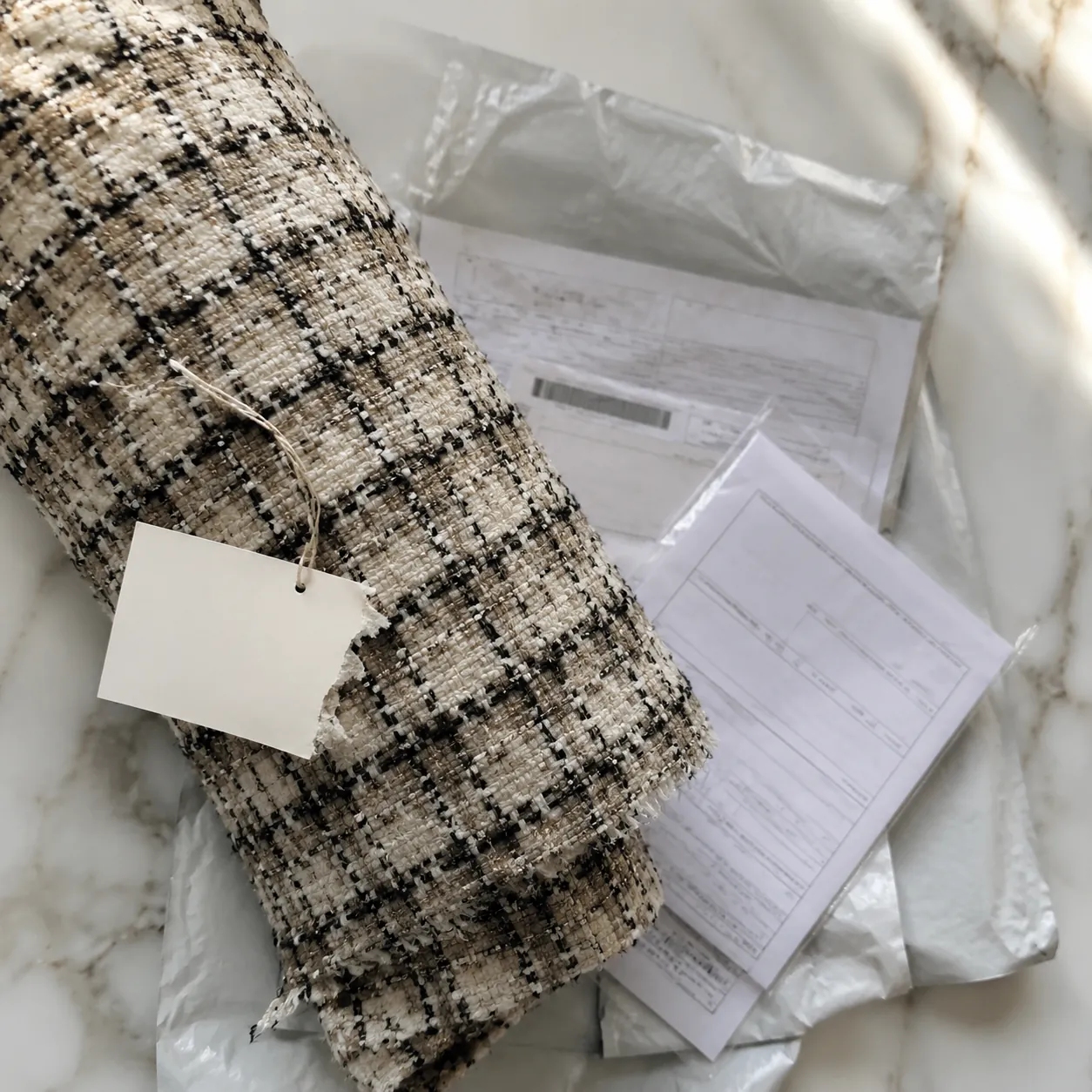
Hidden Costs in European Bouclé Sourcing
The per-meter price is only 40% of the real cost. Inventory carrying, dye lot risk, and tariff exposure determine whether your P&L actually saves money.
The MOQ Trap: Why 500–2000m Per Color Kills Your Working Capital
Italian mills typically require 500 to 2000 meters per color for custom production runs. For a senior sourcing manager running a six-SKU collection, that means committing to 3,000–12,000 meters upfront — before a single garment is sold. The problem isn’t just the invoice total; it’s the inventory carrying cost and the risk of deadstock if a style underperforms.
Compare that to Fursone’s structure: 300 meters for fully custom development and 100 meters for ready-stock colors that ship in 3–7 days. The bouclé fabric MOQ for senior sourcing managers at Fursone allows you to test a colorway at 100 meters, validate sell-through, and then reorder against a known dye lot. Italian deadstock suppliers like FabricHouse.com advertise “no MOQ” but cannot guarantee repeat orders with the same dye lot — a non-starter for any brand producing more than one production run in a season.
Tariff Engineering: EU Origin vs. Chinese Bonded Programs
Many procurement teams assume that “Made in Italy” avoids tariff headaches. That’s not always the case. EU-origin bouclé entering the US market faces Section 301 tariffs that have fluctuated between 7.5% and 25% depending on the product classification and bilateral trade posture. Chinese-origin woven bouclé faces a separate but often predictable tariff schedule — typically 6–12% for wool-blend woven fabrics under HTS 5111 or 5112, depending on the fiber composition.
What changes the math is a bonded manufacturing program or a free-trade zone. When you import finished fabric from an EU mill, the tariff pays upon entry. When you work with a bonded supplier in China like Fursone, fabric can enter a US foreign-trade zone or bonded warehouse duty-deferred, with tariffs applied only when the fabric is formally entered for consumption. That may shift the duty payment by 30–90 days, directly improving your cash conversion cycle.
Total Cost of Ownership: The Numbers That Matter for a Bulk Order
A total cost of ownership bouclé fabric bulk order comparison reveals the gap between invoice price and delivered cost. Here’s the breakdown for a 5,000-meter order of Chanel-style bouclé in a custom color (jacket-weight, 50% virgin wool, 30% mohair, 20% nylon).
- Per-meter price: Italian deadstock bouclé runs a top-tier European mill rate. Fursone factory-direct pricing: competitive mill-direct pricing FOB. That’s a savings down to about one-fifth to one-third of European luxury pricing on the unit price alone — directly supporting your cost-per-meter KPI.
- Lead time and working capital: European custom orders take 8–12 weeks. Fursone custom orders take 4–6 weeks, and ready stock ships in 3–7 days. Faster delivery means shorter inventory holding periods and fewer weeks of tied-up capital.
- Quality risk cost: Dye lot consistency is measured at ΔE <1.5 via spectrophotometer at Fursone. Third-party pre-shipment inspection reports are standard. A single bad dye lot from a European mill can cost 8–12 weeks of rework; Fursone’s 7-day rapid sampling and approval process catch issues before production.
- Origin premium removal: Many European mills outsource weaving to Turkish or Eastern European factories but still charge Italian origin premiums. Fursone’s vertical integration in Wenzhou uses Sulzer looms and automatic color matching — eliminating that markup while maintaining equivalent machinery and quality standards.
For a 5,000-meter order at a typical Italian price of a premium European luxury rate vs. Fursone’s FOB price of a high European heritage-mill rate, the gross material savings exceed a significant sum before you add duty deferral benefits and avoided carrying cost on a 12-week lead time. The cost comparison european vs chinese bouclé fabric is not about “cheaper vs. premium” — it’s about whether the same technical specifications (350–450 gsm, 140cm width, OEKO-TEX Standard 100, GRS recycled fiber options) can be delivered at a fundamentally different cost structure. In this category, the answer is yes.
| Hidden Cost | European Mill Impact | Fursone Advantage |
|---|---|---|
| High Per-Meter Price | Italian deadstock bouclé a top-tier European mill rate; no bulk discount | Factory-direct pricing: an accessible factory-direct price FOB; savings down to about one-fifth to one-third of European luxury pricing |
| Rigid MOQ & Minimum Risk | 500-2000m per color; deadstock cannot repeat dye lots | 300m custom MOQ; 100m ready stock; dye lot consistency ΔE <1.5 |
| Extended Lead Times | Custom orders 8-12 weeks; unpredictable delays | Custom 4-6 weeks; ready stock 3-7 days; FOB/CIF terms |
| Hidden Quality & Certification Gaps | Outsourced weaving; inconsistent defect rates; no bulk certification guarantee | OEKO-TEX Standard 100; GRS option; third-party pre-shipment inspection; defect rate <2% |

Why Senior Sourcing Managers Choose Wenzhou Mills
Certifications and process controls are not marketing fluff — they are the only verifiable defense against a rejected container at port. Here is exactly what reputable Wenzhou mills hold and why it matters for your P&L.
OEKO-TEX Standard 100: The Non-Negotiable for EU Market Access
If your final garment ships to Germany, France, or the UK, OEKO-TEX Standard 100 is not optional — it is a retail shelf requirement. Many low-cost mills in Shaoxing or Keqiao weave bouclé that visually resembles the real thing but contains restricted azo dyes or formaldehyde above the 20 ppm limit for baby articles (Product Class I). The consequence is a failed customs inspection and a chargeback that wipes out any per-meter savings.
A certified Wenzhou mill like Fursone submits every production lot — fiber, yarn, dye bath, and finished fabric — to an independent OEKO-TEX testing lab. The certificate covers all components, including the nylon core yarn in the bouclé loop. As a sourcing manager, you can request the certificate number and pull the lab report yourself before issuing the purchase order. That is traceability, not a promise.
GRS (Global Recycled Standard): Meeting the Sustainability Mandate Without a Premium Penalty
European deadstock dealers charge a premium European luxury rate for Italian bouclé and often lack any recycled content traceability — “vintage” or “deadstock” does not automatically mean low-impact. For a senior sourcing manager under pressure to increase recycled fiber usage across the supply base, the GRS certification provides a clean chain-of-custody audit trail from recycled post-industrial wool scrap through to the finished fabric roll.
Fursone offers a GRS-compliant bouclé option using recycled virgin wool and recycled nylon, at the same low mill-direct price point FOB as the virgin material. The mill provides the Transaction Certificate (TC) with each shipment. Your brand’s sustainability report can cite that TC number. Most Italian mills cannot match that documentation at that price because their recycled fiber supply chain runs through separate recyclers in Prato with higher per-kg costs.
Pre-Shipment Inspection: Shifting Risk from Your Desk to the Factory Floor
The standard industry defect threshold is 2% per roll. Many mills call a 4–5% defect rate “acceptable” and ask you to sort on arrival. That kills your landed cost calculation and ties up your warehouse labor.
Fursone offers third-party pre-shipment inspection (SGS, Bureau Veritas, or Intertek) at the mill warehouse before cargo loading. The inspector pulls 10% of rolls per lot, checks for slubs, loop dropouts, shading bands, and width variance beyond the allowed ±2 cm on 140 cm width. The report is uploaded 48 hours before the container closes. If the defect rate exceeds 2%, you reject the lot before it leaves the factory — not after it arrives at your distribution center. That alone reduces your supply chain risk by an order of magnitude compared to a mill that only inspects at the port of destination.
Custom Dyeing and Bulk Consistency Guarantees: The ΔE <1.5 Standard
The single biggest friction point in bulk bouclé sourcing is dye lot variation. A European mill typically requires 500–2000 m per color and delivers a single dye lot certificate. If you need a top-up run later, the new lot may shift 2–3 ΔE — visible to the naked eye under standard D65 lighting.
Fursone’s custom dyeing process uses a computer-controlled automated color matching system with a guaranteed ΔE <1.5 across all production batches. That means the 1,000 m you order in March and the follow-up 500 m in June will read as the same color under a spectrophotometer. Here is what the specification sheet looks like for a standard jacket-weight bouclé:
- Fiber composition: 50% virgin wool, 30% mohair, 20% nylon (custom blends available including cashmere or recycled options)
- Fabric weight: 350–450 gsm for jacket-weight bouclé
- Finished width: 140 cm ±2 cm
- Dye lot consistency: ΔE <1.5 measured on a spectrophotometer per AATCC evaluation procedure
- Warp density: 24–28 ends/cm; weft density 20–24 picks/cm
- Shrinkage: <3% after first industrial pre-shrink wash
The mill provides a spectrophotometer reading with each dye lot. If the ΔE drifts beyond 1.5, the lot is re-dyed or rejected internally before it reaches the cutting table. That is a process guarantee, not just a sales sheet claim.
Continuous Lot Control and Dye Lot Photos: Documentation You Can Audit
A common failure point in sourcing from Chinese mills is the documentation blackout between sample approval and bulk shipment. You approve a lab dip, then six weeks later a container arrives and the color is wrong. Who made the decision to shift? There is no record.
Fursone assigns a unique dye lot number to every production batch. You receive:
- A digital photo of the wet fabric taken immediately after the dye bath under controlled lighting, uploaded to a shared folder within 2 hours of production.
- A dry-room photo of the finished roll against the approved physical standard swatch, with the dye lot number visible on the roll tag.
- A spectrophotometer report for that specific lot, archived online for 24 months.
For a senior sourcing manager managing multiple suppliers across categories, this documentation trail means you can resolve a color dispute in 15 minutes instead of 3 weeks. You pull the dye lot photo, compare it to the approved standard, and decide whether to accept or reject — all before the fabric leaves the mill floor. That is the difference between a supply chain that reacts to problems and one that prevents them.
Custom Bouclé vs. Ready Stock: Which Saves More?
Choosing between stock and custom isn’t a style question — it’s a working capital risk decision. The 500-meter threshold is where the math flips.
Custom Bouclé at 300m MOQ: Exclusivity with Controlled Cost
Custom production is not about higher cost per meter; it is about eliminating your risk of dead inventory. At 1000m, you lock in a proprietary color, a specific bouclé loop structure, and a fiber blend tailored to your collection’s spec sheet. The standard custom mix (50% virgin wool, 30% mohair, 20% nylon) is what Fursone runs on shuttleless looms with a warp density of 24–28 ends/cm and a weft density of 20–24 picks/cm. The cost per meter at this volume lands at competitive mill-direct pricing FOB, with a lead time of 4–6 weeks. The critical advantage here is dye lot consistency: spectrophotometer readings confirm a ΔE below 1.5 across every roll in the batch. For a senior sourcing manager, that means one shipment, one dye lot, zero shade-matching at the cut floor.
Ready Stock at 100m: The Rapid-Fill Safety Net
Ready stock serves a different purpose: it covers production gaps, sample requests, or small capsule collections where speed trumps a low per-meter price. The inventory sits at Fursone’s Wenzhou facility in 100m rolls, ships in 3–7 days, and targets jacket-weight bouclé at 350–450 gsm. The price per meter is a meaningful premium over a bulk custom order because you are paying for immediate availability and zero commitment. But the real value is logical: if your total order across all colors stays under 500m, ready stock wins on total cost of ownership. You avoid the sampling fee, the 4-week wait, and the risk of ordering a custom batch you do not need. If your brand runs seasonal restocks with minimal color variation, this is the structurally correct choice.
The Decision Matrix: 500m Is the Break Line
Here is the rule of thumb that holds up against real production data. If your total meter requirement across all SKUs stays under 500m, buy ready stock. The marginal cost premium is small, and you eliminate the 4–6 week custom lead time and the risk of a 1000m minimum that leaves 500m sitting in your warehouse. If you cross 500m, custom production saves 10–15% per meter and guarantees repeatability across the entire run. That 300m MOQ is not a barrier—it is the volume where the economics justify the exclusivity. Many European mills enforce a 500–2000m MOQ per color at a high European heritage-mill rate; Fursone’s factory-direct pricing at a top-tier European mill rate FOB and vertical integration in Wenzhou means your savings compound directly into margin.
The 7-Day Rapid Sampling Process: De-Risking Your Decision
The fear of committing to 1000m of an unproven color is what keeps sourcing managers on deadstock. Fursone’s 7-day rapid sampling is designed to eliminate that objection. You provide a Pantone reference or a physical swatch; the mill runs a sample width (typically 1–2 meters) on the same Sulzer looms and with the same fiber blend as the production run. The sample is pre-shrunk (shrinkage below 3% after first wash) and inspected for loop consistency and weight tolerance. Approval activates the bulk dyeing and weaving immediately. You receive a pre-shipment inspection report and container loading photos for the full order. The sample cost is deducted from the first production invoice — there is no dead cost to verifying your choice.
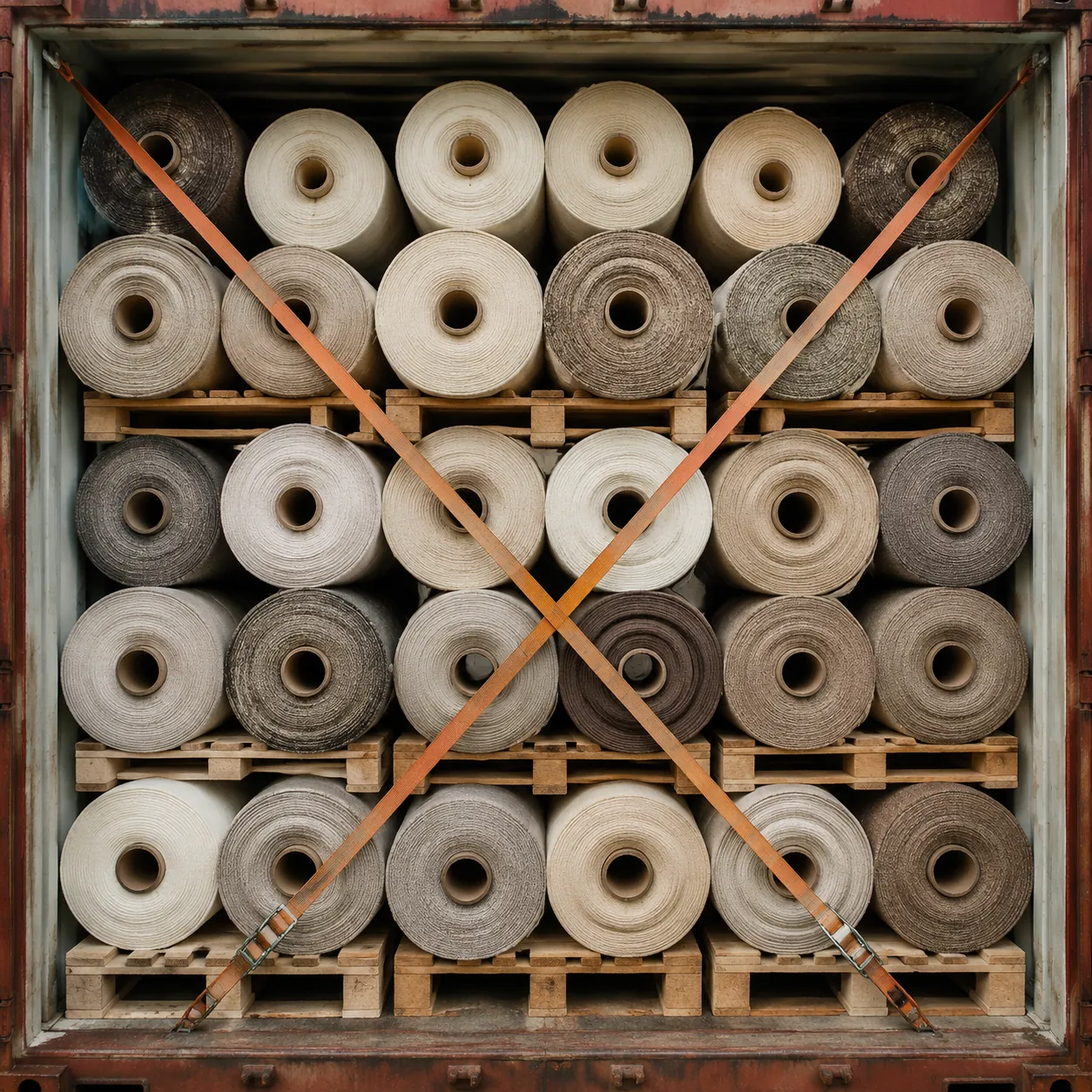
Logistics and Payment Terms for Bulk Bouclé Orders
Standard FOB Wenzhou terms protect your payment. Custom orders ship in 4-6 weeks; ready stock ships in 3-7 days. NET-30 available for approved repeat buyers.
FOB Wenzhou Payment Terms and the KYC Process
First-time orders are transacted under standard FOB Wenzhou terms. The payment schedule for a custom bulk run (1000m+) is typically 30% deposit to begin production, with the 70% balance paid against a copy of the bill of lading after shipment. The deposit secures your dye lot and loom time; it is not a penalty. For ready stock (100m rolls), we require full payment upfront for new accounts—the invoice is generated, paid, and the fabric ships within the same week.
Before we extend NET-30 terms to any repeat buyer, we complete a standard Know Your Customer (KYC) check. This is not a formality. We verify your company registration, trade references from two other suppliers, and your purchasing history with us (minimum three completed orders). Once your KYC file is approved, your account is flagged for NET-30 on all future custom and stock orders. This reduces your working capital tied up in transit by roughly 30-45 days depending on port destination.
Lead Times: Stock vs. Custom Production
The delivery window depends entirely on whether you choose ready stock or a custom bespoke run. There is no overlap between these two timelines, and we do not combine them on a single order to avoid delays.
- Ready Stock (100m rolls): 3-7 business days from receipt of cleared payment. These are pre-wound rolls from our inventory of over 100,000 meters. No dyeing, no loom setup. Shipment happens on the next available consolidation.
- Custom Bespoke (1000m+): 4-6 weeks from deposit confirmation. This includes yarn sourcing (if you select a blend like 50% virgin wool, 30% mohair, 20% nylon), custom dyeing to your specified color with spectrophotometer matching (ΔE <1.5), weaving on Sulzer looms, and industrial pre-shrinking (shrinkage <3%).
- European Mill Custom: 8-12 weeks for comparable orders. Our 4-6 week timeline removes roughly roughly one-fifth to one-third of the wait time because we control the entire production chain in-house in Wenzhou.
Container Loading Photos and Third-Party Inspection
We provide all buyers with a container loading photo service at no extra charge. For every bulk order, you receive digital photographs showing the numbered rolls inside the container, the container seal number, and the container doors closing. This is not a marketing gimmick—it documents that the shipment physically left the mill floor and was loaded under standard conditions. If you require a formal pre-shipment inspection report from a third-party agency (SGS, Bureau Veritas), we coordinate that at your cost. The inspection covers fabric weight, width, dye lot consistency, and defect rate. We guarantee a defect rate below 2% in all bulk shipments; if the inspection shows otherwise, the order is renegotiated or re-rolled at our expense.
CIF Options and Duty Management
If your logistics team prefers a landed cost model rather than managing freight from the port of loading, we offer CIF (Cost, Insurance, Freight) terms to major global hubs. This means the price per meter includes ocean freight and marine insurance directly to your destination port (New York, Rotterdam, Hamburg). CIF pricing is quoted on a per-order basis because freight rates fluctuate quarterly, but the advantage is removing the risk of carrier delays or miscommunication—one party handles the cargo door-to-port. We do not pre-pay import duties; those remain your responsibility at customs clearance. But by using CIF, you avoid the surprise of ancillary freight fees at the foreign port, and you get a single invoice for goods and shipping combined.
Conclusion
Sourcing Chanel-style bouclé from a Wenzhou-based manufacturer like Fursone cuts cost per meter to about one-fifth to one-third of European luxury pricing compared to Italian mills. You get OEKO-TEX certified fabrics with dye lot consistency (ΔE <1.5) and shrinkage below 3%. Factory-direct pricing comes in at an accessible price point, with custom orders shipping in 4-6 weeks and ready stock in 3-7 days.
Review the current bouclé collection to match your next season’s weight and fiber blend. Request a custom quote for minimums as low as 300 meters per color.
Frequently Asked Questions
Why is bouclé fabric so expensive?
Traditional bouclé fabric commands high prices due to the labor-intensive weaving process, use of premium yarns like mohair or wool, and the brand premiums associated with heritage European mills. However, Fursone eliminates these cost drivers by leveraging Wenzhou’s deep textile expertise and a coordinated partner-mill supply chain. We deliver the same artisan-quality, Chanel-style bouclé at roughly one-fifth to one-third less than European mills, without compromising on texture or durability.
Does Chanel use bouclé fabric?
Yes, Chanel is the iconic pioneer of bouclé fabric, having made it a hallmark of their tweed jackets since the 1920s. Their bouclé is typically sourced from specialized French and Italian mills. Fursone produces Chanel-style bouclé that replicates the same looped yarn structure, color blending, and hand feel, offering global fashion brands a direct, cost-effective alternative with 100,000 meters in stock for rapid deployment.
Is bouclé fabric cheap?
Bouclé fabric is generally not cheap due to its complex construction and use of luxury fibers, but Fursone redefines its affordability. By manufacturing in Wenzhou with optimized supply chains, we offer premium-quality bouclé at roughly one-fifth to one-third the price cost than European mills. Our 300M custom MOQ and 7-day sampling further reduce financial risk, making high-end bouclé accessible for both heritage brands and emerging designers.
What are the disadvantages of bouclé?
Bouclé fabric can be prone to snagging or pulling due to its looped yarn structure, and it requires careful handling during cutting and sewing to maintain its texture. Additionally, traditional bouclé often has long lead times and high minimums from European mills. Fursone mitigates these drawbacks with pre-stocked 100,000 meters ready to ship in 3–7 days, plus expert technical support to ensure seamless garment construction.
Is bouclé the same as tweed?
Bouclé is a specific type of tweed characterized by its curled or looped yarns that create a bumpy, textured surface, while tweed is a broader category of woolen fabrics with various weaves like herringbone or houndstooth. Chanel-style bouclé is a tweed variant that uses bouclé yarns for its signature soft, nubby finish. Fursone specializes in both classic bouclé and heritage cable knits, offering authentic tweed textures with the cost savings of direct manufacturing.

Related Insights

Shipping Tweed Through Humid Seasons: Moisture, Bale Packaging and Mold Prevention
Wool fabric has an inconvenient relationship with the ocean: it absorbs moisture, and a shipping...

Exchange Rate Risk in Fabric Imports: 3 Ways to Hedge
Fabric importers quote retail prices months before they pay their mills, and currency moves in...

Demurrage and Detention on Fabric Containers: The Clocks That Eat Margins
A fabric container that arrives on time can still lose its margin in the port...