
The fastest-growing piece of many tweed programs is not the jacket. It is the 40-dollar piece beside it: caps, headbands, crossbody bags, hair bows, dog collars, key fobs. Accessories carry the fabric’s brand language at impulse price points, they turn cutting-room offcuts into sellable inventory, and they give buyers a low-risk way to test a new tweed before committing jacket yardage. For mills, accessory programs are small per SKU but strategically outsized: they are the entry point through which a brand discovers the fabric it will later buy by the thousand meters.
We produce accessory-panel quantities alongside our garment programs on the same Chanel-style tweed floor, and the sourcing logic differs from garment cloth in ways worth spelling out before a brand’s first accessories order.
Why accessories make commercial sense for fabric buyers
Three economics drive the category. Yardage: a flat cap consumes 0.2 to 0.3 meters, a crossbody bag 0.4 to 0.6 meters, a headband under 0.1 meters, so a 50-meter accessory program tests a tweed at a fraction of jacket commitment. Margin structure: accessory retail prices anchor to the category, not to fabric content, so a 0.3-meter panel inside a 45-dollar cap earns back several times its fabric cost. Program cohesion: the tweed that matches the jacket line sells the line twice, once on the person and once at the register, the texture-led merchandising logic behind our quiet luxury analysis. For designers planning a capsule, accessories fill the price ladder between 30 and 90 dollars that a fabric-first brand otherwise leaves empty.
| Accessory | Fabric per unit | Stabilization needed | Typical program size |
|---|---|---|---|
| Flat cap / beret | 0.2-0.3 m | Fusible buckram crown | 300-1,000 pcs |
| Crossbody bag | 0.4-0.6 m | Interlining + lining | 300-800 pcs |
| Headband / bow | under 0.1 m | Wire or stiff interlining | 500-2,000 pcs |
| Key fob / strap | under 0.1 m | Edge seal + hardware | 1,000-3,000 pcs |
| Dog collar / leash | 0.1-0.2 m | Webbing core | 500-1,500 pcs |
Fabric selection: same cloth, different physics
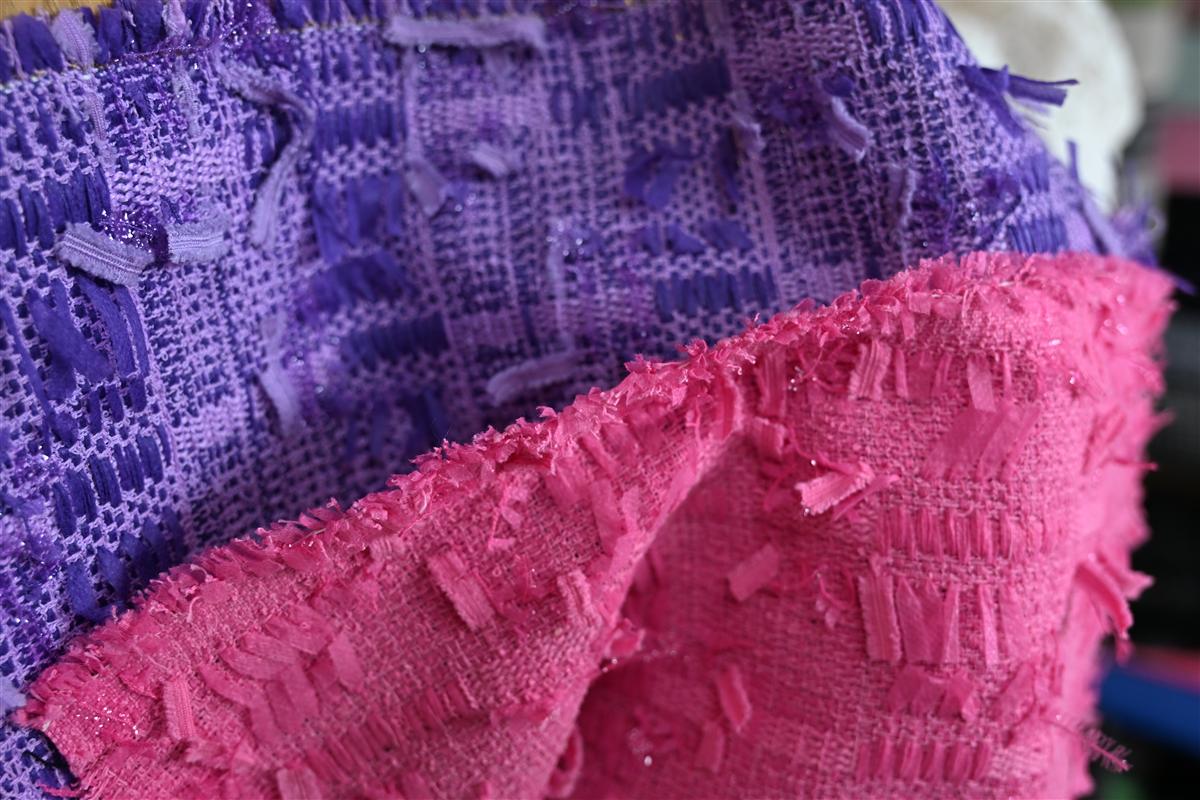
Accessory use changes what the fabric must survive. Abrasion moves to the top of the spec: a bag panel rubs against jacket sleeves and table edges daily, so weave density and ply quality matter more than drape, and the pilling discipline described in our pilling grades guide should target the top grades for bag-grade cloth. Structure replaces tailoring: caps and bags stabilize the tweed with fusible interlinings or buckram, which means the cloth needs clean fusibility (no strike-through on open-weave boucle) rather than shaping memory. Fraying becomes a design parameter instead of a problem to hide: cut edges on small panels show, so accessory makers either line everything, bind edges in grosgrain, or seal selvedges; our production notes on boucle fray control apply directly to panel work.
Metallic threads and sequins, common in Chanel-style constructions, read beautifully on accessories but need honest wear labeling: sequin panels on a crossbody that rides against denim will shed sparkle within a season. The buyer’s spec should state the wear expectation, and the manufacturer should confirm the construction (sequin density, stitch density around sequin lines) that meets it.
The offcut economy: making waste sell
Garment programs leave cutting loss along every marker, and accessory programs convert it. A jacket program cutting 500 meters of tweed generates on the order of 10 to 15 percent offcut yield depending on marker efficiency; routed into caps and bows, that yield becomes sellable units rather than waste weight. Two practical structures exist. Brand-owned: the factory ships offcuts with the bulk, and the brand’s accessory maker cuts them, which keeps full control but adds a logistics step. Mill-coordinated: the accessory panels are cut on the same floor as the bulk, from the same dye lot, with quantity credited against the order; this is the structure behind our own panel quotations and it eliminates the lot-matching question entirely, since the accessory cloth is the jacket cloth. The reuse logic also carries sustainability weight that brands can state precisely, following the claims discipline of the standards tracked by Textile Exchange, rather than vague zero-waste language.

How to order a first accessory program
Keep the first order boring and reversible. Choose one fabric already in the line, one or two accessory SKUs, and a quantity sized to the smaller of the two risks: market test or minimums. On our floor accessory panels quote from the same 300-metre custom minimum as garment cloth, which is why the offcut-coordinated structure often wins for a first program: the brand is already buying the cloth, and the accessory cut rides on it. Sampling runs on the 7-day flow, with construction confirmed on a physical sample before panel cutting. Yardage math for the accessory list follows the same per-unit method described in our collection yardage guide, scaled down to panel dimensions.
Stock-supported tweeds ship accessory quantities without MOQ from the 100,000-meter floor, and custom colors key to the garment program’s dye lot so cap and jacket match under store lighting. Inquiries reach the sales desk within one working day, and the yardage check on any accessory list is a service the quoting team runs before prices are issued.
Video: one fabric, two lifecycles
The clip follows material stewardship through our supply chain. Offcut-to-accessory programs are the same idea at program scale: one dye lot, two sellable lifecycles.
Frequently asked questions
How much tweed does a cap or bag actually need?
A flat cap consumes 0.2 to 0.3 meters, a crossbody bag 0.4 to 0.6 meters, and small goods like bows or key fobs under 0.1 meters per unit, which is why accessories stretch a fabric budget so far.
Can accessory panels match my jacket dye lot?
Yes when panels are cut from the same dye lot as the bulk garment cloth, ideally on the same floor. Mill-coordinated offcut programs guarantee the match; separate accessory orders should specify lot matching in the PO.
Which tweed constructions work best for bags?
Denser weaves with plied yarn and top-grade pilling resistance. Open boucle with heavy sequin content reads well but needs honest wear labeling and reinforced stabilization for daily-rub surfaces.
What is the minimum for a first accessories program?
Most first programs run 300 to 1,000 pieces per SKU. If the cloth is already ordered for garments, coordinated offcut cutting can start below those numbers because the fabric commitment already exists.
See also our recycled vs virgin wool tweed compared.

Related Insights

Tweed and Boucle for Spring 2026: Lighter Weights and Softer Palettes
Tweed’s migration out of the winter wardrobe is now a settled pattern: buyers who once...

Building a Fall Capsule Around One Tweed: The Six-Piece Math
Small fashion brands do not lose money on tweed because they picked the wrong color....

Bridal Tweed: White and Metallic Boucle for 2027
White and metallic boucle is the bridal fabric trend for 2027: looped texture, light-catching metallic...