
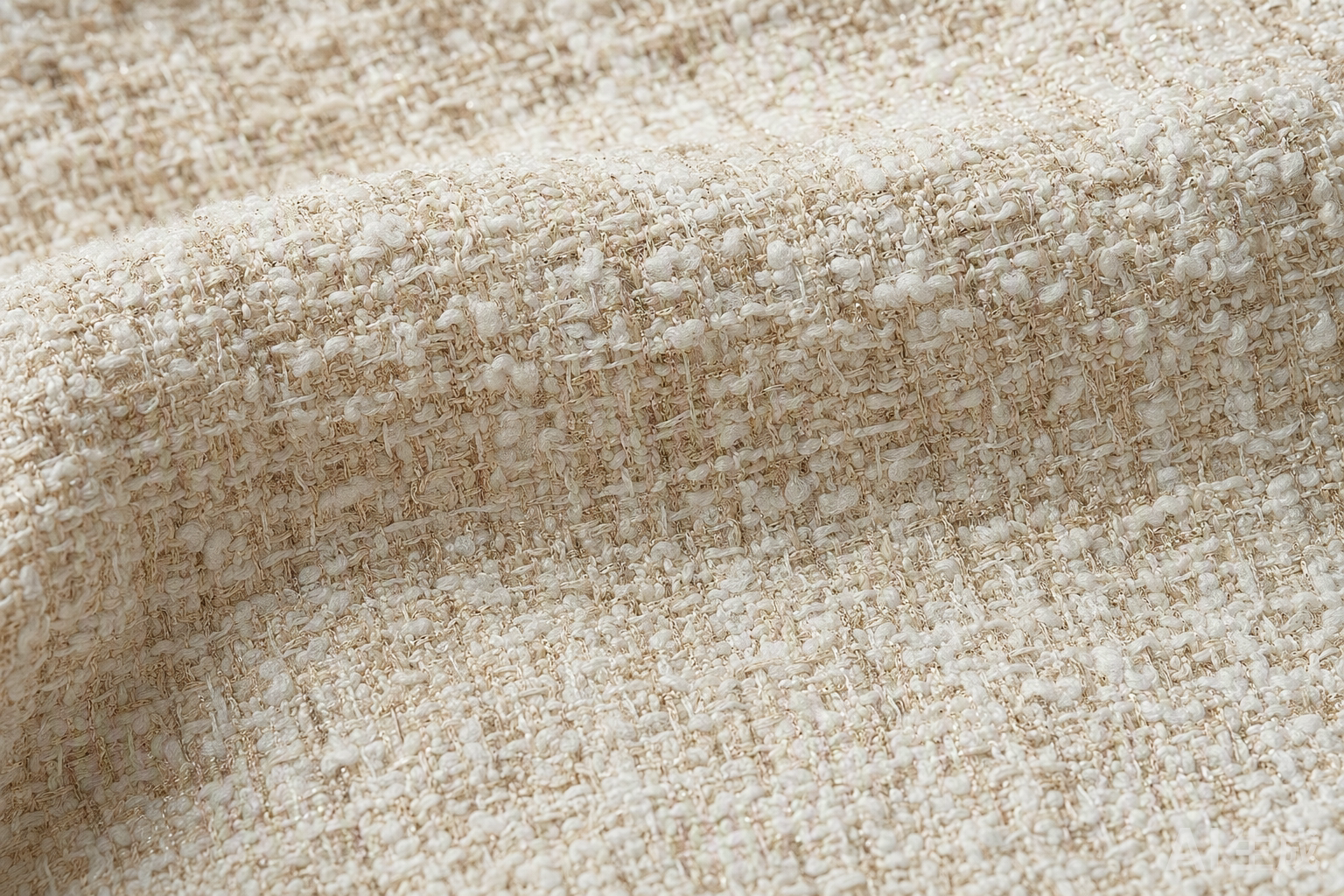
A tweed blend mixes wool with polyamide, acrylic, or both to balance cost, durability, and hand feel in one fabric. Wool brings resilience and warmth; polyamide adds tensile strength and abrasion resistance; acrylic contributes bulk, softness, and color brightness at a lower price point.
The blend ratio is a design decision with measurable consequences, and this guide explains what each fiber actually contributes. We produce tweed blends across 300+ looms at our partner mills in Wenzhou, and the questions below are the ones buyers ask most before ordering.

Wool: the structural and sensory backbone
Wool is why tweed behaves like tweed. The fiber’s natural crimp gives the finished cloth recovery and loft, its scaly surface helps fibers lock during milling for a denser hand, and its moisture management keeps garments comfortable across temperature swings. Wool also takes dye in the muted, heathered way that defines classic tweed color character. The trade is cost and care: wool content raises raw material price and demands gentler finishing. Fiber-level quality varies considerably by breed and preparation, which is one reason the International Wool Textile Organisation maintains measurement standards that mills and buyers both use to keep wool grading comparable across origins. In our own lines, wool-heavy blends are the default for suiting and overcoat weights where drape and recovery do the selling.
Polyamide: the strength engineer
Polyamide, sold under names like nylon, is the durability fiber. It carries exceptional tensile strength and abrasion resistance, so a 10 to 20 percent polyamide share measurably extends the service life of high-wear zones, elbows, cuffs, seat panels, in a tweed garment. It also stabilizes the fabric dimensionally, reducing the bagging-out that pure wool can show after repeated wear. The costs are subtler: polyamide takes acid dyes differently from wool, so shade matching across the blend needs mill discipline, and high synthetic shares can shift the hand toward a slicker, less wool-like feel. For upholstery-grade tweed and workwear-adjacent applications the strength argument wins; for luxury tailoring it stays a minority component.
Acrylic: bulk, softness, and price relief
Acrylic is the wool-look workhorse: it spins into soft, bulky yarns, takes bright colors well, resists sunlight degradation better than wool, and costs materially less. In tweed blends it typically appears at 20 to 50 percent to pull the meter price down while keeping the visual wool character. The trade is performance: acrylic pills more readily than wool under friction and has weaker recovery, so garments can lose shape faster. Pilling behavior is testable and specifiable, anti-pilling grades exist, and our Chanel-style tweed lines run at ISO grade 3-4 pilling resistance as the baseline acceptance level. If a quote looks dramatically cheaper than comparable wool-rich tweed, the acrylic share is usually the explanation, and the pilling test report is the document to request.
Reading blend ratios: what the numbers buy you
| Typical ratio | Character | Best application |
|---|---|---|
| 80-100% wool | Full recovery, premium hand, heathered depth | Tailored suiting, premium overcoats |
| Wool 60-75% / polyamide 15-25% | Added abrasion life, stable dimensions | Outerwear, high-wear garment zones |
| Wool 40-60% / acrylic 30-50% | Soft hand, lower price, bright shades | Fashion jackets, accessible collections |
| Wool 30-40% / polyamide+acrylic balance | Cost-driven, decent wool look | Volume lines, upholstery-grade uses |
These are direction bands, not fixed recipes; weave structure and finishing move the outcome as much as the ratio does. Two fabrics with identical blend ratios can feel completely different if one is heavily milled and the other is left open and dry, so always judge ratio and construction together. If you need to verify what a delivered roll actually contains, fiber identification by burn test and microscopy is a fast check we documented in our wool vs polyester identification guide, and the composition-versus-price logic goes deeper in our wool vs synthetic composition guide.
Cost and sourcing implications for buyers
Blend choice is ultimately a margin decision. Every 10 points of wool replaced with acrylic moves the meter price down noticeably while shifting pilling and recovery risk onto the garment’s second season; polyamide substitution protects lifespan but complicates shade control. Our structure supports both directions: ready-stock blends from our 100M-meter inventory ship within days with no minimum, and custom blend development runs from a 300-metre MOQ with a 7-day sampling cycle, so brands can test hand feel and performance before committing bulk. If you want to see where blend engineering lands in a finished couture-look fabric, our Chanel-style tweed collection shows the looped, multi-yarn construction at production scale. Compare construction-to-construction with our tweed vs flannel comparison if weight-class questions are part of the same decision, and request a physical swatch of any blend you evaluate. The swatch tells you what the spec sheet cannot: whether the hand still feels like the product your customer imagines.
One closing sourcing note: ask every mill how it controls shade across blended fibers before you place a repeat order. Wool and synthetics absorb dye differently, and the mills that hold color across lots are the ones running disciplined lab-dip approval and lot-card tracking, not the ones quoting fastest. Repeatable shade is the difference between a blend that scales and a blend that surprises you at the cutting table.
Frequently asked questions
What does polyamide add to a tweed blend?
Tensile strength, abrasion resistance, and dimensional stability. A 10-20 percent share extends garment life in high-wear zones; higher shares start to change the hand away from a wool character.
Why do tweed blends contain acrylic?
Acrylic lowers cost while keeping a wool-like look, adding bulk, softness, and brightness. The trade is higher pilling tendency and weaker recovery, so request a pilling test report for acrylic-heavy blends.
Which blend ratio is best for tailored jackets?
Wool-dominated blends, 80 percent and above, give the recovery and drape tailoring demands. Add polyamide rather than acrylic if durability is the concern.
How do I verify a blend claim on delivered fabric?
Request the composition test report with the roll, and spot-check with burn test or microscopy. Composition drift between sample and bulk is a real risk worth inspecting for.
For how the order side connects to the numbers on your invoice, see the payment terms guide for Chinese fabric mills.
For the construction differences behind metallic knits, from film ribbon to spun metal blends, see how metallic yarn families differ in knits.
Learn more: Tweed Fabric Guide · Explore Chanel-Style Tweed. Need samples? Request free swatches.
Related reading: Fiber Content Labels for Tweed and Knit: Reading Composition Percentages Right
Related Insights
Skew and Bow in Woven Fabric: Measuring Before You Cut Plaid and Tweed
A solid grey tweed can hide almost anything. The same mill, the same loom and...

Boucle and Tweed for Dresses: GSM and Drape Selection
Tweed and boucle on a dress form behave differently than on a jacket stand, and...

Boucle Pilling vs Snagging: Different Defects, Different Fixes
A boucle jacket comes back from a fitting with two problems on the same sleeve:...