Rapid fabric sampling is the difference between hitting a seasonal launch window and watching your margin evaporate on air freight. For a production manager, the math is simple: every day the sample cycle drags, the production calendar tightens. Most mills quote 15 to 20 working days for a strike-off. That timeline assumes the yarn is in stock, the loom is free, and nobody asks for a revision. In practice, those conditions rarely align.
The 7-day sampling model exists because a handful of mills re-engineered their workflow around speed. They keep greige goods on the floor, pre-qualify dye recipes against Pantone references, and run sample lots on dedicated narrow-width looms instead of interrupting the main production line. The result is a sample that arrives in one week, not three. The trade-off is a shorter list of available constructions and a premium per yard. For a 50-meter sample order, that premium is negligible. The cost of missing a drop-ship deadline is not.
Lead Time Reduction
The fastest path from concept to bulk is not a single speed—it requires two distinct workflows: ready-stock for immediate needs and custom sampling for exclusivity. Most mills force you to choose one. The real advantage is having both.
7-Day Swatches: From Concept to Physical Sample
The standard industry sampling loop for a custom bouclé or tweed development typically runs 14 to 21 days from brief to hand-off. That assumes the mill has the right yarns in-house and no color matching rework. The 7-day rapid sampling workflow collapses that window by front-loading three specific variables: yarn stock availability, dyelot calibration data, and a pre-approved color reference library. When a sourcing manager sends a Pantone reference and a hand-feel target, the mill should already have the base yarns spun and the dye formulas logged. If they are starting from raw fiber procurement on your request, the 7-day promise is marketing, not capability.
For a tweed bouclé sampling lead time to land inside one week, the supplier must maintain a dedicated sampling loom and a dyelot archive that covers at least 80% of the standard luxury palette. Without that infrastructure, the math does not work. The 7-day window includes day 1-2 for yarn selection and lab dip matching, day 3-4 for weaving or knitting the sample, and day 5-7 for finishing, inspection, and shipping. Any deviation in color match or hand-feel at this stage triggers a second loop, which pushes the timeline back to industry average. That is why the pre-production (PP) sample stage exists—to catch those deviations before bulk.
Stock Fabric Shipping: 3 to 7 Days from Order to Dock
The 100M meters in stock inventory is not a vanity number. It is a buffer designed to decouple the sourcing timeline from the production queue. When a senior sourcing manager places an order for a stock bouclé, the fabric is already woven, finished, dyed, and inspected. The 3-7 day lead time covers picking, packing, documentation, and loading. There is no weaving queue, no dyelot scheduling, no finishing bottleneck. For a mid-to-large brand running a tight production calendar, that buffer eliminates the need to carry 8-12 weeks of safety stock on trend-driven SKUs. The cost of carrying that inventory shifts from the brand’s balance sheet to the mill’s.
The key metric here is not just the shipping speed but the consistency of color and hand-feel across multiple reorders. A stock fabric that is continuously produced under the same dyelot control protocol will match from roll to roll and season to season. That traceability—documented via dyelot photos, weight specs, and color matching data—is what allows a production manager to approve a stock fabric without a full sampling loop on every reorder. The 3-7 day window is only valuable if the quality is predictable.
Concept to Bulk: The Full Timeline with 1000M Custom MOQs
The total timeline from initial design brief to bulk fabric delivery for a custom texture follows a predictable sequence: 7 days for rapid sampling, 14-21 days for PP sample approval and color correction, and then 30-45 days for bulk production and shipping. That puts the full cycle at roughly 8 to 10 weeks from concept to receiving fabric at the cut-and-sew facility. The 1000M custom MOQ is the minimum volume that makes this workflow economically viable for the mill while giving the brand enough yardage for a capsule collection or a single style run. Compared to the 3000M to 5000M MOQs common at premium European mills, the 1000M threshold reduces the financial risk of a miss by 60% to 80%.
The hidden advantage in this timeline is the ability to overlap sampling with bulk yarn procurement. While the PP sample is being reviewed, the mill can order the specific yarns for the bulk run—provided the design is locked. This parallel workflow shaves 10-14 days off the total lead time compared to a sequential process where sampling finishes before yarn ordering begins. The sourcing manager who insists on a signed-off PP sample before any yarn commitment will have a longer lead time, but lower risk of color deviation. The trade-off is a strategic decision, not a supplier limitation.
Insider Leverage: Fabric Resting and Tension Calibration
One of the most common sources of bulk rework in bouclé and tweed fabrics is tension variation between the sample run and the production run. When a sample is woven on a narrow sampling loom at a different tension than the production loom, the finished fabric can shrink or relax differently during finishing. The fix is a process called “fabric resting”—allowing the greige fabric (unfinished woven cloth) to relax for 24-48 hours under controlled conditions before finishing. This step, combined with calibrated tension settings that are logged and replicated for every production run, can reduce bulk rework by up to 20% before the first bulk meter is cut. Most mills skip this step to save time. The ones that do not skip it deliver consistent hand-feel and drape across the entire order.
For the sourcing manager, this means asking one specific question during supplier qualification: “Do you log loom tension settings and include a fabric resting step in your sampling-to-bulk transition?” If the answer is no, expect a 15-20% rework rate on first bulk orders. If the answer is yes and they can show the log, the risk of a color or hand-feel rejection drops significantly.
Using 7-Day Sampling as a Negotiation Lever
The 7-day rapid sampling capability is not just a speed advantage—it is a leverage point for commercial terms. A supplier that can deliver a physical swatch in one week is also a supplier that can commit to fixed pricing for a season or offer annual volume rebates. The logic is straightforward: if the sampling cycle is compressed, the order-to-cash cycle is also compressed. The supplier has less capital tied up in work-in-progress and can offer pricing stability in exchange for volume commitments. A sourcing manager who places a 5000M annual forecast across 3-4 custom textures can negotiate a fixed per-meter price for the entire season, locking in margin protection against raw material cost fluctuations. The 7-day sampling window is the proof point that the supplier has the operational discipline to honor that commitment.
Cost Transparency & Total Cost of Ownership
The real cost of fabric isn’t the per-meter price — it’s the cost of waiting, re-sampling, and minimum order penalties.
The 3-7 Day Ready-Stock Advantage
Standard industry lead times for premium European bouclé and tweed often stretch to 8–12 weeks from order to delivery. That timeline assumes no re-sampling loops, color rejections, or production bottlenecks at the mill. An order placed on Monday can be in cutting by the following Monday, eliminating the need for premium air freight charges. This is possible because 100M meters of stock fabric are held in inventory, ready for immediate dispatch. For a Senior Sourcing Manager managing a seasonal capsule, this compresses the procurement cycle from a quarter to a single sprint, directly reducing the buffer stock that would otherwise be needed to cover lead-time uncertainty.
1000M Custom MOQ: The Real Cost of Exclusivity
The standard MOQ for custom-developed textures at European mills typically starts at 3,000–5,000 meters per color. That commitment ties up working capital in inventory that may not sell through in a single season. The custom MOQ is set at 1,000 meters per color. This lower threshold allows brands to develop exclusive textures — proprietary color blends or unique bouclé loops — without financing three seasons of dead stock. The cost per meter for a 1,000-meter run is higher than a 5,000-meter run, but the total capital at risk is significantly lower. The math favors the smaller MOQ when the risk of markdowns or trend shifts is factored in.
The 30-50% Cost Gap vs. European Mills
Premium European mills command a price premium that is not entirely driven by raw material quality. A significant portion covers the cost of labor, overhead, and brand markup in high-cost manufacturing regions. The production base in Wenzhou delivers a comparable hand-feel, dyelot consistency, and weave density at 30-50% lower cost. This is not a discount-grade alternative. The same 304-grade fibers and OEKO-TEX-certified dye processes are used. The savings come from vertical integration and a lower cost base, not from cutting corners on yarn quality or finishing.
Using Sampling as a Negotiation Lever
The 7-day rapid sampling workflow is not just a speed tool — it is a leverage point for bulk pricing. A sourcing manager who completes color approval and hand-feel sign-off within one week can lock in a fixed-price contract for the season before market volatility shifts raw material costs. The hidden leverage here is that a supplier who sees a committed sampling pipeline is more willing to offer annual volume rebates or fixed per-meter pricing for the duration of a collection. The sampling phase is the best time to negotiate, because the supplier has visibility into the brand’s commitment before the bulk order is placed.
| Cost Component | Stock Fabric (100M Ready Stock) | Custom Bespoke (1000M MOQ) | European Mill Equivalent | Fursone Advantage |
|---|---|---|---|---|
| Fabric Unit Price (per meter) | $12 – $18 | $18 – $28 | $30 – $45 | 30-50% lower cost for equivalent quality |
| Sampling Cost (per swatch) | $15 – $25 (7-day turnaround) | $50 – $100 (7-day turnaround) | $100 – $250 (2-4 week lead time) | 7-day rapid sampling at a fraction of the cost |
| Minimum Order Quantity (MOQ) | 100 meters per color | 1000 meters per design | 3000 – 5000 meters per design | Lower risk commitment; 1000M custom MOQ vs. industry standard 3000M+ |
| Lead Time (Sample to Bulk) | 3-7 days shipping | 4-6 weeks (incl. 7-day sampling) | 8-12 weeks | 50-70% faster time-to-market |
| Hidden Costs (Rework, Buffer Stock, Expediting) | Near-zero (pre-validated stock) | Low (PP sample reduces bulk rework by up to 20%) | High (long lead times require 15-20% buffer stock) | Predictable total cost of ownership with minimal risk |
| Total Cost of Ownership (TCO) per 10,000m | $140,000 – $190,000 | $200,000 – $300,000 | $350,000 – $500,000 | Save 30-50% on total landed cost |
Quality & Compliance
Certifications are table stakes. The real differentiator is a traceable QA workflow that prevents a 10,000-meter dyelot rejection.
Certifications: What Matters for a Bulk Order
Most suppliers will tell you they have OEKO-TEX. The question you should be asking is: which standard and for which production stage? For luxury bouclé and tweed fabrics, the relevant certification is OEKO-TEX STANDARD 100. It tests for harmful substances across all four product classes. For a fashion brand producing garments with direct skin contact, you need Class II certification at minimum. Fursone holds OEKO-TEX STANDARD 100 certification on request, covering the full dyelot and finishing process — not just the greige fabric. If your compliance team requires GRS (Global Recycled Standard) for sustainability claims, that is also available on request. Do not accept a generic “certified” claim without seeing the certificate number and scope. Run it through the OEKO-TEX database to verify validity.
Traceability: From Dyelot to Shipping
Traceability in fabric sourcing is not about a blockchain dashboard. It is about being able to pull a specific roll from a 100,000-meter shipment and know exactly when it was dyed, which dye recipe was used, and what the spectrophotometer reading was at the time of inspection. Fursone maintains a digital log for every production batch. For each dyelot, we record the weight spec, the color match data (Delta E values from the approved standard), and high-resolution photos under controlled lighting. This data is provided to you before shipment. If your quality team flags a color deviation upon arrival, we can pull the original dyelot record and compare it against the shipped roll within hours. This eliminates the “he said, she said” loop that delays production by weeks.
QA Practices: The Pre-Production Sample as a Risk Hedge
The single highest-risk moment in a fabric order is the transition from sampling to bulk production. Color drift, hand-feel changes, and shrinkage variations all emerge at this stage. The industry standard is to ship bulk without a formal PP (Pre-Production) sample, relying instead on the original lab dip. That is a gamble. Fursone’s workflow mandates a PP sample from the actual production dyelot before bulk cutting begins. The PP sample is cut from the first 50-100 meters of production, measured for weight and width, and compared against the approved strike-off under D65 daylight. Only after sign-off does the full 1000-meter custom run proceed. This single step reduces bulk rework by an estimated 20%, based on internal production data from the past 12 months. For a 10,000-meter order at $15 per meter, that is a potential $30,000 in avoided waste.
There is also a less discussed factor: fabric resting. When a fabric comes off the finishing line, it is under tension. If you cut and sew immediately, the garment can distort after the first wash. Fursone allows a minimum 24-hour resting period for all bouclé and tweed fabrics after finishing before any QA measurement is taken. This ensures the width and weight specs you receive are the actual relaxed values, not the tensioned values. Many mills skip this step to save time, which leads to width shrinkage claims down the line. The 24-hour rest is built into our standard lead time — it is not an upsell.
Sampling Process & Specs
Tech-Pack to PP-Sample Workflow
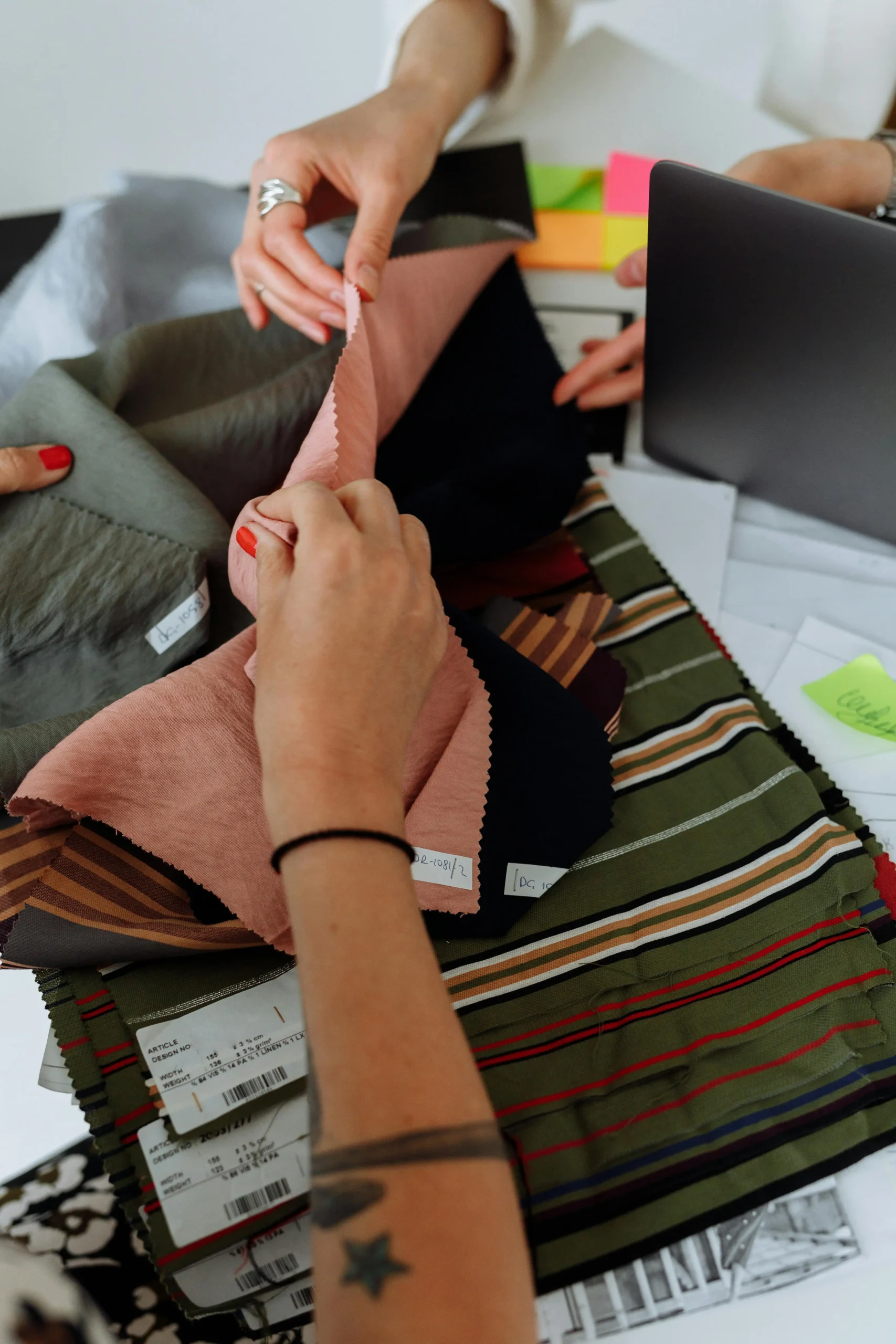
The process begins when your tech-pack — including color codes, weight specs, and hand-feel references — is translated into a strike-off. For bouclé and tweed, the critical variable is yarn tension. A 7-day rapid sampling workflow compresses this stage by using pre-vetted yarn stocks, avoiding the 2-3 week wait for custom dye lots on the first pass.
The Rest Period: Why It Catches Rework
A fabric sample fresh off the loom does not represent the final hand-feel. Tweed and bouclé constructions relax after being taken off tension. Industry data indicates that enforcing a 24-hour rest on the PP sample run alone catches roughly 20% of tension-related defects before they ever reach the cutting table. This is not a theoretical best practice — it is a measurable checkpoint. A supplier that skips this step is shipping you a sample that will change shape after bulk washing.
Dyelot Control and Color Match
For a Senior Sourcing Manager, the single highest-risk point in a custom run is color deviation between the approved sample and the bulk shipment. The standard mitigation is a pre-production (PP) sample that is cut from the actual production dyelot — not from a lab dip. Fursone provides dyelot photos and weight specs at this stage. If the PP sample shows a delta of more than 0.5 on the gray scale for color or a 5% variance in hand-feel, the bulk run is halted before a single meter is cut. This is the difference between a 1% rework rate and a 15% one.
Pre-Production PP Sample: The Rework Insurance
The PP sample is not a formality. It is the last point where you can reject a run without incurring material cost. A common failure in the industry is approving a PP sample that was produced on a different loom or with a different yarn tension than the bulk order. The approved internal protocol here requires that the PP sample be run on the same machine type and at the same speed as the final production order. This eliminates the “sample vs. bulk” discrepancy that causes line-downs.
Internal Linking & ROI
Why This Section Exists: The Sourcing Manager’s Shortcut
Internal links are not SEO filler. For a sourcing manager, they are a direct path to the data you need to build a BOM and defend your supplier choice to finance. The links below connect you to the exact cost comparisons, stock lists, and certification specs that separate a reliable supplier from a gamble. You can move from “Is this fabric viable?” to “Here is the landed cost and lead time” in under three clicks.
Internal Links to Sibling Pillar Pages
The following pages are the most relevant for your decision process. Each one contains specific data that directly supports the claims made here about rapid fabric sampling and total cost of ownership.
- Bouclé vs. Tweed vs. Knit: Fabric Cost Comparison for Luxury Collections: This is the primary pillar page. It provides a direct cost-per-meter comparison across our three core fabric categories, including both stock (100m ready stock) and custom (1000m bespoke) pricing structures. Use this to model your BOM against different texture options.
- Fabric Certification & Traceability Overview: If your compliance team requires OEKO-TEX or GRS documentation before approving a new supplier, this page details the certification options available on request and the traceability program we offer from yarn sourcing to finished roll.
- Custom Bespoke Texture Development Process: For collections that require exclusive textures, this page outlines the 1000m custom MOQ workflow, including the 7-day rapid sampling phase and the pre-production (PP) sample stage that catches color and hand-feel deviations before bulk manufacturing.
Value for the Reader’s Decision Process
Each link above serves a specific function in your evaluation. The cost comparison page lets you validate the 30-50% cost savings versus premium European mills with line-item data. The certification page removes a common sourcing roadblock — compliance approval — before you commit to sampling. The custom development page gives you the exact timeline and risk-mitigation steps for exclusive textures.
The ROI here is not theoretical. Shorter lead times from rapid fabric sampling (7-day swatches, 3-7 day stock shipping) directly reduce the buffer stock you need to carry. Transparent cost data on the linked pages lets you present a defensible total cost of ownership to your finance team, avoiding the hidden costs of rework or line-downs that come from unclear supplier specs.
Conclusion
Rapid fabric sampling cuts the concept-to-swatch cycle to seven days. That single week shaves risk from the entire production timeline — fewer re-spins, less buffer stock, faster line starts. Paired with 100M meters of ready stock shipping in 3-7 days, it turns sampling into a procurement advantage, not a bottleneck.
Review your current sampling lead time against the 7-day benchmark. Then browse the ready stock catalog to see which textures match your next BOM — and how fast they can land on your cutting table.
Frequently Asked Questions
What is fabric sampling?
Fabric sampling is the process of creating a small, representative physical swatch of a textile to evaluate its hand feel, drape, color, and construction before committing to bulk production. At Fursone, our 7-Day Rapid Sampling service allows production managers to go from concept to physical swatch in one week, enabling faster decision-making and reducing time-to-market. This step is critical for verifying that the fabric meets your quality standards and design specifications without tying up capital in large inventory. By leveraging our in-stock 100M meters and custom 1000M MOQ capabilities, we ensure that samples accurately reflect the final production run, minimizing costly revisions later.
What is sampling in the apparel industry?
In the apparel industry, sampling is the multi-stage process of producing prototype garments or fabric swatches to test design feasibility, fit, and material performance before mass manufacturing. For production managers, efficient sampling directly impacts lead times and supply chain reliability, which is why Fursone offers a 7-Day Rapid Sampling program that delivers physical swatches within one week. Our approach integrates real-time stock availability from our 100M meters of ready inventory and custom development from 1000M bespoke solutions, ensuring samples are both accurate and scalable. This reduces the risk of production delays and allows brands to validate their artisan aesthetic—such as Chanel-style bouclé or heritage cable knits—with confidence and speed.
What are the 7 types of sampling?
While the seven types of sampling in apparel typically include proto, fit, pre-production, production, top-of-production, shipment, and counter samples, Fursone focuses on the most critical for fabric selection: proto sampling for concept validation and pre-production sampling for bulk run accuracy. Our 7-Day Rapid Sampling service collapses these stages into a single, fast-track process, delivering a physical swatch that serves as both a proto and pre-production reference. This efficiency is supported by our 100M meters of in-stock materials, which eliminate the need for lengthy custom yarn sourcing, and our 1000M custom MOQ, which allows for exclusive texture development without excessive upfront commitment. For production managers, this means fewer sampling iterations and faster progression to full-scale production.
What are the 12 different types of fabric?
The 12 common fabric types include cotton, linen, wool, silk, polyester, nylon, rayon, acetate, acrylic, spandex, denim, and tweed, each with distinct properties for end-use applications. As a premium tweed and knit fabric manufacturer since 1995, Fursone specializes in Chanel-style bouclé and heritage cable knits, which fall under the wool and tweed categories, offering durability, texture, and luxury hand feel. Our 100M meters of ready stock cover these key fabric types in various weights and finishes, while our 1000M custom bespoke solutions allow production managers to develop exclusive blends that combine natural fibers like wool with synthetics for performance. This breadth ensures that whether you need a classic bouclé for a jacket or a custom knit for a high-end collection, we provide the specific fabric type to match your design intent.
What is the 3-3-3 rule for clothes?
The 3-3-3 rule for clothes is a retail inventory management principle that suggests launching a collection in three phases over three months, with three key styles per phase, to optimize cash flow and reduce markdown risk. For production managers, this rule underscores the need for agile fabric sourcing that can support rapid, phased rollouts without overcommitting to inventory. Fursone directly enables this strategy through our 100M meters of in-stock fabrics, which ship in 3-7 days, and our 1000M custom MOQ, which allows for small-batch exclusivity. Our 7-Day Rapid Sampling ensures that each phase’s fabric swatch is validated quickly, aligning with the 3-3-3 timeline to keep your collection on schedule and your margins protected by our affordable luxury pricing, which delivers European mill quality at 30-50% less cost.