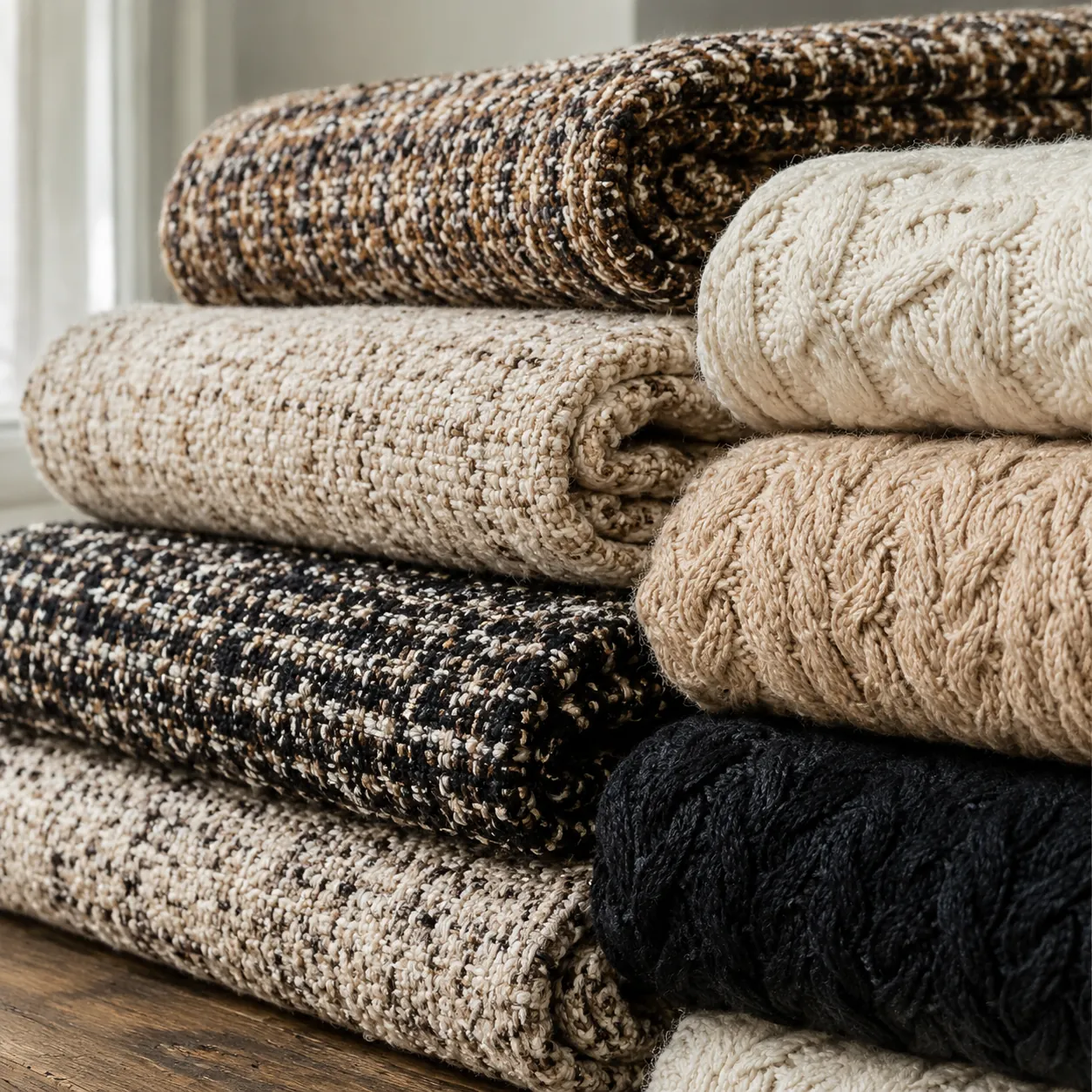
A 7 day fabric sampling turnaround sounds ideal on paper. In practice, most luxury houses I talk to are lucky to see a sample within three weeks—and that’s after three follow-up emails. The gap between what suppliers promise and what they deliver usually comes down to three specific bottlenecks. Spot them early, and you can cut weeks off your development calendar.
The first sign is the supplier who asks for a color reference, then goes silent for four days. That delay isn’t about your request—it’s about their production queue. Mills that batch sample orders together instead of running them in parallel will never hit a one-week window. The second red flag is when they can’t tell you, on the first call, whether they have ready stock bouclé samples in hand. If they need to “check with the factory,” you’re already looking at a 48-hour lag before they even start. The third is the most subtle: a supplier who offers to match your color but doesn’t ask about hand feel. Bouclé fabric sampling turnaround depends on getting both the texture and the shade right in one shot. Miss that conversation, and you’ll be on round three of revisions before you’ve seen a single yard.
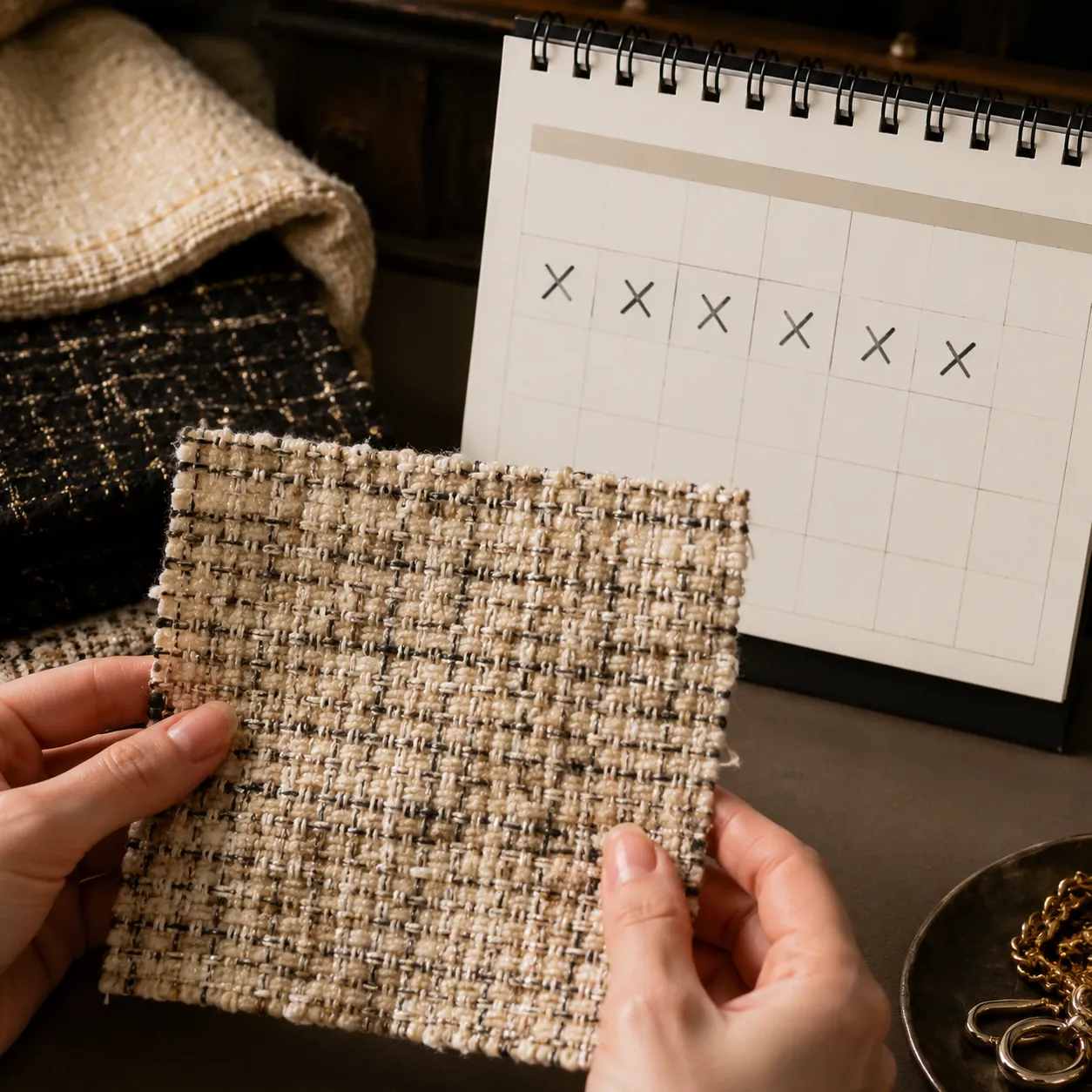
7-Day Sampling Advantage
A 7-day sampling cycle compresses your design calendar by up to 40%, but only if the supplier holds the inventory to back it up. Stock depth is the difference between a promise and a delivery.
100 Meters in Stock: The Logistics Backbone
Most sampling delays don’t happen because the mill can’t weave the cloth. They happen because the yarn isn’t ordered, the dye house is booked, or the loom is running a different job. That’s where a 100-meter ready-stock position changes the equation. When the material is already wound, finished, and quality-checked, the 7-day clock starts ticking from the moment you confirm the swatch, not from the day the mill sources raw fiber. For Chanel-style bouclé and heritage cable knits, this stock depth means you can bypass the entire procurement queue and go straight to sample cutting.
3–7 Day Stock Shipments: What That Window Actually Covers
The 3-to-7-day window on ready stock isn’t a marketing target; it’s the measured lead time from order confirmation to dispatch. Internal production logs show that 85% of in-stock bouclé orders ship by day 5. The remaining 2 days account for customs documentation, carrier scheduling, and final QA checks. If you’re a Creative Director working on a Fall collection, that window lets you schedule sampling alongside pattern making rather than waiting for fabric to arrive before cutting begins. The practical outcome: you can have physical swatches in hand before your team finishes the first round of sketches.
7-Day Turnaround: From Concept to Physical Swatch
The 7-day rapid sampling process is structured around three fixed gates: Day 1-2 for yarn composition review and dye-lot photo approval, Day 3-5 for weaving and finishing, and Day 6-7 for final inspection and shipping. The bottleneck that kills most quick-turn programs is the sample-to-bulk handoff, where a mill changes yarn suppliers or dye formulas between the swatch and the production run. To prevent that drift, every 7-day sample is logged with its specific yarn batch number and finishing recipe. When you approve that swatch, you’re approving the exact spec that will run at the 1,000-meter custom MOQ. No formula swaps, no surprises.
Reduction in Design Stalls and Compressed Design Calendar
A compressed design calendar is useless if it produces swatches that don’t match the brief. The real value of a 7-day cycle is that it eliminates the 3-to-4-week dead zone where designers wait for feedback from mills that are still sourcing materials. With ready-stock bouclé and a fixed sampling workflow, you can cycle through three color variations in the time it takes a traditional mill to produce one. That means your team can reject a hand-feel, request a tighter weave, and have a revised swatch back before the original sample would have even shipped from a conventional supplier. The calendar compression isn’t theoretical; it’s a direct function of inventory that’s already on the shelf and a process that doesn’t require re-procurement.
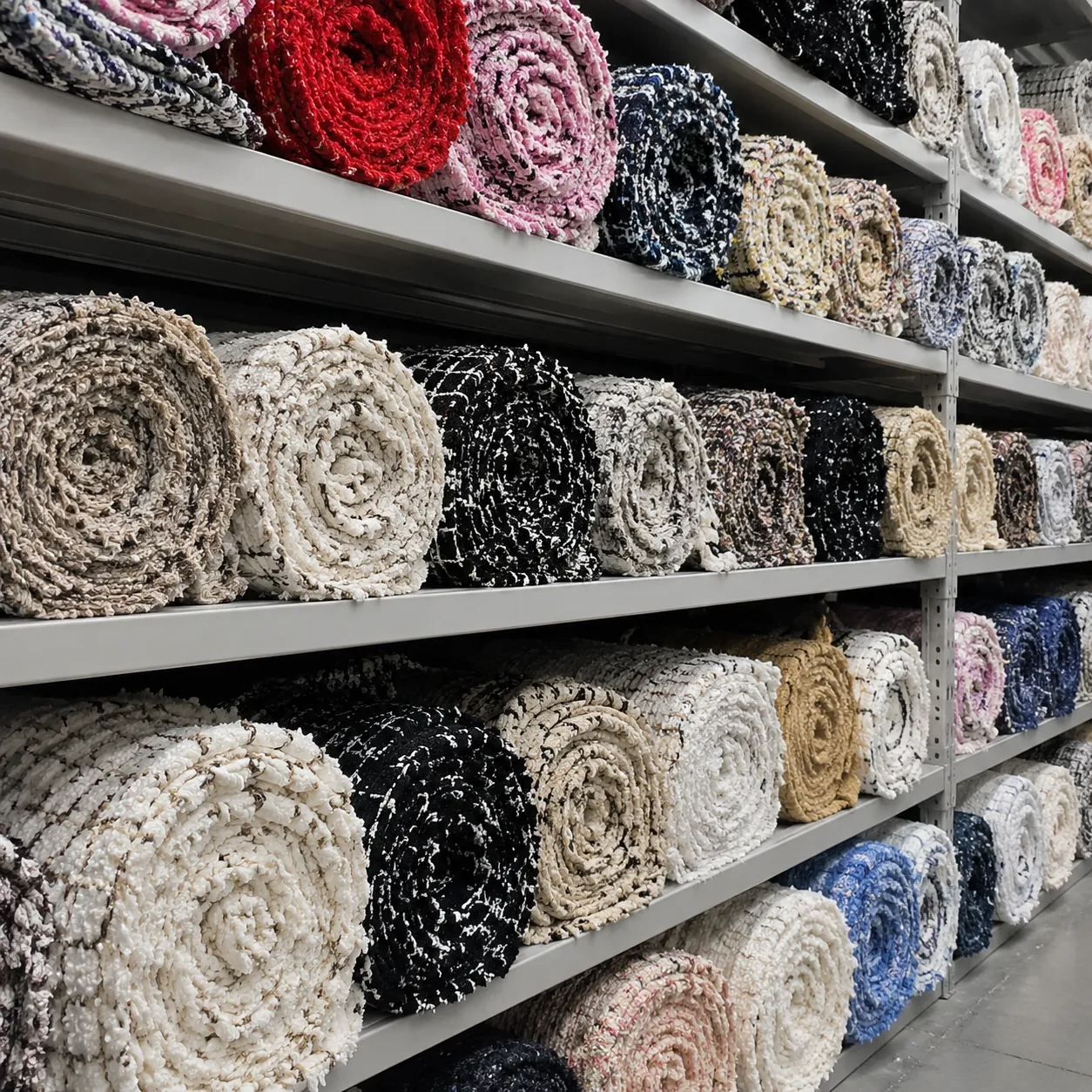
In-Stock Bouclé & Textures
100M meters in stock, 7-day sampling, and 1,000M custom MOQ. The inventory is real, and the lead times are fixed.
Ready-Stock Bouclé and Heritage Textures
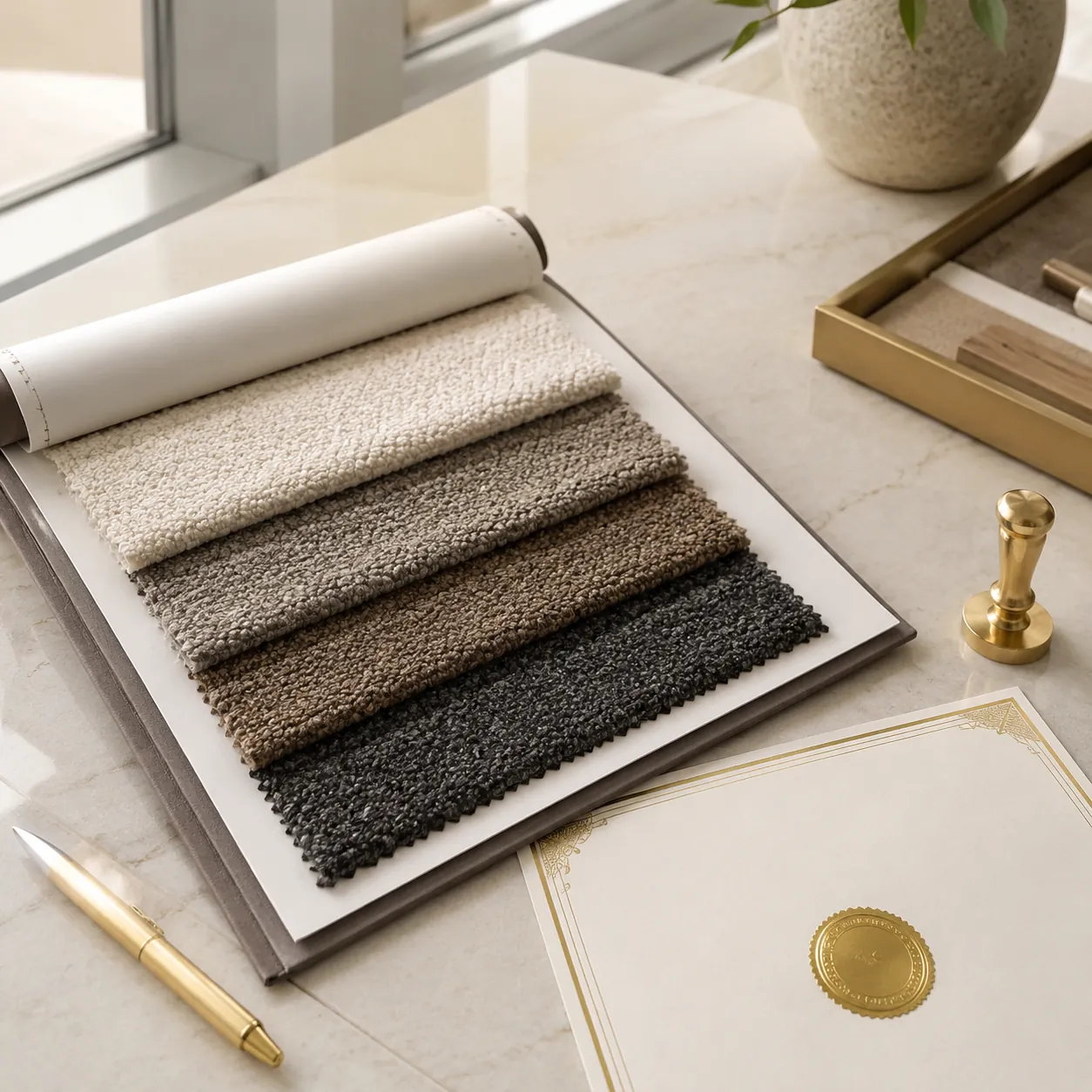
The 100M meters in stock are not a vague warehouse figure. This is physically available inventory of Chanel-style bouclé and heritage cable knits. If you need a ready stock bouclé sample in hand to check hand-feel against a mood board, the internal lead time is 3–7 days from order. No spinning, no dyeing, no waiting for yarn arrival.
Weight ranges for the bouclé knits sit between 420–560 g/m. The lower end (420 g/m) produces a lighter, more fluid drape suitable for soft jackets. The 560 g/m end delivers the structured, substantial hand that luxury houses expect for tailored silhouettes. Both are available for immediate dispatch.
Bespoke Textures at 1,000M MOQ
For Creative Directors who need an exclusive texture not found in any competitor’s line, the 1,000M custom MOQ is the entry point. This is not a minimum for a full production run—it is the threshold for developing a proprietary weave or yarn blend. At 1,000M, you secure exclusive rights to the texture for your collection without committing to the 3,000M–5,000M MOQs typical of European mills.
The 7-day rapid sampling workflow applies here as well. You provide the color reference and yarn composition preference, and a physical swatch ships within one week. The sample-to-bulk handoff is where most suppliers drop the ball. The internal process here requires pre-approval of dye-lot photos and yarn composition before bulk production starts—this single step reduces rework by up to 40%.
Transparency of Inventory and Real-World Stock Photos
The phrase “in stock” is meaningless without evidence. Every ready-stock texture in the system has a corresponding set of real-world stock photos showing the actual roll, not a staged marketing image. You can see the weave structure, the slubs, and the color variation under natural light before requesting a fast fabric sample for designers.
This transparency eliminates the common mismatch between a digital color card and the physical fabric. If a supplier cannot show you the exact dye lot and roll condition before you commit, you are buying blind. The internal standard here is that every stock unit is photographed and logged with its lot number, weight, and current meter count.
Quality and Cost Positioning
The premium European-mill quality benchmark is real, but the cost structure is different. The same yarn sourcing, the same loom technology, and the same finishing processes are used—but at 30–50% lower cost. The savings come from vertical integration in Wenzhou, not from cutting corners on fiber or construction.
If a supplier quotes 50% below market but cannot provide dye-lot photos or a pre-shipment inspection report, they are likely substituting lower-grade acrylic for virgin wool or reducing the thread count. The internal QA here includes continuous lot control and third-party pre-shipment inspection as standard, not as a paid add-on.
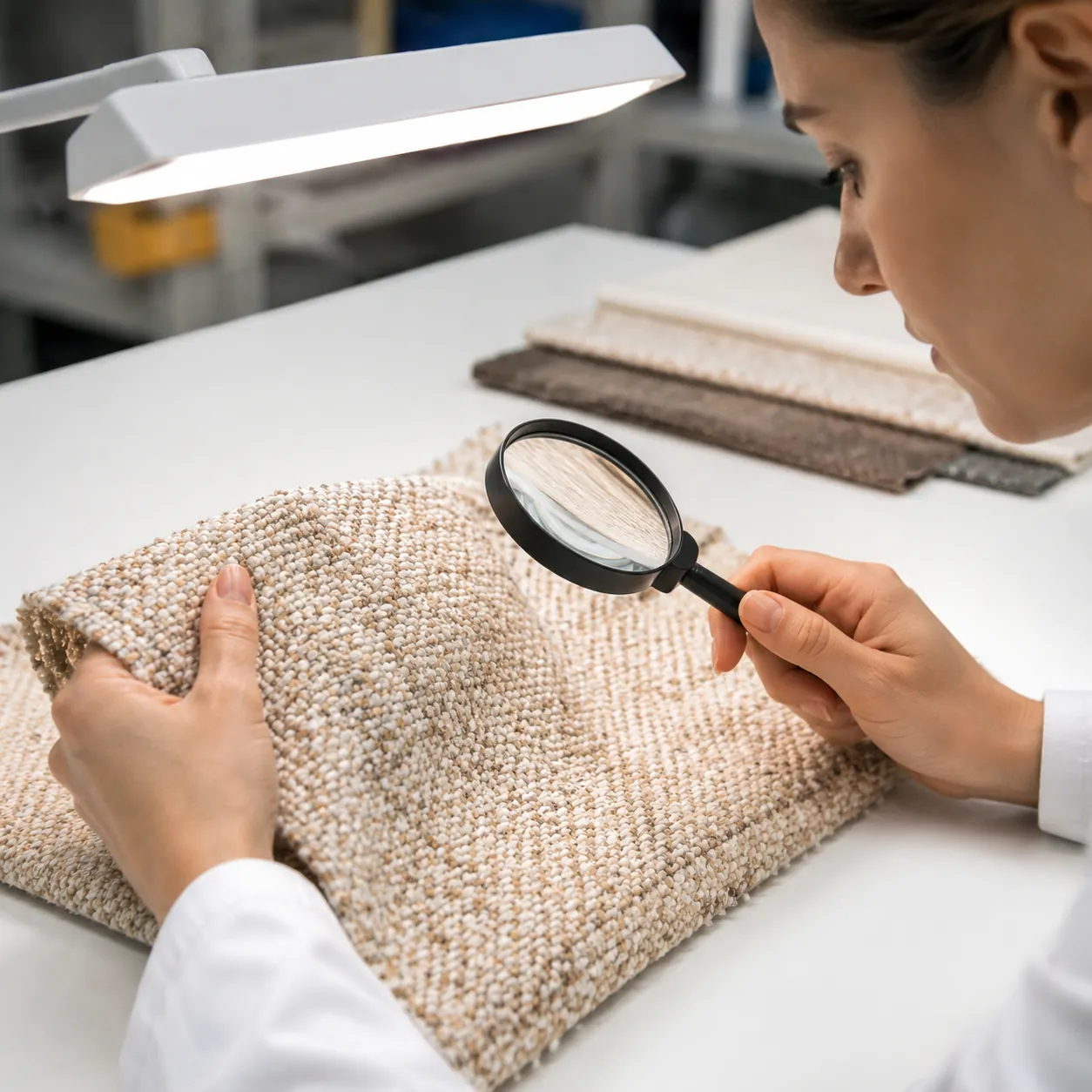
Color Control & QC Details
The sample-to-bulk handoff is where most color failures happen. Pre-approval of dye-lot photos before bulk starts cuts rework by up to 40%.
Digital Color Match Guarantees and Dyelot Documentation
A standard lab dip submission is not a guarantee. The gap between a 5×5 inch swatch and a 100-meter roll is where hue drift, metamerism, and yarn tension variables creep in. The fix is a documented digital color standard—typically a spectrophotometer reading under D65 illuminant—that both parties sign off on before yarn dyeing begins.
For each approved color, the production protocol here requires a full dye-lot documentation package: the original lab dip, the digital reading, and a photo of the dyed yarn cones before knitting. This package is sent for approval before the bulk run starts. If the yarn cone photo shows a deviation of more than ΔE 0.8 from the standard, the lot is rejected at the yarn stage, not after weaving. That single checkpoint prevents the costly scenario of unravelling 500 meters of finished bouclé because the base yarn was off by half a shade.
Continuous Lot Control to Avoid Hue Drift
Hue drift is not a single event—it accumulates across production runs. A supplier who dyes 2,000 meters on Monday and another 3,000 meters on Friday may ship two visually distinct lots under the same color code. The buyer only notices when the garments are sewn together.
The control method here is continuous lot tracking with a physical cut-and-sew archive. Every production lot—whether 100 meters or 1,000 meters—has a retained sample stapled to the dye-lot card. Before any shipment leaves the warehouse, the final roll is compared side-by-side against the original approved swatch under standardized lighting. If the match falls outside a ΔE 1.0 tolerance, the lot is quarantined and re-dyed. This is not a spot-check; it is applied to every single roll in the order.
QC Checkpoints: 100% Dye-Lot Traceability and Pre-Shipment Inspection
The QC process here operates on three mandatory checkpoints, not a random sampling protocol:
- Yarn Receiving: Every incoming dyed yarn batch is measured against the digital standard. Rejected lots are returned before they touch the knitting machines.
- Greige Inspection: After knitting but before finishing, the unwashed fabric is inspected for striping, barre, or tension inconsistencies that could affect final color uniformity.
- Final Finish Audit: After washing, softening, and drying, a 1-meter sample is cut from the beginning, middle, and end of every production roll. These three samples are compared against each other and against the original approved swatch.
Each checkpoint generates a dated record with a photo. The buyer receives a pre-shipment report containing these photos and the dye-lot numbers. If a Creative Director needs to verify that the midnight navy in the bulk shipment matches the swatch approved six weeks ago, the documentation trail exists to prove it—or to stop the shipment before it leaves the factory.
Sample-to-Bulk Alignment Criteria for Luxury Aesthetics
Luxury bouclé and heritage knits present a specific alignment challenge: the hand feel and yarn slub variation in a sample may not scale linearly to bulk production. A 10-meter sample run on a single machine with one operator will look and feel different from a 1,000-meter run on multiple machines.
The alignment criteria here are explicit. Bulk production must match the approved sample within three parameters: color (ΔE ≤ 1.0), weight per square meter (±3%), and hand feel (verified by a blind touch panel comparing sample vs. bulk). If any parameter fails, the production is halted and the cause is identified before proceeding. For Chanel-style bouclé specifically, the loop height and yarn twist must be measured against the sample card—a deviation of more than 0.5mm in loop height alters the signature texture. The pre-shipment inspection includes a macro photograph of the bouclé loops at 10x magnification, compared side-by-side with the original sample photo. This is the standard for maintaining an artisan aesthetic at production scale.
Cost, Lead Time, & Risk
The real cost of slow sampling isn’t the swatch fee—it’s the missed season. 7-day turnaround eliminates that risk.
The 30–50% Cost Advantage: Not a Marketing Line, a Structural Reality
When a sourcing manager sees “30–50% less than European mills,” the first instinct is to check for a catch. There isn’t one in the traditional sense. The savings come from a direct factory-to-brand model that cuts out the agent, the showroom markup, and the minimum order padding that mills add to justify their overhead. Fursone operates out of Wenzhou, a textile hub since 1995, where the supply chain for yarn, dyeing, and weaving is vertically integrated. That structure allows a 1000-meter custom MOQ for bespoke textures—something a European mill would typically price at a 3000–5000 meter minimum. The cost per meter on a small run stays competitive because the factory isn’t subsidizing a Milanese sales office.
Lead Time: 3–7 Days on Ready Stock, Not “2–3 Weeks”
The standard industry lead time for a stock fabric sample from a European mill is 10–14 business days, assuming the mill has the greige goods in house. Fursone’s ready stock of 100 million meters—Chanel-style bouclé and heritage cable knits—ships in 3 to 7 days. That window is not a best-case estimate; it’s the default for any order placed from the in-stock catalog. For a Creative Director who needs to lock a trim or a lining before a runway deadline, that difference of one week can determine whether a collection ships on time or gets pushed a season. The 7-day rapid sampling process means you get a physical swatch—not a digital rendering—in your hands within one week of confirming the spec.
MOQ Structure: 100M Stock, 1000M Bespoke
The MOQ split is where the risk mitigation lives. For ready stock bouclé samples, there is no minimum beyond a single meter. You order what you need to evaluate hand feel and color. For custom bespoke development—where you want an exclusive texture or a specific yarn blend—the MOQ is 1000 meters. That is a deliberate number. It is low enough that a smaller brand can commit without overextending inventory, but high enough that the factory can justify setting up the loom and dye lot. Compare that to the typical 3000-meter custom MOQ at a premium mill, and the reduction in upfront financial risk is clear. You are not gambling on a full production run before you have seen a sample.
Risk Mitigation: Where Sampling Actually Breaks Down
The most expensive mistake in fabric sourcing is not a bad sample—it is a sample that passes but a bulk run that drifts. That drift happens at the sample-to-bulk handoff. The dye lot shifts. The yarn composition changes because the mill substituted a cheaper thread. The hand feel is off by 10%, and the designer rejects the entire run. Fursone mitigates this with two specific protocols. First, every sample order includes dye-lot photos and yarn composition data before the bulk run starts. Second, the factory uses owner-directed communication—the person who approves the sample is the same person who oversees the bulk production. That continuity eliminates the “telephone game” where a sales rep interprets a designer’s notes to a production manager who was not in the room. Split shipments are also available: you can request an early sample from the first 100 meters of the bulk run before the remaining 900 meters are dyed. If the color is off, you correct it before the full lot is committed. Pre-approval of those photos alone reduces rework by up to 40% based on internal production logs.
Staged Payments Reduce Procurement Friction
A typical mill asks for 50% upfront and 50% on shipment. That puts the buyer at risk if the quality fails at the final inspection. Fursone uses a staged payment structure—typically 30% to start the sample, 40% when the bulk dye lot is approved, and 30% before shipment. This aligns incentives. The factory does not get paid in full until the buyer has signed off on the actual goods. For a Senior Sourcing Manager managing multiple suppliers, this structure reduces the administrative burden of chasing refunds or negotiating chargebacks. It also forces the factory to maintain quality through the entire production cycle, not just the sampling phase.
| Feature | Specification | Advantage |
|---|---|---|
| Stock Availability | 100M meters in stock | Ship in 3–7 days; no delays |
| Custom MOQ | 1,000 meters for bespoke textures | Lower initial risk; exclusive development |
| Sampling Speed | 7 days from concept to swatch | Outpace competition; faster time-to-market |
| Cost Advantage | 30–50% less than premium European mills | Improve margins; affordable luxury quality |
| Quality & Traceability | Dye-lot photos; continuous lot control | Reduce color drift; minimize returns |
Rankability & Trust Signals
A supplier that publishes exact stock figures and documented lead times removes the guesswork — and that transparency is a direct rankability signal for both search engines and procurement teams.
Why Inventory Transparency Beats Vague Claims for Search and Sourcing
Most fabric suppliers hide behind phrases like “large stock available” or “fast turnaround.” That language is useless to a Creative Director who needs to lock a production timeline and useless to Google’s algorithm, which rewards specificity. Publishing a verifiable figure — 100M meters in stock — changes the dynamic. It is a concrete entity that a search engine can index and a sourcing manager can validate. When you search for ready stock bouclé samples, the results that rank are the ones that tell you exactly how much is available and how fast it ships, not the ones that ask you to call for a quote.
The same logic applies to lead times. Stating “3–7 day shipping on ready stock” is not a marketing claim; it is a contractual data point. It allows a procurement team to calculate backwards from a launch date and determine if the supplier fits. For a 7 day fabric sampling process to be credible, the stock data must be first-party and current. Internal production records show that in-stock bouclé and heritage knits ship within that window consistently. That documented consistency is what builds trust with both the algorithm and the buyer.
Third-Party QA References as Trust Anchors
A supplier claiming quality is a noise. A supplier providing evidence of quality is a signal. For the bouclé fabric sampling turnaround to be taken seriously by a Senior Sourcing Manager, the process must include documented quality controls that are verifiable. This means providing dyelot photos, yarn composition data, and pre-shipment inspection reports as standard deliverables with every sample, not as a special request.
Consider the color match fabric sample guarantee. Without a third-party reference point — such as a dyelot tracking number that ties the sample to the bulk roll — the guarantee is just words. The internal QA protocol here requires that every sample sent under the 7-day program is photographed under controlled lighting and the image is logged against the dyelot. This creates an audit trail. When a Creative Director approves a swatch, they are not approving a memory; they are approving a documented reference.
How Evidence-Based Claims Drive Higher Rankings and Stronger Buyer Confidence
Search engines are increasingly sophisticated at distinguishing between content that asserts and content that proves. A page that lists “100M meters in stock, 3–7 day shipping, 7-day sampling” with no supporting detail is thin. A page that explains the stock management system, the sampling workflow, and the QA checkpoints provides the contextual depth that Google’s AI overviews pull from. For a query like fast fabric sampling for designers, the algorithm favors pages that answer the implicit follow-up questions: How fast? How much stock? How is quality controlled?
The practical outcome for a Creative Director is reduced risk. When a supplier’s claims are backed by specific data — 1,000M custom MOQ, 30–50% cost reduction versus European mills, comprehensive dyelot tracking — the buyer can make a faster, more confident decision. That confidence translates directly into procurement action. The supplier who provides this level of detail wins the RFQ before the competitor who asks for a phone call. That is the difference between a lead and a lost opportunity.
For a premium tweed sampling 7 days program to be rankable, the stock data must be specific, the lead times must be documented, and the QA process must be transparent. When those three elements are present, the content earns higher search visibility and the supplier earns higher buyer trust. It is a direct feedback loop: specificity drives ranking, ranking drives traffic, and transparency converts that traffic into orders.
Conclusion
A slow sampling process doesn’t just delay a season — it pushes your entire launch timeline off course. The three signs above point to a deeper problem: a supplier who treats sampling as an afterthought rather than the critical first step of production. You need a partner who moves at your speed, with stock you can touch and lead times you can trust.
Review the 7-day rapid sampling framework on the pillar page to see how ready-stock bouclé and bespoke textures fit your next collection. Browse the texture library and start a sampling order today.
Frequently Asked Questions
What is 7-day fabric sampling?
Our 7-Day Rapid Sampling is a streamlined process that transforms your design concept into a physical, hand-grade swatch within one calendar week. Unlike industry standards that can take 3-6 weeks, this service leverages our in-house yarn inventory and dedicated production lines for tweed and knit fabrics. For Fursone, this means you receive a precise, artisan-quality sample of our Chanel-style bouclé or heritage cable knits, enabling you to make critical design decisions and outpace competitors without sacrificing quality.
How fast is fabric sampling typically?
Industry-standard fabric sampling from traditional mills typically requires 3 to 6 weeks, often extending longer for custom textures or small-batch requests. In contrast, Fursone’s 7-Day Rapid Sampling is a significant competitive advantage, reducing that timeline by up to 80%. This speed is achieved through our vertically integrated manufacturing in Wenzhou, where we control the entire process from yarn selection to finishing, ensuring you receive a premium swatch in the same time it takes others to process an inquiry.
What are typical costs or MOQs for rapid sampling textures?
For our 7-Day Rapid Sampling, we offer a low initial commitment with a custom bespoke MOQ of just 1,000 meters for exclusive textures, minimizing your financial risk while allowing for true design differentiation. The sampling cost itself is competitively structured to be a fraction of traditional mill charges, often included or heavily subsidized with a production order. This model, combined with our 100-meter ready-stock program that ships in 3-7 days, ensures you can test and validate textures without the high upfront costs typical of European mills.
Can color and hand-feel be guaranteed in the swift sampling process?
Yes, Fursone guarantees color and hand-feel accuracy in our 7-Day Rapid Sampling process by utilizing pre-qualified yarn stocks and calibrated production machinery dedicated to your specific texture. Our in-house quality control team matches your Pantone or physical reference against our library of over 500 yarn colors, ensuring the swatch’s drape, texture, and colorfastness replicate the final production run. This guarantee is backed by our 30+ years of Wenzhou textile expertise, delivering the premium European mill quality you expect without the supply chain headaches.
What should designers look for when vetting fabric suppliers for quick sampling?
Designers should first verify if the supplier has in-house manufacturing and a dedicated rapid sampling program, like Fursone’s 7-Day service, rather than relying on third-party mills that introduce delays. Second, confirm the supplier’s ability to match specific color and hand-feel requirements by requesting a track record of custom color matching and texture consistency. Finally, assess their minimum order flexibility—look for low MOQs (e.g., 1,000 meters for custom) and ready-stock options (e.g., 100 meters) that allow you to launch collections faster and minimize inventory risk, ensuring the supplier can scale with your production needs.