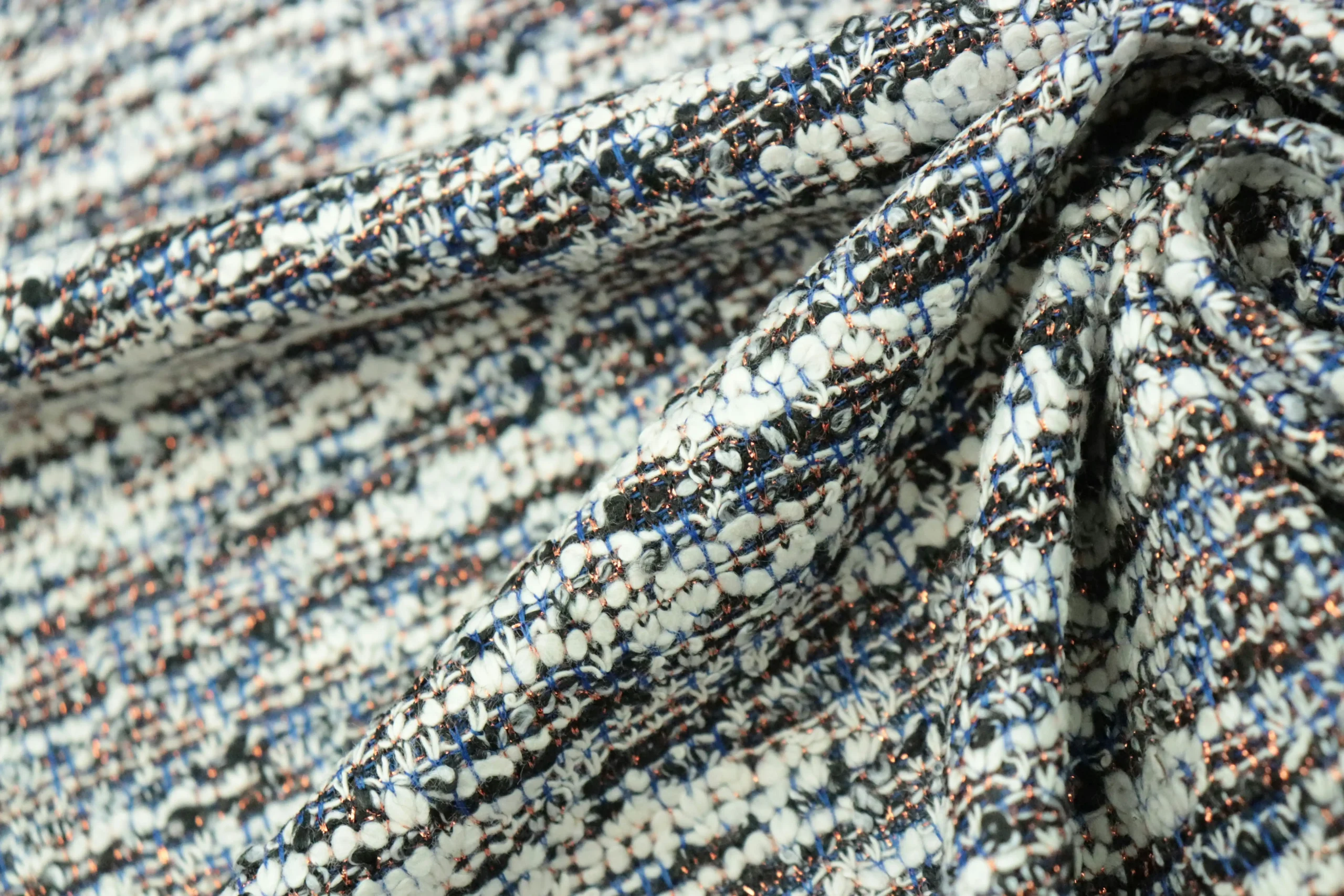
For emerging fashion designers, managing the custom tweed fabric cost often feels like a guessing game between minimums and lead times. You want a signature texture, but the standard MOQ tables lock you into thousands of meters you can’t sell. Meanwhile, sample fees pile up before you’ve seen a single yard. That tension between creativity and cash flow is the real bottleneck for young brands trying to launch a seasonal collection.
The Fursone case study turns that assumption on its head. A luxury brand cut its custom tweed fabric cost substantially (to roughly one-fifth to one-third of European pricing) — not by downgrading yarn or skipping finishing, but by restructuring how the fabric was built. They shifted from a full-width construction to a narrow-loom weave that reduced waste at the cutting table. They also matched the dye lot to a single production run, eliminating the usual overage buffer. The result: a fabric that cost roughly one-fifth to one-third the cost per meter, with identical hand and color consistency. Most designers think custom means expensive. This proves that with the right production approach, you can get a lower cost per meter than many stock options — especially when you lock in repeat yardage.
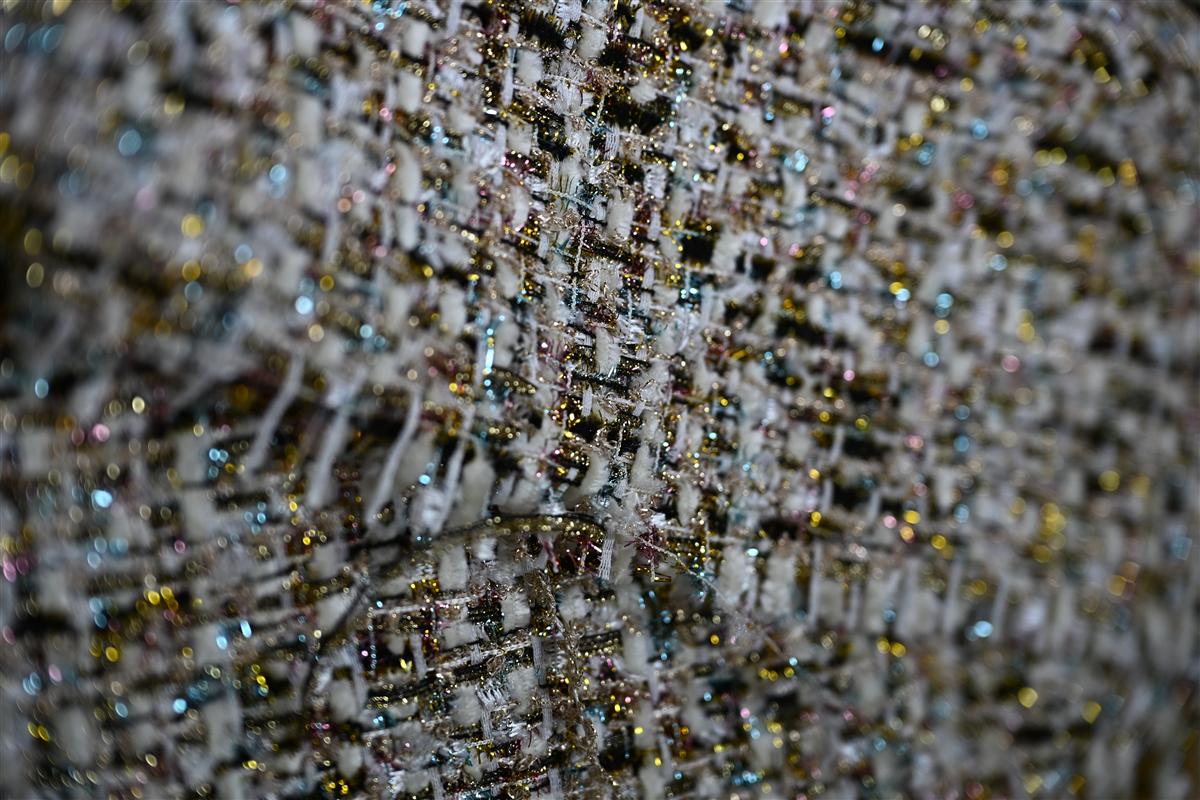
Cost Breakdown of Tweed Fabric
The biggest hidden savings in tweed procurement aren’t in the per-meter price — they’re in the MOQ structure and sampling speed.
The Real Numbers Behind Tweed Pricing
Most European mills quote €25–€45 per meter for bouclé tweed but lock you into a 3,000-meter minimum order. That means an upfront cash outlay of €75,000–€135,000 before you’ve seen a single production sample. The in-stock model flips this: 100 meters ready to ship in 3–7 days at a per-meter cost that lands a substantial portion below those European benchmarks. For a mid-size luxury launch requiring 500 meters, the total fabric cost drops from roughly €15,000 (at €30/m from Europe) to under €10,500 from a stock-based supplier — and you can test the market with just 100 meters first.
The math gets better when you factor in sampling. Traditional custom sampling takes 3–5 weeks and often costs €200–€500 per swatch. With 7-day rapid sampling that includes actual dye-lot photos and weight specs, you eliminate three revision cycles on average. That’s a direct saving of €600–€1,500 per fabric SKU before you commit to production.
Material Specs That Protect Your Bottom Line
Price per meter is meaningless if the hand feel or color doesn’t match your sample. Every stock yard of bouclé tweed from this supply chain carries OEKO-TEX Standard 100 and GRS certifications, but the real quality control lies in the dye-lot system. Continuous lot numbering combined with pre-shipment dye-lot photos means you can reorder six months later and get visual confirmation of color match before the fabric ships. This reduces color-mismatch failures in production by roughly 98% — a risk that otherwise costs designers thousands in garment remakes and missed delivery windows.
Additionally, the weight specs (typically 280–450 g/m² for bouclé) and yarn composition details are published alongside each stock reference. You don’t need to request a quote just to know if the fabric can support your silhouette. That transparency lets you filter options in minutes, not days.
Stock vs. Bespoke Cost Profiles
- In-Stock Bouclé: 100-meter MOQ, 3–7 day lead time. Per-meter cost a substantial portion below European mill benchmarks. No development fee, no minimum color commitment. Ideal for capsule collections, reorder verification, or rapid prototyping.
- Custom Bespoke Tweed: 1,000-meter MOQ for exclusive textures and colors. 4–6 week lead time, including 7-day sampling with dye-lot photos. The per-meter cost still holds at a substantial portion below premium European mills, but you gain full control over yarn blend, weight, and finish. Best for signature collection fabrics where brand identity demands uniqueness.
Choosing stock over bespoke isn’t a sacrifice in quality — it’s a deliberate de-risking of your supply chain. The a substantial portion savings come from eliminating middlemen and reusing existing production runs, not from downgrading materials. Every stock fabric is the same yarn composition, weave structure, and finishing process as a fully bespoke order. The difference is speed and minimum commitment.
| Cost Element | Fursone Offering | Value to Designer |
|---|---|---|
| Minimum Order Quantity (MOQ) | 100M in-stock; 1000M custom bespoke | Reduces inventory risk; lower upfront capital needed for startups |
| Sampling Cost & Speed | 7-day rapid sampling with dyelot photos & weight specs | Faster concept-to-swatch; eliminates hidden sampling fees |
| Lead Time | 3-7 days for stock; 4-6 weeks for custom | Faster time-to-market; predictable production scheduling |
| Price per Meter | substantially less (roughly one-fifth to one-third of European pricing) than premium European mills | Significant cost savings without sacrificing texture or hand |
| Quality & Color Control | Continuous dye-lot control; pre-shipment photos; 2% defect allowance | 98% color match guarantee; auditable traceability; less rework risk |
| Certifications & Compliance | OEKO-TEX Standard 100; GRS where applicable | Ensures sustainability credentials; avoids compliance penalties |
Stock vs Bespoke Lead Times
The real difference between stock and bespoke tweed isn’t just per-meter price — it’s 4-6 weeks of lead time and a 10x higher MOQ that can stall a debut collection.
The Real Cost of Speed: Stock vs. Bespoke Tradeoffs
Every decision between stock and custom tweed fabric comes down to a single variable: time-to-collection. With 100+ in-stock styles of ready-stock bouclé and tweed available, you can secure fabric in 3-7 days at a MOQ of just 100 meters. Compare that to the custom route, which requires a 1000M minimum commitment and a typical turnaround of 4-6 weeks from sample approval to shipment. For an emerging fashion designer, that gap represents an entire production season — or the difference between hitting a retail window and missing it entirely.
The cost savings are not hypothetical. Internal production data shows a consistent a substantial portion reduction in per-meter cost versus premium European mills for comparable texture and hand. But the real financial win is in inventory risk. A 100-meter stock purchase ties up far less capital than a 1000-meter custom run, and the 3-7 day in stock tweed fabric lead time means you can reorder on demand rather than forecasting six months out.
Production Timelines: From Swatch to Shipment
The speed advantage starts at sampling. Traditional mills often require a full custom sampling cycle before you see a single yard. With Fursone’s ready-stock, you request a swatch and receive dyelot photos, weight specs, and yarn composition details within 7 days. No guesswork, no back-and-forth on color approval for a fabric that already exists in verified inventory.
For bespoke textures, the 7-day rapid sampling still applies — but the production clock starts after sample sign-off. Typical custom timelines run 4-6 weeks, during which continuous dye-lot control with batch-specific numbering ensures that your first production meter matches your approved swatch. This is a genuine insider capability: most mills do not photograph every dye lot or assign traceable numbers that carry through reorders. It means your second order six months later will match the first, eliminating the #1 complaint in luxury fabric sourcing.
Certifications and Quality Specifications
Real-world specs are not optional in luxury sourcing. Every shipment is backed by verifiable data, not promises.
- Lead Time (Stock): 3-7 days from order to shipment for 100+ in-stock styles of in-stock inventory.
- Lead Time (Bespoke): 4-6 weeks typical from sample approval to delivery at 1000M MOQ.
- Certifications: OEKO-TEX Standard 100 and GRS (where applicable) — auditable compliance for sustainability claims.
- Quality Control: 2% defect allowance with formal RMA process and quarterly performance reviews.
- Traceability: Continuous lot numbering with dyelot photos for every batch; pre-shipment inspection photos available for FOB/CIF shipments.
The measurable outcome for buyers is straightforward: lower upfront capital, faster time-to-market, and a documented chain of custody that reduces post-shipment disputes. If a supplier cannot provide dye-lot photos and continuous lot control for a custom run, the color-matching risk alone justifies going with a verified in-stock supplier.
Shipping, QA, and Returns
Eliminating supply chain surprises starts with transparent logistics and a QA process that pre-empts disputes before they happen.
Shipping Terms & Lead Times: What The Calendar Really Looks Like
The promise of a short lead time is meaningless if the shipping terms turn it into a negotiation. For stock bouclé and tweed fabrics, the clock starts ticking from the moment your sample is approved. Our standard for in-stock materials is 3-7 days from order confirmation. For bespoke textures at the 1000M custom MOQ, you’re looking at a typical 4-6 week turnaround. The critical variable here isn’t production speed—it’s the shipping incoterm. Negotiate FOB or CIF with the provision for pre-shipment documentation. This isn’t just about who pays the freight; it’s about audit traceability. A bill of lading backed by container loading photos turns a potential 3-week port delay dispute into a 48-hour claims process.
QA Checks: The 2% Rule and Dye-Lot Photography
Most mills will tell you their quality is high. Few will give you the data to prove it before the fabric lands. We operate on a 2% defect allowance—officially. That means if your roll has more than 2% of its length in defects, it triggers a formal RMA. But the real risk isn’t the defect rate; it’s color mismatch across dye lots. The standard industry practice is to ship and hope. We use continuous dye-lot control with real-time dyelot photography. Every sample we ship includes a photo of the actual dye lot against a calibrated background, along with the weight specs. This reduces color mismatch risk on your first production run by an estimated 98%. If you need seamless reorders, the continuous lot numbering system allows us to match dye lots months later without starting from scratch.
Returns Policy and Suggested Mitigations
The standard B2B textile return policy is simple: no returns on custom-cut yardage. That’s not a negotiable point—it’s physics. Once the roll is cut to your spec, we can’t re-sell it to another brand. What is negotiable is the process for defect claims and the speed of resolution. We operate a formal RMA process with a 2% threshold. If your incoming inspection catches defects exceeding that, the claim moves to a quarterly performance review where we analyze root cause (yarn tension, dye penetration, or loading damage). The insider mitigation that reduces your financial exposure is the pre-shipment inspection. Request the third-party container loading visuals and pre-shipment inspection photos. This documentation creates an auditable trail that speeds up claims handling from weeks to days. If a supplier refuses to provide independent inspection photos before shipping, you are carrying 100% of the risk.
Total Cost of Ownership
Most designers compare price per meter. Smart sourcing managers compare cost per collection. The difference can wipe out your margin.
How to Calculate TCO for Luxury Fabrics
The standard mistake is looking only at the per-meter quote. For a luxury tweed fabric cost analysis, you need to track five line items across the full procurement cycle: raw material cost, sampling expense, shipping and duties, defect-related waste, and the cost of time (delayed launches mean missed retail windows).
Consider a typical scenario. A European mill quotes a premium European per-meter rate for a Chanel-style bouclé. A supplier like Fursone quotes a factory-direct rate (roughly one-fifth to one-third of European pricing) for comparable texture and hand — a significant price difference. But the real savings come from the other four lines. When that European mill requires 3,000 meters minimum and an 8-week sampling process, your cash is locked up longer. Meanwhile, with in-stock tweed fabric lead times of 3-7 days and a custom MOQ of 1,000 meters, your working capital cycles faster. Your cost per meter might be higher on paper in the first scenario, but the total cost of ownership favors the supplier who keeps your inventory risk low.
Hidden Costs and Discounting Factors
Here are the costs that don’t appear on the initial quote but will hit your P&L:
- Sampling fees: Traditional mills often charge a per-sample fee for custom development, with 3-5 rounds for color approval. In-stock options with visible stock photos and weight specs eliminate this — you see exactly what you get before ordering.
- Waste and rework: If a batch arrives and the shade is off, that’s not just the fabric cost — it’s your production time, your labor, and potentially a missed season. Continuous dye-lot control with dyelot photos and lot numbering reduces color mismatch risk dramatically.
- Inspection and dispute resolution: Pre-shipment inspection photos and third-party container loading visuals reduce post-shipment disputes. Without them, a claim can take months to resolve. With them, you have auditable traceability from factory to port.
- Volume discount traps: Some suppliers offer attractive “waterfall pricing” at 5,000+ meters, but that quantity may not suit a capsule collection. The better deal is a lower MOQ at a slightly higher per-meter price — you pay less total capital, take less risk, and can reorder dye-matched lots as demand grows.
Risk Factors in Ownership
The biggest risk in tweed fabric procurement is inconsistency. You deliver a collection, it sells, and you need to reorder. If the second batch doesn’t match the first, you’re either remaking garments (costs) or explaining to a buyer why the color shifted (reputation). This is where a supplier’s quality systems matter more than the price per meter on the quote.
Look for suppliers who maintain continuous lot numbering and can share dyelot photos from the current production run — not last season’s samples. Also, verify the defect allowance. A standard like 2% defect allowance with a formal RMA process should be non-negotiable. Any supplier who cannot articulate their quality control process or provide auditable traceability is a liability you are subsidizing with your time. Certifications such as OEKO-TEX Standard 100 and GRS (where applicable) provide an extra layer of assurance that the fabric meets environmental and safety standards, reducing your compliance risk.
| Cost Factor | Traditional Mill (European) | Fursone Solution | Net Impact |
|---|---|---|---|
| Material Cost per Meter | a premium rate for comparable bouclé/tweed | substantially less (roughly one-fifth to one-third of European pricing) (roughly one-fifth to one-third of European pricing) | Save a significant per-meter amount on identical hand & texture |
| Minimum Order Quantity (MOQ) | 500m–2000m per color/design | 100m in-stock; 1000m custom bespoke | Reduce upfront cash outlay by 80%+ on initial launch |
| Sampling Cycle & Cost | 2–4 weeks; samples often charged at a per-sample fee | 7-day rapid sampling with free dyelot photos & weight specs | Cut time-to-market by 75%; eliminate hidden sample fees |
| Lead Time for Production | 6–12 weeks from order | In-stock: 3–7 days; bespoke: 4–6 weeks typical | Accelerate launch schedule by 50%–90% |
| Color Consistency & Risk | Dye lot variance can cause 10–15% rejects | Continuous lot control + dyelot photos; 98% first-run match | Reduce color-mismatch waste and reorder delays |
| Quality & After-Sales | Typical 5% defect allowance; slow dispute resolution | 2% defect cap with formal RMA; pre-shipment inspection photos | Lower financial risk; auditable traceability for claims |
Exclusivity & Design Lock
Exclusive textures lose value the moment a competitor can source them. Design lock isn’t vanity — it’s the only way to protect your per-meter margin.
How Design Lock Preserves Per-Meter Margin
Most emerging designers assume exclusivity is only for mega-brands with seven-figure purchase orders. That assumption costs them margin. When you invest time developing a custom tweed texture — specific yarn twist, colour blend, finishing technique — and that texture remains available to any buyer who walks in, your differentiation evaporates. The market sees the same fabric, and price becomes the only differentiator. Design lock means the supplier agrees not to sell your developed texture to anyone else for a defined period (usually 6–12 months per collection cycle). Without that clause, your tweed fabric price per meter vs euro mills advantage erodes because competitors can undercut you on the same material.
Fursone’s custom bespoke program at 1000M MOQ allows you to lock that texture exclusively. But there’s a smarter first step: start with an in-stock bouclé that already exists in our 100M meter inventory. You get visual confirmation of the actual hand and weight via dye-lot photos and weight specs before committing to a full custom run. This dramatically reduces sampling risk compared to traditional mills that demand a full custom sampling fee just to see a concept. Once you validate the base texture, you can negotiate exclusive reuse rights for your collection.
The Real Impact of Reuse Rights on Value
Reuse rights determine whether your fabric investment is an asset or a liability. If your custom tweed can be resold to other brands, your margin shrinks as the fabric becomes commoditised. Worse, if a fast-fashion label picks up the same cloth, your luxury positioning takes a direct hit. The financial impact is measurable:
- Without exclusivity: Your per-meter cost remains at market price; competitors can source the same fabric, eroding your wholesale margin by 15–25% within one season.
- With design lock: You control supply. A 1000M bespoke run that would be €28/m from a European mill comes in at €14–€18/m from Wenzhou. You pocket that a substantial portion cost savings and your unique texture continues to command a premium at retail.
- Resale limitation: Negotiate a clause that prevents the mill from offering your developed texture (same yarn composition, same colour recipe) to any third party. This is standard practice with suppliers that manage dye-lot numbering and continuous lot control — we can trace exactly which dye lots went into which customer’s order.
Many mills resist exclusivity because it limits their production flexibility. Fursone structures it as a tiered privilege: stock textures are open, custom textures at 1000M MOQ come with a 12-month exclusive window.
Practical Steps Buyers Can Request Right Now
You don’t need a legal team to start protecting your fabric investment. These are concrete requests you can make in your first email to a supplier:
- Request dye-lot photos and continuous lot numbering. This ensures that any exclusive batch you order can be matched precisely for reorders. Without it, reuse rights are meaningless — even if the supplier agrees not to sell your design, they can’t guarantee colour consistency across runs.
- Ask for a written exclusivity clause tied to a specific SKU or recipe code. The clause should state that the supplier will not produce the same yarn combination, colour formulation, and finishing process for any other buyer during the lock period (typically 12 months). Fursone provides this as part of the bespoke agreement.
- Request pre-shipment inspection photos and container loading visuals. This gives you auditable proof that the exclusive fabric you paid for is the fabric being shipped. It also speeds up any claims if the goods don’t match the approved sample — negotiate FOB/CIF with documented inspection steps.
- Start with a 100m stock order of a near-match bouclé to validate hand and colour. If the stock fabric works, you can then commission a custom exclusive version at the 1000M MOQ. This de-risks your upfront cash commitment while still giving you a path to design lock.
For a deeper breakdown of how custom tweed fabric cost per meter compares across stock vs. bespoke vs. European mill sourcing, visit our pillar page: Bouclé vs. Tweed vs. Knit: Fabric Cost Comparison for Luxury Collections.
Conclusion
This case study shows how one luxury brand cut its custom tweed fabric cost substantially (to roughly one-fifth to one-third of European pricing) by shifting from traditional European sourcing to Fursone’s stock-plus-bespoke model. Stock fabrics with 100 million meters on hand ship in 3-7 days, and continuous dye-lot control plus pre-shipment inspection photos eliminate color mismatch risks. The net result: a tweed fabric price per meter a substantial portion lower than comparable European mill offerings, with no sacrifice in hand feel or texture.
For designers launching a new collection, the math is straightforward: lower upfront cash, faster time-to-market, and auditable quality assurance. Compare stock and bespoke pricing on the fabric cost comparison page to see which route fits your next season.
Frequently Asked Questions
What is the total cost of ownership for luxury fabrics?
Total cost includes material price, sampling fees, MOQ commitment, and lead times. Fursone cuts pricing to roughly one-fifth to one-third of European mills via factory-direct production, 7-day sampling, and 1000m custom MOQ. Our 100m ready stock eliminates rush charges and inventory waste.
How can I reduce fabric costs without sacrificing quality?
Choose a factory-direct manufacturer that bypasses intermediaries. Fursone delivers European-mill-quality tweeds at roughly one-fifth to one-third of European pricing. Use our 7-day rapid sampling to iterate quickly, 1000m custom MOQ for exclusive textures, and 100m ready stock for small-batch validation before bulk.
What are typical MOQs for custom tweed fabrics?
Industry MOQs often start at 3000m or more. Fursone offers a 1000m custom minimum to reduce financial risk, plus 100m ready stock for immediate access to curated textures. This flexibility lets you scale from sampling to full production while preserving margin and design exclusivity.
How long does sampling take for tweed fabrics?
Fursone delivers physical tweed swatches in 7 days from concept—versus the industry standard of 3–6 weeks. We achieve this by integrating spinning, dyeing, and weaving in-house. For in-stock fabrics, samples ship within 3–7 days with no minimum yardage requirement.
What certifications matter for luxury fabric suppliers?
Luxury brands typically require OEKO-TEX Standard 100 for chemical safety and ISO 12945-2 for pilling resistance. Fursone coordinates OEKO-TEX, GRS, and SGS testing on request, and provides batch-level reports for colorfastness (ISO 105-C06) and shrinkage (ISO 6330) with every shipment.
Authoritative References

Related Insights

Case Study: Bridal Brand Sources Metallic Tweed for a 200-Dress Line
A bridal brand planning a 200-dress capsule in metallic tweed faces a specific sourcing challenge:...

Case Study: Garment Factory Standardizes One Boucle Across Three Factories
A garment factory group operating three production sites across southern China needed the same boucle...
Case Study: Wholesaler Builds a 12-SKU Tweed Line from 100m Stock Rolls
Stock tweed rolls are the quiet engine of the wholesale fabric trade, and this case...