
Key Takeaway
Two knit constructions are pulling outerwear budgets in opposite directions for AW26-27: chunky cable knits at 5-gauge and below, and fine-gauge double knits at 14-gauge and above. They are not competing for the same consumer, and they are not made on the same machinery. Buyers who treat them as one "knit outerwear" li
Two knit constructions are pulling outerwear budgets in opposite directions for AW26-27: chunky cable knits at 5-gauge and below, and fine-gauge double knits at 14-gauge and above. They are not competing for the same consumer, and they are not made on the same machinery. Buyers who treat them as one “knit outerwear” line item usually end up with a program that splits capacity across two machine pools without a clear margin story. The sourcing decision starts with understanding what the gauge number actually controls.
Gauge Math: What Chunky and Fine Actually Mean
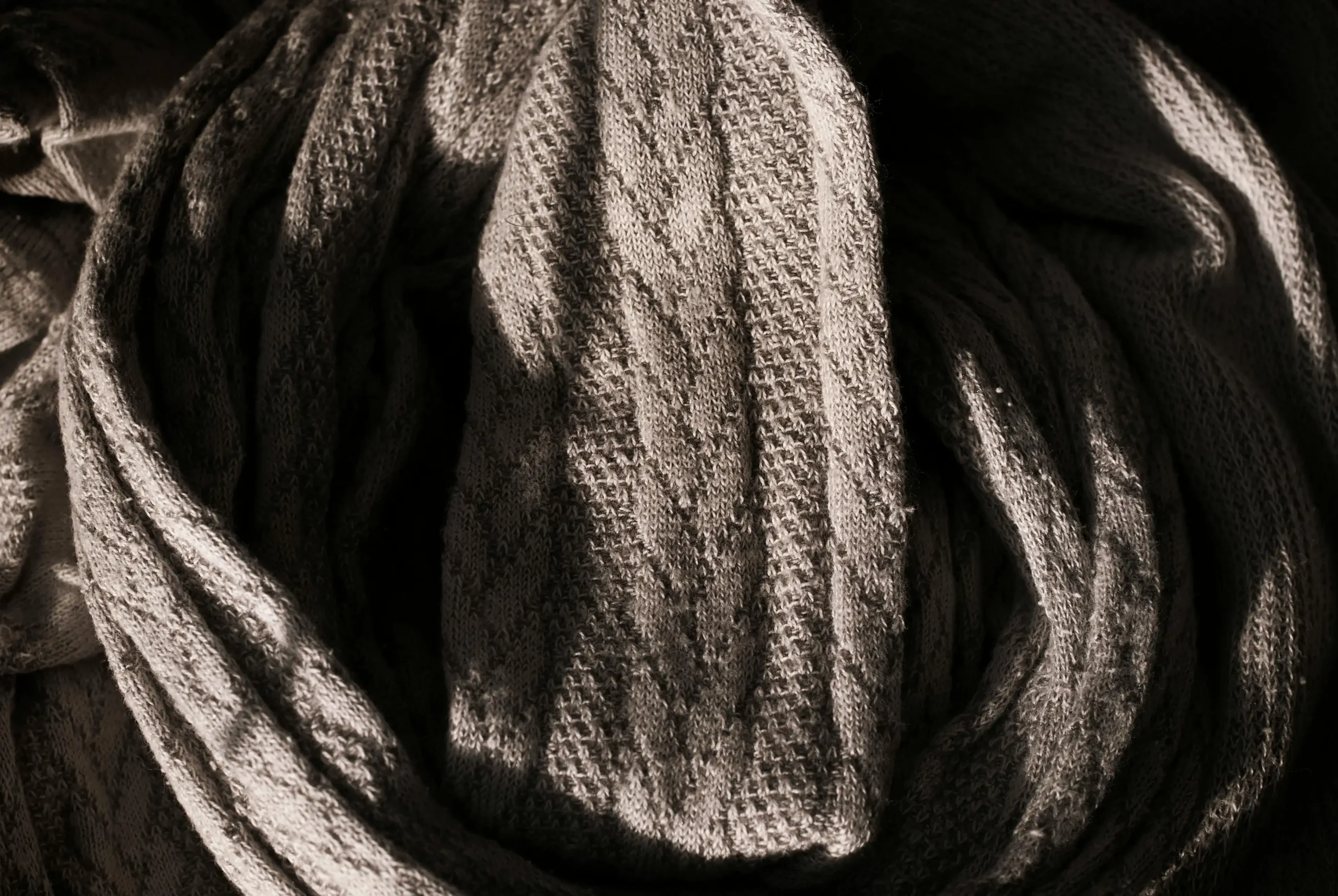
In flat knitting, gauge is needles per inch across the needle bed. A 3-gauge machine has three needles per inch; a 14-gauge machine has fourteen. Lower gauge means thicker yarn and bigger loops — the fabric builds up fast, reaching 600–900 GSM in a single layer. Higher gauge means finer yarn and smaller loops, landing around 220–380 GSM unless the mill runs a double-knit or interlock construction.
The practical ceiling matters more than the number itself. Chunky cable patterns need enough space between needles for the cable crossings to articulate. Below 3-gauge, cables start to look like ropes; above 5-gauge, the twist structure flattens out and the pattern reads as texture rather than relief. Most commercial cable outerwear sits at 3.5- or 5-gauge. Fine-gauge programs, by contrast, live at 12-, 14-, and 16-gauge — dense enough to block wind, light enough to layer under a shell.
Yarn consumption follows the gauge almost one-to-one. A 5-gauge chunky cardigan in a wool-blend can consume 900–1,200 grams of yarn per garment. The same silhouette at 14-gauge uses 300–450 grams. When wool prices move, chunky programs feel the shock first — which is exactly what happened through 2025, when merino prices climbed and some brands quietly shifted their AW26 chunky blocks toward wool-acrylic blends to hold the retail price point.
Why AW26-27 Is Tilting Chunky — But Not Everywhere
Runway signals and wholesale order books both point the same way: chunky cable is having a strong cycle. The pattern is on schedule — cable knit outerwear follows an 8-to-10-year revival rhythm, and the last major peak was around 2018. AW25 order books across European wholesalers showed cable knit coats up roughly 15–20% in units, and early AW26 indications from knitwear trade shows in Florence suggest the cycle still has a season or two to run.
Fine gauge is not retreating, though. What changed is its role. Brands that used to run fine-gauge merino as a standalone fashion story have repositioned it as a technical layer — 16-gauge circular-knit base layers, 12-gauge double-knit overshirts, and performance knits for the travel and light-outerwear categories. The growth in fine gauge is coming from function-led product, not from fashion-led product. Two different buyers, two different value chains.
For a fabric or garment supplier, the practical reading is: chunky cable capacity will be tight for AW26-27 if you wait too long to book. Cable programs need 5-gauge or 7-gauge flat machines with transfer capability — a machine pool that most Chinese knitwear mills run at 70–80% utilization during peak booking months, which for AW26 delivery means committing production slots between March and June 2026.
Production Cost and Lead Time: Where the Gap Really Is
Chunky knits are slower to knit but faster to finish. A 5-gauge cable panel takes more machine time per garment than a 14-gauge plain knit — the cable transfers add roughly 30–40% to knitting time — but the finishing route is forgiving: thick fabric hides minor linking flaws, and the bulky hand means buyers accept a wider tolerance on stitch regularity.
Fine gauge reverses the equation. Knitting is fast; linking and finishing are the bottleneck. At 14-gauge, a single misplaced stitch shows, so the mill runs higher inspection density and more overlock rejects. Fine-gauge programs also lean on wash-and-dry finishing for dimensional stability, which adds process steps that chunky garments skip.
Net cost per garment lands surprisingly close. A chunky cable cardigan at 900 grams of 50/50 wool-acrylic runs roughly USD 18–26 FOB on a 1,500-piece order. A fine-gauge 14-gauge merino-blend cardigan at 350 grams runs USD 14–20 FOB. The chunky garment costs more in materials and machine time; the fine-gauge garment costs more in labor per stitch. Gross margin per piece favors chunky — the perceived value at retail supports a higher multiple on the landed cost — which is another reason buyers keep the cable category in the plan.
Lead times differ by machinery more than by gauge. Cable programs on 5-gauge flat machines with transfer capability: 45–60 days from yarn-in to ex-factory for a standard 1,500-piece color program, assuming the yarn is on the shelf. Fine-gauge programs on 14-gauge machines: 35–50 days. The cable penalty is real but modest — the bigger risk is capacity, not calendar time.

Quality Risks That Differ by Construction
The two constructions fail in different ways, and QC needs to look for different things. Chunky cable knits pill, especially in wool-rich blends below 30% synthetic content. The Martindale abrasion score on a 5-gauge cable in 70/30 wool-acrylic will typically land between 8,000 and 15,000 rubs before visible pilling — acceptable for outerwear, unacceptable for anything worn against skin. Fine-gauge knits suffer more from dimensional instability: a 14-gauge merino cardigan that was not properly wash-relaxed can lose 5–8% of its length after first wash, which is a returns driver in consumer reviews.
Snagging behaves differently too. Cable structure creates raised loops that catch on hardware — zippers, buttons, bag straps. Designers mitigate this with tighter stitch density at the cable crossings, which the knitting program must specify per panel. Fine gauge snags invisibly: single-end breaks create tiny holes that consumers find weeks later. Both defects are preventable at the inspection stage, but the inspection criteria differ, and a mill that specializes in one gauge will often miss the failure mode of the other.
This is the strongest argument for splitting the program across specialists rather than consolidating. The Textile Institute’s published technical guidance on knitted fabric assessment notes that gauge-specific defect patterns — laddering in fine gauge, cable distortion in chunky — require different test protocols, and mills tend to hold either flat-bed cable expertise or fine-gauge linking expertise, rarely both at equal depth. More on the Institute’s resources is available at textileinstitute.org.
How to Structure the AW26-27 Order
A workable program for most mid-market brands looks like a 60/40 split: chunky cable as the fashion hero with higher margin per piece, fine gauge as the volume layer with lower risk. Book the chunky first. Machine capacity on 5-gauge cable lines tightens before fine-gauge capacity does, and the yarn is heavier to warehouse, so mills prefer to load cable orders early in the season and keep fine-gauge lines for late fill-ins.
On specs, pin three things before sampling. Gauge and needle configuration — specify 3.5G or 5G explicitly, because “chunky” means different things to different mills. Yarn blend and count — the difference between 70/30 wool-acrylic and 50/50 changes the pilling score and the price by 20%+. Finishing route — washed versus dry-cleaned only, because that decision controls shrinkage claims on the care label.
For buyers starting a cable program without existing 5-gauge relationships, the practical entry point is a sampling order of 300–500 pieces in two colorways, which most Wenzhou-area knitwear mills accept with a 7–10 day lab-dip and 14–21 day salesman sample. That is enough volume to lock machine slots and validate the washing performance before committing the bulk program. For a deeper read on how fabric construction decisions flow into sourcing strategy, see our sustainable fabric sourcing checklist and the technical comparison of woolen versus worsted yarns, where gauge and spin interact the same way.
Learn more: Knit Fabric Guide · Explore Performance Knit Fabrics. Need samples? Request free swatches.
Related reading: Building a Fall Capsule Around One Tweed: The Six-Piece Math
Related reading: Reading Knit Gauge: What 7gg, 12gg and 14gg Mean for Sweater Programs

Related Insights
Performance Knits in Luxury Outerwear: The Athluxury Trend
The jacket that sold luxury knitwear for a century met the fabric technologies of sportswear,...
Tweed and Boucle for Spring 2026: Lighter Weights and Softer Palettes
Tweed’s migration out of the winter wardrobe is now a settled pattern: buyers who once...
Building a Fall Capsule Around One Tweed: The Six-Piece Math
Small fashion brands do not lose money on tweed because they picked the wrong color....