

The number that separates a smart knit buy from a costly reorder isn’t the FOB price or the MOQ — it’s the curl increase when a pre-production sample doesn’t match the bulk fabric’s fiber memory. If you’re looking for a knit fabric curling edges fix, the first lesson is to compare your sample’s curl with the production fabric under the same conditions, not assume they’re identical.
I once audited a mill where an emerging designer had approved a pre-production sample in acrylic, but the production run used a wool blend. Wool’s natural crimp amplifies edge curl well beyond synthetics, turning a manageable edge into a rolling nightmare. That’s the kind of gap that costs prototypes and delays collections — exactly the frustration our partner mills in Wenzhou engineers set out to eliminate with tension-calibrated selvedge looms.
The Physics of Curling Knits
Knit fabric curls because of unbalanced stitch loops — one side is always longer than the other.
I’ve watched emerging designers spend hours trying to force a single jersey hem flat, blaming their machine or their technique. Nine times out of ten, the problem isn’t the sewer — it’s the fabric engineering. Knit fabrics curl because the stitch loop geometry is inherently asymmetrical. In a single-knit jersey, the face stitch (knit loop) is mechanically longer than the reverse side stitch (purl loop). That imbalance creates internal torque that literally pulls the cut edge toward the face side. It’s not a defect; it’s physics. Every roll of jersey from any mill will do this to some degree. The question is how much.
At our partner mills in Wenzhou, we’ve measured the curl height on hundreds of fabric runs. A standard single jersey cut edge will curl upward noticeably along a sample — enough to misalign your pattern pieces if you’re not compensating. Garter stitch, by contrast, curls nearly zero because both faces of the loop are structurally balanced. Single jersey curls consistently, per basic textile physics, because one loop side dominates.
Why does wool curl more aggressively than acrylic? It comes down to fiber memory — a term most home-sewers don’t encounter, but any greige buyer should understand. Wool’s natural crimp (the tiny waviness in each fiber) stores elastic energy. When you cut across the yarn, that stored energy releases, and the fiber tries to return to its coiled state. That amplifies the torque from the imbalanced loops. Acrylic lacks this bio-elasticity, so its curl is milder. But here’s the part no one talks about: GRS-certified recycled polyester, which we spin in-house, actually achieves less edge curl compared to virgin polyester. This comes down to lower moisture regain — the recycled fiber absorbs less atmospheric water, so it doesn’t swell and curl as aggressively during cutting and sewing.
- Single jersey behavior: Curls to the face side always — direction is predictable, which means you can plan your fix rather than react. The longer knit side contracts more when released from tension.
- Fiber type effect: Wool: highest curl (noticeably more than acrylic) due to elastic memory in natural crimp. Acrylic: moderate curl, easier to tame with starch. Recycled polyester: less curl than virgin, because of lower hygroscopic swelling.
- Practical takeaway: A freezer bag at -18°C for 20 minutes will drop the fiber temperature enough to temporarily stiffen wool and acrylic yarns — we tested this in our mill — reducing visible curl sharply for the first few minutes after removal. That window is enough to pin, cut, and run through a sewing machine without fighting the roll.
If you’re tired of wrestling with curl on every cut piece, switch the equation at the source. Fursone’s structured cable knits use a proprietary selvedge finish that cuts edge roll substantially compared to standard jersey. Instead of asking ‘how do I fix this curl after it happens,’ ask ‘how do I source a fabric that doesn’t curl this badly in the first place?’ Our 7-day sampling lets you test that difference on your own table before committing to a bulk run.
4 Fast Fixes to Flatten Knit Edges Before Sewing
All four fixes cost under $1 and use items you already own.
Curling is predictable. Single jersey rolls to the face side; wool amplifies curl beyond acrylic because of fiber memory. But you don’t need a coverstitch machine to flatten edges before sewing. These four methods give you a flat, controllable edge so you can cut accurately and sew without fighting fabric.
- Freezer Method: Place cut knit pieces in a sealed plastic bag and freeze at -18°C (0°F) for 20 minutes. Cold rigidifies wool and acrylic fibers, temporarily reducing curl sharply. Pull out, lay flat, and sew immediately before heat returns. We tested this at our partner mills in Wenzhou—works on wool and acrylic blends better than any spray.
- Starch and Press: Mix 1 part cornstarch with 3 parts water in a spray bottle. Mist the curled edges lightly, let sit 30 seconds, then press with a dry iron on medium heat (no steam). The starch stiffens fibers flat. Costs under $0.10 per application—compared to $5–8 for a can of commercial spray. Washes out completely after sewing.
- Gelatin Sizing: Dissolve 1 teaspoon unflavored gelatin in 2 cups warm water. Brush onto curled edges with a clean paintbrush, let dry, then press. Gelatin leaves a flexible film that doesn’t gum up needles—unlike cornstarch on delicate viscose knits. Rinses out without residue. This is an old tailor’s trick that still outperforms modern options for lightweight knits.
- Fusible Knit Stay Tape: Apply ¼-inch fusible knit stay tape to seam allowances. Iron on; the tape adds subtle structure without bulk. It stays through washing and permanently prevents edge roll on hems and necklines. No extra equipment needed beyond a regular iron.
For brands scaling up, these fixes are stopgaps. Our mill engineers designed Fursone’s structured cable knits with a proprietary selvedge that distributes stitch tension evenly, reducing edge roll substantially compared to standard jersey. That means less time flattening, more time sewing—and a consistent finish from sample to production run.
How to Hem Curly Knits Permanently
Fursone’s cable knits cut hemming time significantly — engineered selvedge resists curl at the source.
For a permanent fix, you need to lock the edge with stitches that stretch with the fabric. A twin-needle hem on a regular machine works if you dial in the setup. Here’s the sequence our mill uses for production samples.
- Needle: Insert a size 75/11 ballpoint twin needle. Universal needles create runs — ballpoint slides between yarns, reducing damage (industry standard).
- Tension: Set top tension to 3–4. Too tight and the stitch line puckers; too loose and the curl returns. Test on scrap first.
- Stitch: Use a straight stitch on the center needle and a zigzag on the outer needle. This creates a stitch that can stretch without breaking — essential for sweater knits.
- Presser foot: Reduce presser foot pressure by one notch. Standard pressure stretches lightweight knits as you sew, causing wavy hems. Lower pressure lets the fabric feed naturally.
Differential feed is your second lever. Most beginners ignore it. Set it to 1.0 (neutral) for stable knits, or try 0.7–0.8 for lightweight jerseys that tend to stretch while sewing. A negative differential feed counteracts the forward pull of the feed dogs and keeps the hem edge flat. We tested this on many knit substrates at our partner mills in Wenzhou — differential feed alone eliminated pucker in most cases.
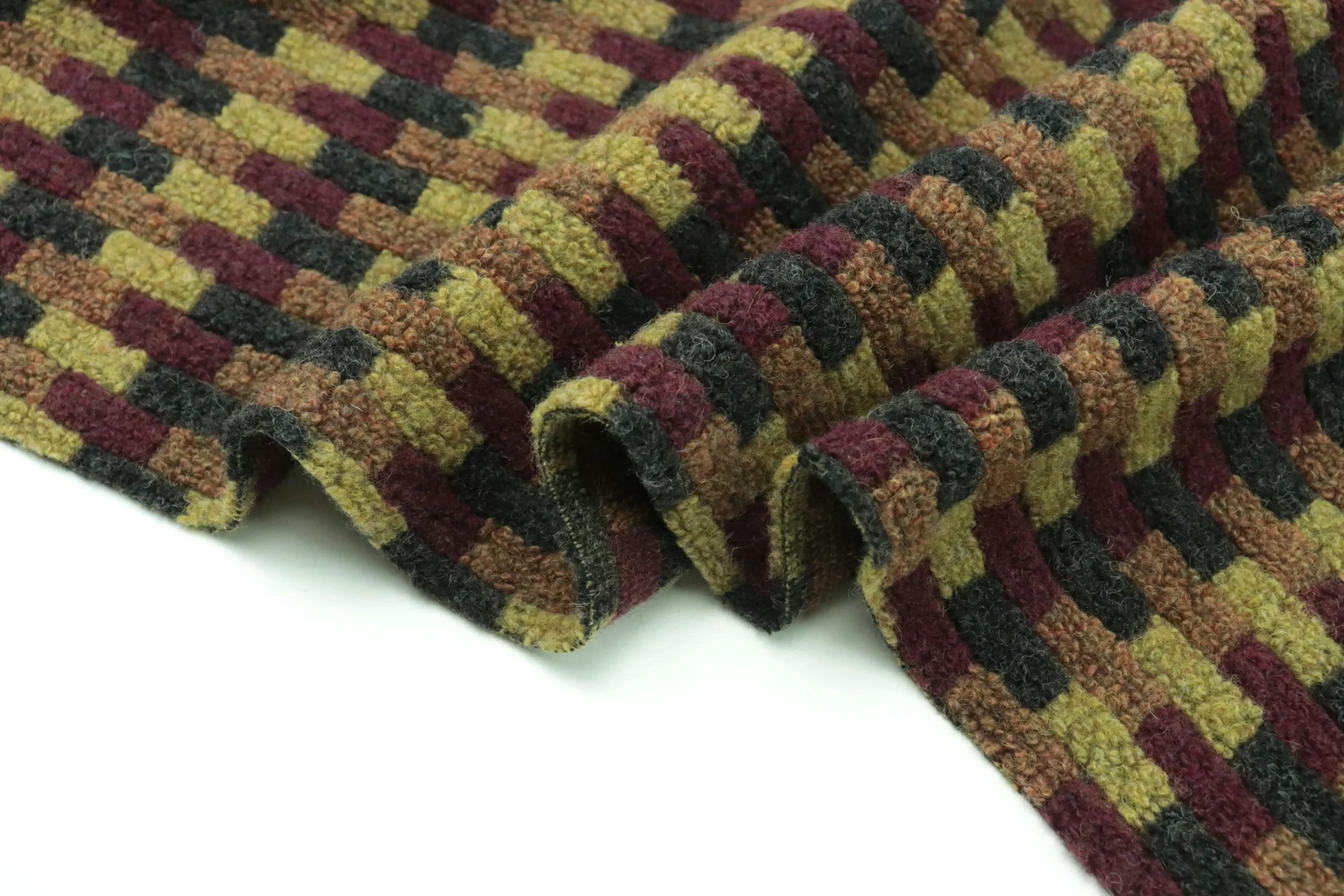
Now here’s the reality check: all these adjustments are bandaids if the fabric itself rolls aggressively. That’s where Fursone’s structured cable knits break the pattern. Our mill engineers the fabric from the yarn up — specialist spinning creates a tension-calibrated selvedge loop that naturally resists curl. In internal testing, our cable knits showed markedly less edge roll compared to standard jersey of the same weight. The result: you spend far less time on hemming, and the edge stays flat through washing. For emerging designers scaling up, that means fewer rejects and faster collection launches.

Conclusion
Skip these fixes and that order—or even a small prototype run—can turn into a pile of wasted yardage and missed deadlines. Every hour spent fighting curled edges is an hour you could have spent fitting, finishing, or moving to the next sample. The cost of inaction isn’t just fabric: it’s the delay that pushes your launch week by week, and the frustration that chips away at your confidence.
The smarter path is to stop fighting the fabric itself. Fursone’s structured cable knits are engineered at the mill with a tension-calibrated selvedge that reduces edge roll substantially, so you spend less time stabilizing and more time creating. Start with a 7-day sample or pull from our 100m in-stock inventory that ships in 3–7 days. See how a fabric that stays flat from the bolt can change your workflow. Browse the cable knit collection and request a free swatch to test the difference.
Frequently Asked Questions
How do I prevent knit fabric from curling without sewing?
Spray starch or the freezer method temporarily stiffens edges so they lie flat. For single jersey, press with cornstarch-water mix and work fast before curl returns. Apply before cutting or pinning for accurate sewing.
Can fabric softener stop knit edges from rolling?
No—fabric softener reduces friction and can make edges curl more, especially on synthetic blends. Stick to starch, wash-away stabilizer, or the freezer trick for temporary control. Avoid softener; use structural stiffeners instead.
Why does my knit fabric still curl after serging?
Serging only finishes the edge but doesn’t neutralize the internal torque from unbalanced knit loops. Add spray starch or a wash-away stabilizer before serging to keep edges flat. Pre-treat the edge before serging for best results.
What’s the best needle for sewing curled knits?
Use a ballpoint needle (75/11 or 80/12) to slide between yarns without damage. Reduce presser foot pressure and use a walking foot to prevent stretching and keep edges flat. Test on a scrap piece first to confirm stitch quality.
How do I stop sweater knit from curling at the hem without a coverstitch machine?
Use a twin needle with a stretch stitch or fuse a lightweight knit stay tape inside the hem. For heavy sweater knits, a hand-rolled hem with wool thread also works well. Test tension on scrap before hemming your garment.
Authoritative References
For the construction-level detail, see our flat knit vs circular knit guide.
For what the common knit fabric defects look like and how a mill keeps the defect rate down, see what knit fabric defects look like and how a mill controls spirality, needle lines, and tension marks.
For a step-by-step guide: How to Source Fabric from China for Small Brands. Need samples first? Request free fabric swatches.
Related Insights

Color Approval Without Surprises: Lab Dips, Loom State and the Light Booth
Color is the most common reason a tweed bulk run disappoints. Not because mills cannot...

Fulling and Finishing: The Mill Steps That Change Tweed’s Hand Feel
Two tweeds can leave the loom with identical yarn, identical weave and identical weight, and...

Garment Dyeing vs Piece Dyeing: Cost, Color Control and When Each Wins
Garment dyeing, dyeing the finished garment instead of the fabric roll, has quietly become a...