Key Takeaway
Most fabric buyers don't think about finishing until they receive a roll that shrinks 4% on the first garment press. Decatizing and crabbing are the two wet-finishing processes that lock woven tweed into its final dimensions, hand, and surface appearance. They're not the same thing, and confusing them leads to wrong sp
Most fabric buyers don’t think about finishing until they receive a roll that shrinks 4% on the first garment press. Decatizing and crabbing are the two wet-finishing processes that lock woven tweed into its final dimensions, hand, and surface appearance. They’re not the same thing, and confusing them leads to wrong specifications — a fabric that was crabbed but not decatized will still shrink under steam, while one that was decatized but not crabbed may have stable dimensions but a surface that hasn’t been properly set.
What Decatizing Actually Does to Tweed
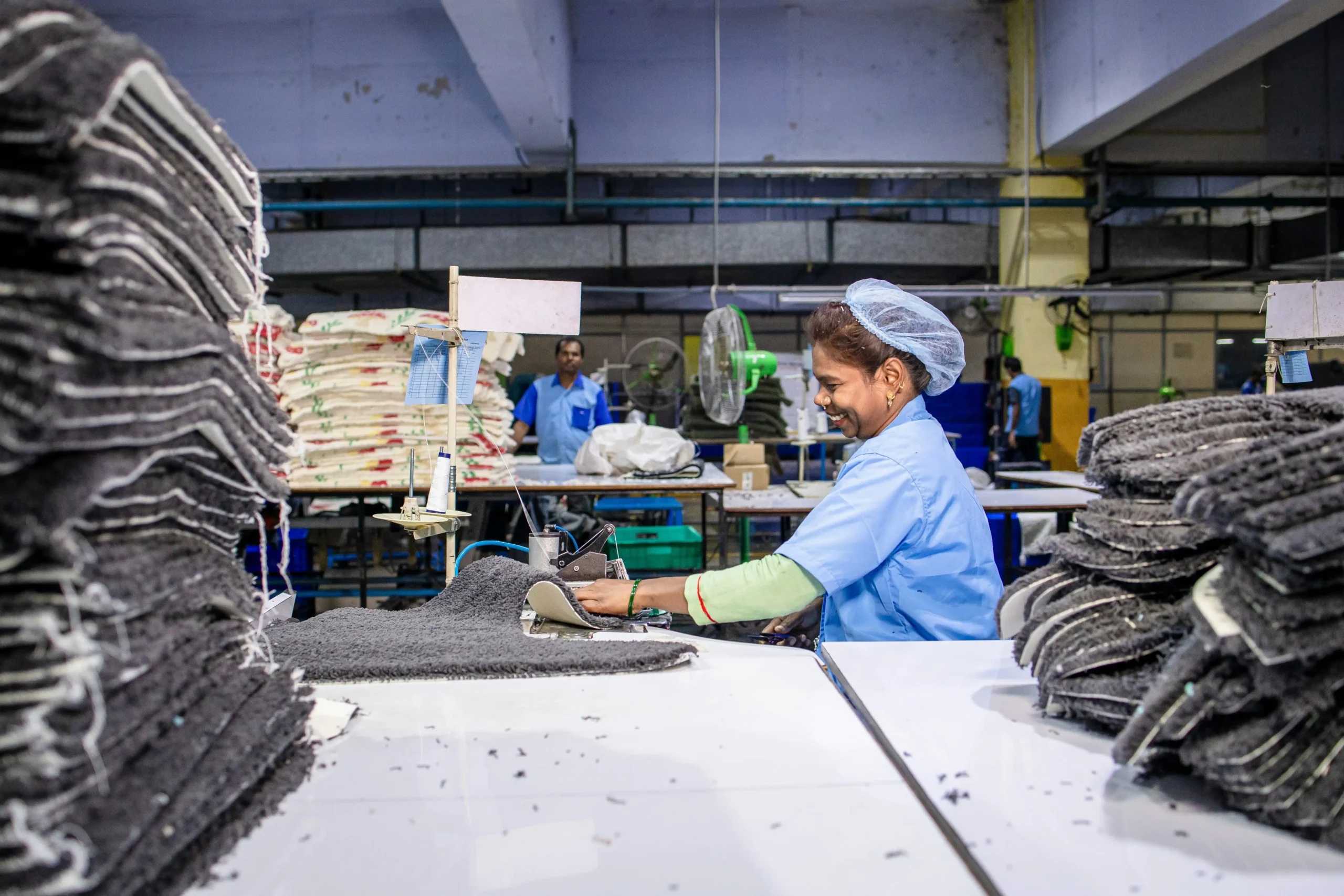
Decatizing (sometimes spelled “decatising” in British English) passes the fabric through a steam chamber and then wraps it around a perforated cylinder under tension. Steam penetrates the fiber, relaxing the internal stresses that built up during weaving. The wool or blend fibers swell, the yarn crimp redistributes, and the weave structure settles into its equilibrium position. After decatizing, the fabric is dried in position on the cylinder, which locks in the new dimensions.
The key parameters are steam pressure (typically 2–4 bar for wool tweed), cylinder rotation speed (8–15 m/min), and the number of passes. A single pass gives light relaxation — enough to remove most residual shrinkage but leave the fabric with a fairly natural hand. Two passes with higher pressure produce a fuller, softer fabric with more surface bloom, which is what premium suiting buyers expect. At a 300-loom mill, a standard decatizing cycle for 1,000 meters of 350 GSM tweed takes about 45 minutes.
The measurable outcome is residual shrinkage. A properly decatized wool tweed should show less than 1.5% shrinkage in both warp and weft when tested under ISO 3759 (relaxation) and ISO 3760 (relaxation and relaxation-wet). If a buyer receives fabric that shrinks more than 2%, the mill either skipped decatizing or ran it too lightly. This is one of the most common quality disputes in woven fabric trade.
Crabbing: Setting the Weave Structure
Crabbing is a different operation, though it’s often done on the same machine line. In crabbing, the fabric passes through a hot water trough (85–95°C for wool) and then wraps tightly around a large-diameter cylinder while under controlled tension. The hot water opens the wool fiber scales, and the tension on the cylinder forces the warp and weft yarns into their final positions within the weave. When the fabric cools on the cylinder, the fiber scales close again, locking the yarns in place.
The purpose of crabbing is not just shrinkage control — it’s weave stability. A crabbed fabric resists skewing (also called spirality or bowing), which is the tendency of weft yarns to shift diagonally across the fabric width. Skewing is especially problematic in patterned tweeds like herringbone or houndstooth, where even a 2% skew is visually obvious. Crabbing also improves the fabric’s dimensional stability during garment manufacturing: a crabbed fabric holds its shape better when cut, pressed, and handled on the production floor.
There are two types: single-crabbing (one pass through the hot water and cylinder) and double-crabbing (two passes, with the fabric rewound between passes so that both faces get equal treatment). Double-crabbing is the standard for premium suiting fabrics because it produces a more uniform set across the full fabric width. Single-crabbing is acceptable for coating and heavier tweeds where surface uniformity is less critical.
The Correct Sequence: Crab First, Then Decatize
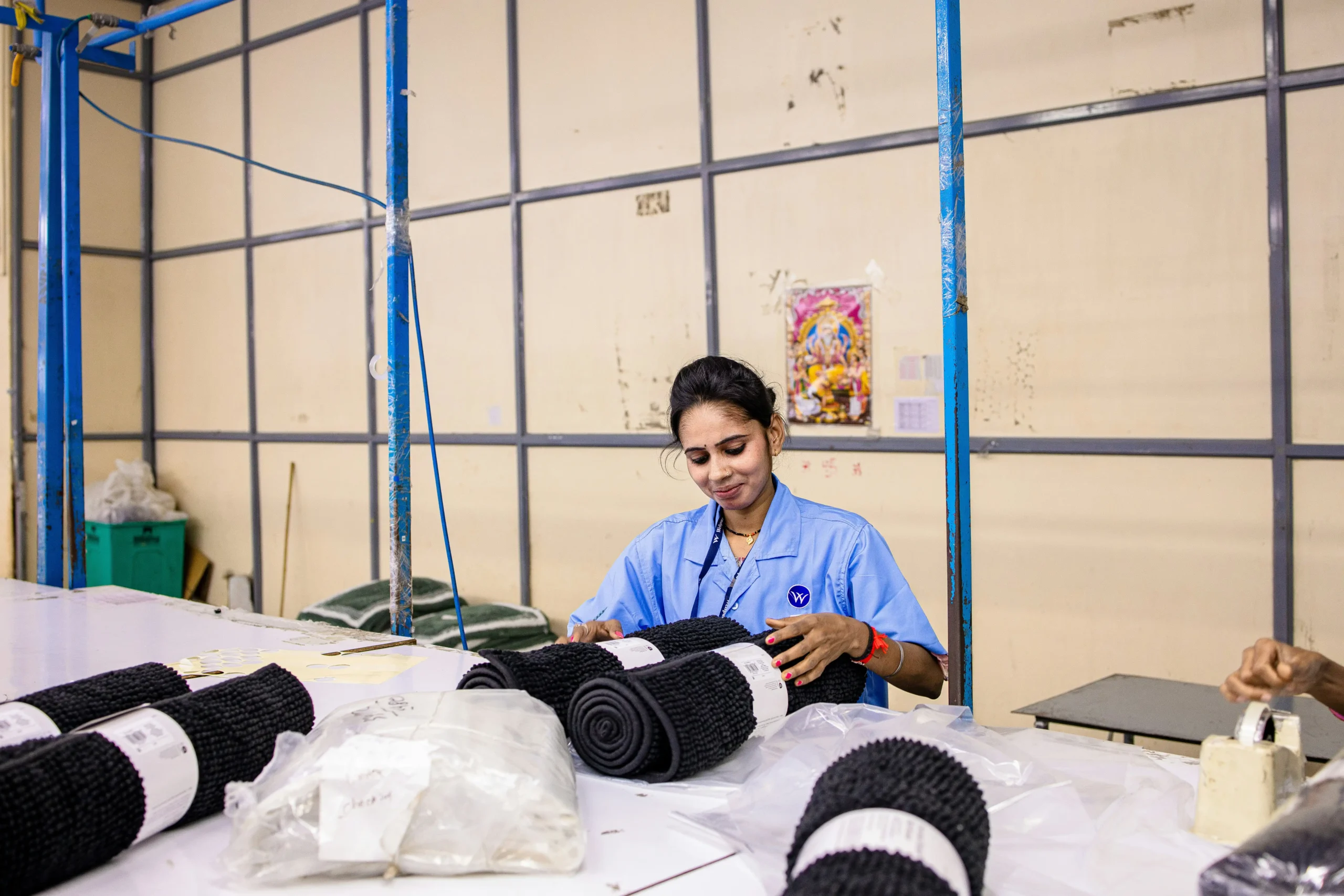
In a production finishing line, the order matters. Crabbing comes first, then decatizing. The logic is straightforward: crabbing sets the yarn positions in the weave under high tension and hot water; decatizing then relaxes the fibers and removes any residual shrinkage without disturbing the set that crabbing achieved. If you reverse the order — decatize first, then crab — the high-tension crabbing step can partially undo the relaxation that decatizing provided, and the fabric ends up with internal stress that shows up as shrinkage later.
A typical finishing sequence for a 350 GSM wool tweed destined for suiting looks like this: singe → crab (double) → decatize (two passes) → press → inspect. Each step adds cost and time — roughly USD 0.15–0.25 per meter for the combined crabbing and decatizing operations — but it’s a small fraction of the total fabric price and it eliminates the most common quality complaint.
For lighter-weight tweeds (under 280 GSM), some mills skip crabbing entirely and rely on decatizing alone. This works for plain weaves where skewing is less of a risk, but it’s a cost-cutting move, not a technical decision. If you’re sourcing patterned tweed — especially herringbone or other directional patterns — insist on double-crabbing in your specification.
What Buyers Should Test and Specify
When you receive a bulk order, the first check is dimensional stability. Cut a 50 cm × 50 cm sample, mark it, steam it for 30 seconds with a standard hand press at 150°C, and measure the change. Warp shrinkage should be under 1.5%, weft under 1.5%. If it exceeds 2%, the finishing was inadequate.
The second check is skewing. Lay the fabric flat and measure the angle of the weft yarns relative to the selvedge. For a crabbed fabric, skew should be under 2%. For an uncrabbed fabric, 3–5% is common and may cause problems in garment cutting. The test method is standardized — ASTM International publishes D3882 for measuring bow and skewness in woven and knitted fabrics, and most third-party inspection houses in China and Vietnam run it as part of pre-shipment inspection.
In your RFQ, specify the finishing sequence explicitly: “double-crabbed + two-pass decatized” for suiting-weight tweed, or “single-crabbed + one-pass decatized” for coating-weight. Don’t just write “finished” — that term means different things to different mills. Some mills consider a light steam pass to be “finishing,” while others run the full sequence. If you’re building a tweed program and want the finishing spec written into the contract before sampling, send us the target weight and end-use and we’ll confirm the standard finishing route and price band. The 4-point inspection system catches surface defects but won’t catch inadequate finishing — that requires separate shrinkage and skew testing.
For brands that run multiple fabric programs across different mills, standardizing the finishing specification is one of the highest-leverage quality controls available. A fabric that is properly crabbed and decatized at the mill will behave predictably in the garment factory, regardless of which cutting or pressing equipment is used downstream. For more on how weaving parameters interact with finishing to determine final fabric quality, see our technical guide on tension and beat-up settings.
On seam slippage and the wider QC toolkit for fabric rolls, seam slippage testing for tweed suiting covers the testing side.
For the full agenda of a mill pre-production meeting, from seal sample to escalation path, see what a fabric pre-production meeting should cover.
(function(){
var facades=document.querySelectorAll(‘.yt-facade’);
for(var i=0;i<facades.length;i++){
(function(f){
f.addEventListener('click',function() var id=f.getAttribute('data-yt-id');
if(!id||!/^[w-]{6,20}$/.test(id)){return; f.innerHTML='’;
});
})(facades[i]);
}
})();
Learn more: Tweed Fabric Guide · Explore Chanel-Style Tweed. Need samples? Request free swatches.
Related reading: Raising and Brushing: How Nap Is Built in Wool Finishing