

An incomplete fabric RFQ wastes everyone’s time. The mill quotes based on assumptions, the buyer receives a price that does not reflect actual requirements, and the first production batch reveals costly misunderstandings about GSM, yarn count, or color matching. A structured fabric RFQ template with the right fields prevents this cycle. For tweed and knit fabric sourcing from Chinese mills, twelve specific fields capture the information needed for an accurate quote, a usable sample, and a production run that meets specification.
Fursone’s Wenzhou facility processes RFQs daily across its 300+ loom configuration, producing Chanel-style tweed, boucle, and knit fabrics for global buyers. The fields below reflect the information that the production team needs to generate an accurate quote and allocate the correct looms, yarn, and finishing processes. Omitting any field forces the mill to guess, and guesses produce texture mismatches, weight deviations, and color rejections that surface late in the production cycle.
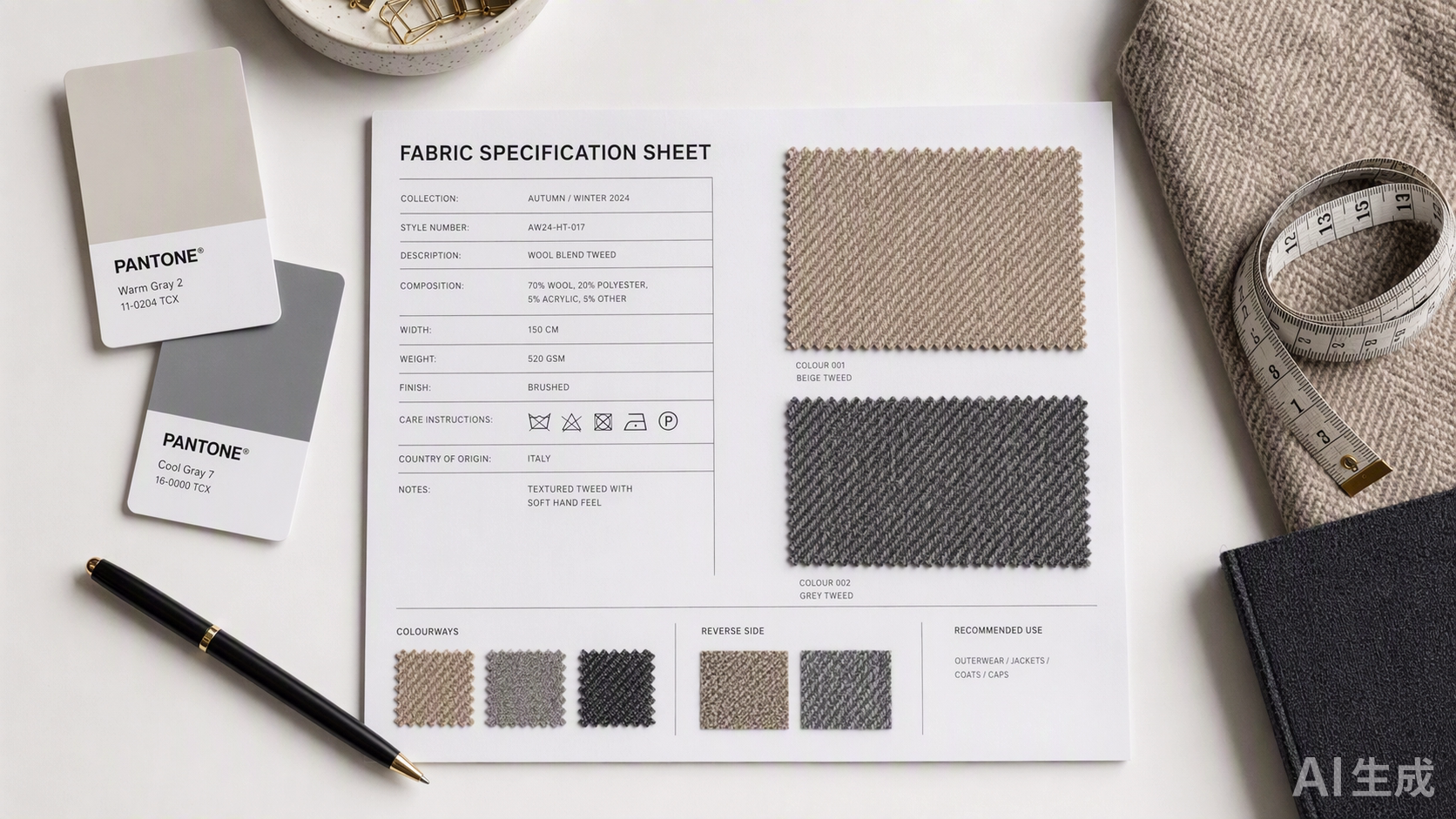

Field 1: Fabric Type and Construction
What to specify: Woven tweed, boucle tweed, cable knit, flat knit, or jacquard knit. State whether the construction is plain weave, twill, herringbone, or double cloth. For knit fabrics, specify gauge (7G, 9G, 12G) and whether the construction is flat or circular.
Why it matters: Fabric type determines which looms or knitting machines are allocated. Fursone’s 300+ loom configuration includes power looms for woven tweed and circular machines for knit fabrics. An RFQ that says “wool fabric” without specifying construction could be quoted as woven tweed when the buyer wants knit.
Field 2: Fiber Composition
What to specify: Exact percentage breakdown of each fiber. Example: 60% wool, 25% polyester, 10% acrylic, 5% metallic. State whether recycled content is required and at what percentage.
Why it matters: Composition affects price, hand feel, pilling performance, and sustainability claims. Wool content above 50 percent generally produces better drape and warmth; acrylic reduces cost but increases pilling tendency. If GRS-certified recycled content is needed, specify the percentage and certification requirement.
Field 3: Yarn Specification
What to specify: Yarn count (Ne or Nm), twist direction (Z/S), and for boucle: overfeed ratio and binder type. If unsure, attach a swatch and request reverse-engineering.
Why it matters: Yarn specification is the most commonly omitted field and the most common source of texture mismatch. Without it, the mill selects default yarn that may not match the buyer’s intended hand feel or surface character. For boucle tweed, the overfeed ratio directly controls loop size.
Field 4: GSM (Fabric Weight)
What to specify: Target GSM with an acceptable tolerance range. Coat-weight tweed typically targets 380 to 450 GSM; dress-weight targets 280 to 350 GSM; knit outerwear targets 300 to 500 GSM depending on gauge.
Why it matters: GSM affects drape, warmth, and cutting yield. A 50 GSM deviation changes how many garments can be cut from each meter. Specifying GSM without width (Field 5) is incomplete because total fabric weight per linear meter depends on both.
Field 5: Fabric Width
What to specify: Target width in inches or centimeters. Standard widths are 58 inches (147 cm) and 60 inches (152 cm) for woven tweed; knit fabrics vary from 130 to 180 cm depending on machine type.
Why it matters: Width determines cutting yield. A buyer who calculates yardage based on 60-inch width but receives 58-inch rolls loses approximately 3.3 percent of usable fabric per garment. This mismatch is a common cause of short shipments in garment production.
Submit your complete 12-field RFQ to Fursone for accurate quoting. 100m stock rolls for sampling, 300m custom MOQ with 7-day turnaround. ISO-certified quality control on 300+ looms.
Field 6: Color Specification
What to specify: Pantone TCX (Textile Cotton) reference number. For custom colors, send a physical swatch, not a digital image. State whether the fabric is yarn-dyed or piece-dyed.
Why it matters: Screen colors vary by device, monitor calibration, and ambient lighting. A Pantone TCX reference is the industry-standard method for communicating color in textiles. Yarn-dyed tweed produces color-through construction where the pattern is visible on both sides; piece-dyed fabric has color only on the surface.
Field 7: MOQ and Order Quantity
What to specify: Total order quantity in meters and whether the order is stock (100m minimum, no MOQ) or custom (300m MOQ). State whether the order will be split across multiple deliveries.
Why it matters: Stock orders ship from existing inventory within days. Custom orders require yarn procurement, loom allocation, and finishing, which is why the 300m MOQ exists. Splitting a 5,000-meter order into two 2,500-meter deliveries allows the buyer to verify bulk quality before the full shipment is produced.
Field 8: Sampling Requirements
What to specify: Whether lab dips (color matches on fabric substrate) are needed before bulk production. Whether strike-offs (small woven samples showing the actual pattern and texture) are required. State the sampling deadline.
Why it matters: Fursone offers 7-day sampling turnaround from specification lock. Lab dips verify color accuracy before bulk dyeing; strike-offs verify weave structure and texture. Skipping sampling to save time risks discovering color or texture problems after 1,000 meters are produced, when corrections require a full re-run.
<h2 id="field-9-testing-requirements”>Field 9: Testing Requirements
What to specify: Required test standards and minimum grades. Example: ISO 12945-2 pilling grade 3-4 minimum; ISO 105-X12 colorfastness to rubbing grade 4 minimum; ISO 6330 washing shrinkage maximum 3 percent.
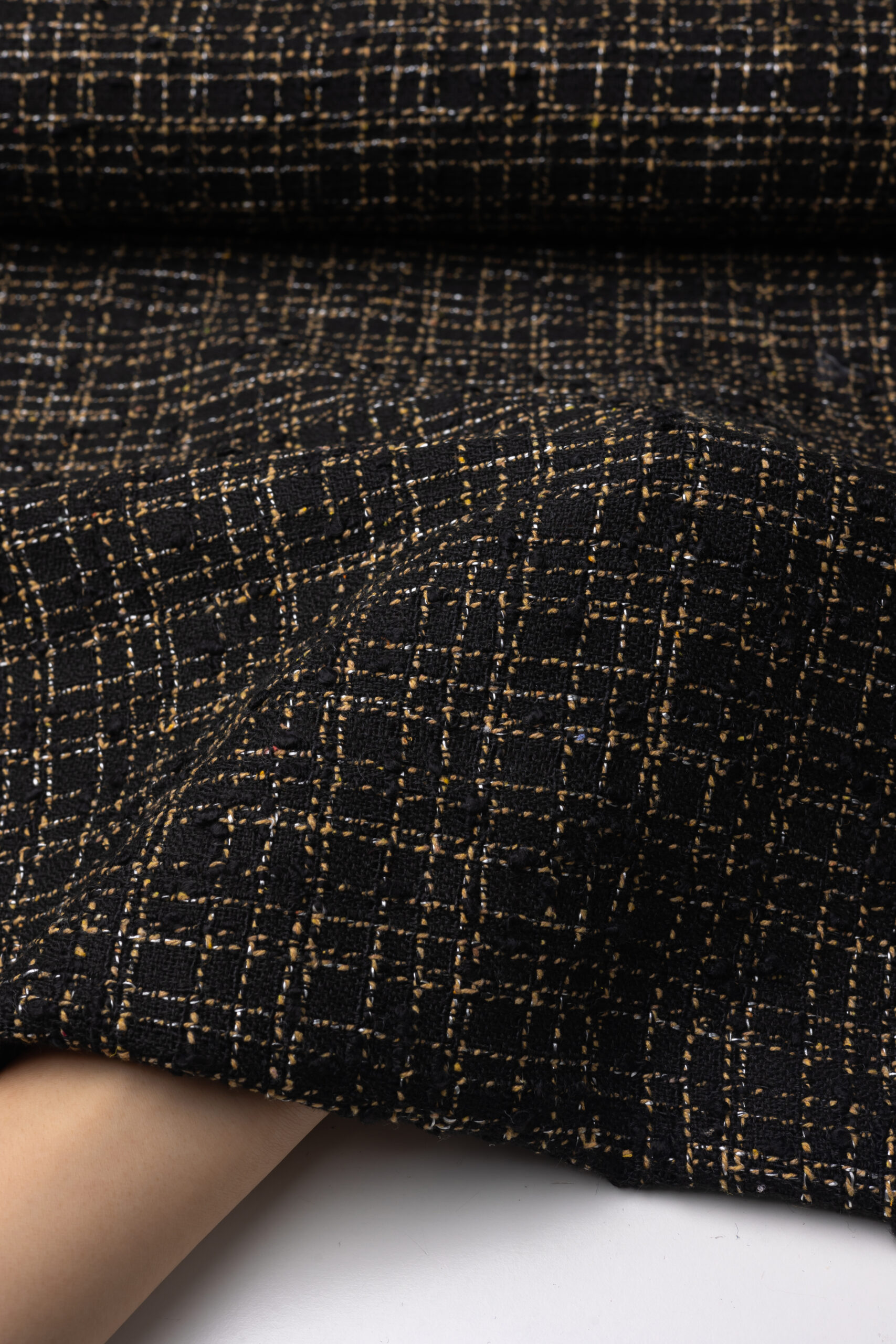
Why it matters: Generic quality language like “good quality” or “high standard” is unenforceable. Citing specific ISO test standards and grade thresholds creates a measurable acceptance criterion. Fursone’s ISO-certified testing provides grade 3-4 pilling results with each shipment. For Chanel-style tweed and premium boucle, grade 3-4 is the recommended minimum.
Field 10: Packaging and Roll Specifications
What to specify: Roll length (e.g., 30m or 50m per roll), tube type (cardboard or plastic), roll diameter limit, and whether bolts of fabric should be wrapped in plastic with desiccant. State whether roll tickets must include batch numbers and test report references.
Why it matters: Roll length affects cutting room efficiency; garment factories prefer consistent roll lengths to minimize end-of-roll waste. Desiccant packaging prevents moisture damage during sea freight. Roll tickets with batch numbers enable traceability if quality issues are discovered after delivery.
Field 11: Delivery Timeline and Incoterms
What to specify: Required delivery date (week or date), Incoterms 2020 term (FOB Ningbo, EXW Wenzhou, DDP destination), and whether air freight is acceptable for urgent orders. State the port of destination.
Why it matters: Incoterms define who is responsible for freight, insurance, and customs clearance. FOB (Free on Board) means the buyer’s freight forwarder takes over at the port; DDP (Delivered Duty Paid) means the mill handles door-to-door delivery. Fursone’s Wenzhou location ships from Ningbo port, approximately 4 hours by truck.
Field 12: Payment Terms
What to specify: Payment method (T/T wire transfer, L/C letter of credit, or trade assurance), deposit percentage, and balance payment trigger (before shipment, against documents, or after inspection). State the currency.
Why it matters: Standard terms for fabric orders from Chinese mills are 30 percent deposit with order confirmation and 70 percent balance before shipment, paid by T/T. L/C adds bank fees but provides payment security for larger orders. Specifying payment terms in the RFQ prevents last-minute negotiation delays when the order is ready to ship.
A real 5,000-meter herringbone program shows how the RFQ fields play out in our herringbone tweed case study.
Frequently Asked Questions
What is a fabric RFQ template?
A fabric RFQ template is a structured document listing the technical and commercial fields a mill needs to generate an accurate price quote. For tweed and knit fabric, twelve fields cover fabric type, composition, yarn spec, GSM, width, color, MOQ, sampling, testing, packaging, delivery, and payment.
Why do fabric quotes vary so much between mills?
Quote variation usually comes from incomplete RFQs. When fields are missing, each mill fills gaps with different assumptions about yarn quality, GSM, width, or testing standards. A complete 12-field RFQ forces all mills to quote against the same specification, making prices comparable.
What MOQ should I specify for tweed fabric?
For stock fabric, specify 100 meters (Fursone’s stock minimum with no MOQ). For custom fabric with specific color, GSM, or yarn composition, specify 1,000 meters (Fursone’s custom MOQ). Stock orders ship in days; custom orders require 7-day sampling followed by production.
Should I specify Pantone TCX or TPX for fabric?
Use Pantone TCX (Textile Cotton) references, not TPX (Paper). TCX swatches are printed on cotton fabric substrate, which provides a closer match to how color appears on textile material. Always send a physical swatch rather than relying on digital color communication.
Conclusion
Twelve fields transform a vague fabric inquiry into a precise purchase order. The fields fall into three groups: technical specification (fields 1 through 6) defines what the fabric is; commercial terms (fields 7, 8, 11, 12) define how the transaction works; quality and logistics (fields 9, 10) define how the product is verified and delivered. A complete RFQ in all twelve fields enables the mill to quote accurately, sample correctly, and produce to specification without guesswork.
Submit the completed RFQ to Fursone through the quote request page for tweed and knit fabric production. Stock orders of 100 meters ship within days; custom orders at the 300m MOQ include 7-day sampling, ISO-certified testing, and production on 300+ partner-mill looms with deep Wenzhou textile experience. The production team can also assist with reverse-engineering yarn specifications from a physical swatch if fields 2 through 4 are uncertain.
,
{“question”: “What MOQ should I specify for tweed fabric?”, “answer”: “100m for stock orders with no MOQ, 300m for custom orders with specific color or GSM requirements.”},
{“question”: “Should I specify Pantone TCX or TPX?”, “answer”: “Use Pantone TCX (Textile Cotton) references printed on cotton substrate, not TPX paper references.”}
]
}
},
]
}
For the construction-level detail, see our flat knit vs circular knit guide.
For how to compare fabric supplier quotes and read a total landed cost, see how to compare fabric supplier quotes and read a total landed cost.
For a step-by-step guide: How to Source Fabric from China for Small Brands. Need samples first? Request free fabric swatches.

Related Insights

How to Compare Fabric Quotes from Three Mills: A Side-by-Side Method
Three mills return three quotes for the same fabric brief, and the spread between them...

CNY Capacity Planning: Booking a Fabric Mill Around Chinese New Year
Every year, fabric buyers lose the same three weeks to the same event: Chinese New...

Second-Source Strategy: How Brands Qualify a Second Tweed Mill
Single-sourcing a signature fabric feels efficient right up to the season it fails: the mill’s...