Color fastness is the single most common reason fabric fails a buyer’s lab test. Two tests dominate the conversation: crocking (color rub-off) and lightfastness (color fade under UV exposure). They measure different failure modes, follow different ISO standards, and fail for different reasons. A fabric that passes crocking at Grade 4 can still fail lightfastness at Grade 3, and vice versa.
If you source tweed or knit fabric for fashion programs, you need to understand what each test actually measures, which standard governs it, and what grade your buyer’s lab will demand. This article breaks down both tests with the numbers that matter.

What the Crocking Test Measures
Crocking tests color transfer from a dyed fabric surface to another material through rubbing. The standard method is ISO 105-X12 (equivalent to AATCC 8 for acidic conditions and AATCC 116 for non-acidic). A weighted finger covered with a standard white cotton cloth rubs the test fabric in a straight line, 10 cycles forward and 10 back, covering roughly 10 cm per cycle.
Results are graded on the Grey Scale for Staining from 1 (severe color transfer) to 5 (no transfer). Both dry and wet conditions are tested. Wet crocking typically scores 0.5 to 1 grade lower than dry because moisture mobilizes unfixed dye molecules.
Typical buyer requirements:
- Mass-market retail: Grade 3-4 dry, Grade 3 wet
- Mid-market brands: Grade 4 dry, Grade 3-4 wet
- Luxury programs: Grade 4-5 dry, Grade 4 wet
Crocking failures are most common with dark shades (navy, black, burgundy) on wool and cotton blends. The root cause is usually unfixed reactive dye or insufficient soaping after dyeing. In tweed, multi-color yarn-dyed constructions actually score better on crocking than piece-dyed solids because each yarn is dyed individually and soaped thoroughly before weaving.
What the Lightfastness Test Measures
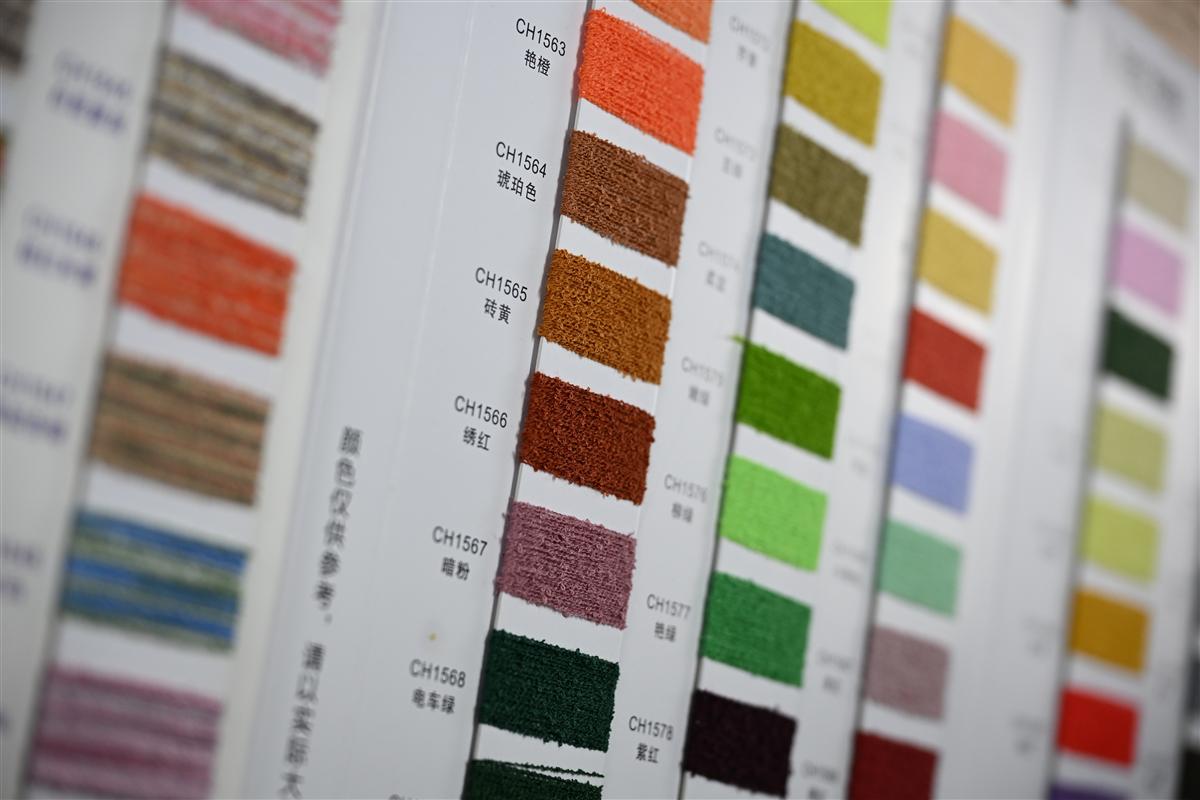
Lightfastness measures how well a fabric’s color resists fading when exposed to light over time. The governing standard is ISO 105-B02, which uses a xenon arc lamp to simulate daylight including UV. Test specimens are exposed alongside Blue Wool Standards (L2 through L8), reference fabrics with known fade rates.
The test runs until the Blue Wool Standard 3 has faded to a specified degree. The test specimen is then compared to the standards and graded 1-8, where 8 means no visible change and 1 means severe fading. Unlike crocking, lightfastness is not about transfer. It is about chemical stability of the dye under photon bombardment.
Typical buyer requirements:
- Interior fabrics (curtains, upholstery): Grade 5-6 minimum
- Outerwear and fashion fabrics: Grade 4-5 minimum
- Automotive textiles: Grade 6+ (SAE J1885 or ISO 105-B06)
Lightfastness failures are most common with bright reds, oranges, and certain fluorescent dyes. Indigo and some vat dyes perform well. Reactive dyes on wool generally score Grade 5-6, while direct dyes on cotton may score only Grade 3-4.
Side-by-Side Comparison
| Parameter | Crocking (ISO 105-X12) | Lightfastness (ISO 105-B02) |
|---|---|---|
| What it measures | Color transfer by rubbing | Color fade by light exposure |
| Scale | 1-5 (grey scale staining) | 1-8 (Blue Wool Standards) |
| Test duration | Minutes (mechanical test) | 20-80 hours (xenon arc exposure) |
| Key variable | Dye fixation quality | Dye chemical class |
| Worst offenders | Dark piece-dyed shades | Bright reds, oranges, fluorescents |
| Typical buyer minimum | Grade 3-4 dry | Grade 4-5 |
| Prevention | Proper soaping, fixatives | UV-stable dye selection |
Why Both Tests Matter for Your Order
A common mistake in fabric sourcing is to specify only one test. A buyer might require crocking Grade 4 and accept the order, only to have the garment fade after one summer on a retail rack. Or the reverse: lightfastness passes but the fabric rubs off on a white handbag during the first wear.
For tweed and knitwear, we recommend specifying both tests in your purchase order. At Fursone, every production lot runs both tests in-house before shipment, including our Chanel-Style Tweed line where yarn-dyed multi-color constructions make crocking control a daily priority. Dark shades go through an additional soaping cycle to push crocking above Grade 4, and any colorway below Grade 4 on lightfastness gets reformulated with a more UV-stable dye before the bulk run.
If you are developing a new colorway, request a lab dip submission with both test results before approving the color. This avoids the expensive situation where bulk fabric passes one test but fails the other after 3,000 meters are already dyed.
How to Spec Both Tests in Your Purchase Order
The most effective way to prevent color fastness disputes is to write both test requirements into your purchase order before production begins. A typical specification block looks like this:
- Crocking (ISO 105-X12): Grade 4 dry, Grade 3-4 wet minimum
- Lightfastness (ISO 105-B02): Grade 4-5 minimum for fashion fabrics; Grade 5-6 for interior or automotive textiles
- Washing fastness (ISO 105-C06): Grade 4 for color change, Grade 3-4 for staining
- Rubbing fastness for dark shades only: specify separately if your order includes navy, black, or burgundy
Include the test method version (e.g., ISO 105-X12:2020) to avoid ambiguity between older and newer procedures. Some buyers still reference AATCC equivalents. If your buyer specifies AATCC test methods, confirm which version they require and whether they accept ISO equivalents.
Root Causes and How Mills Prevent Failures
Crocking failures trace back to three root causes: insufficient soaping after dyeing (unfixed dye remains on the fiber surface), incorrect dye fixation pH (the dye bonds weakly to the fiber), and excessive dye concentration in dark shades (more unfixed molecules per unit area). The fix is process discipline: extend soaping time by 10-15 minutes for shades above 3% depth, check fixation pH within 0.2 of the dye’s optimal range, and for blacks and navies, run a second soaping cycle as standard.
Lightfastness failures have a different root cause: the dye molecule’s chromophore is inherently vulnerable to UV cleavage. No amount of process improvement will fix a poor dye selection. The solution is to reformulate the color with a more UV-stable dye from the start. For wool, reactive dyes based on vinyl sulfone chemistry typically achieve Grade 5-6 on lightfastness. For cotton, vat dyes and high-performance reactive dyes reach Grade 6+. The trade-off is cost: UV-stable dyes cost 20-40% more per kilogram, but they prevent the far larger cost of a failed bulk order.
At Fursone, every bulk dye batch is tested for both crocking and lightfastness before the fabric leaves the dye house. Dark shades receive an automatic second soaping cycle. Any lightfastness result below Grade 4 triggers a reformulation before the bulk run continues. This protocol keeps our claim rate below 0.5% across all production lots.
FAQ
Is ISO 105-X12 the same as AATCC 8?
They measure the same property (crocking) but use slightly different equipment and parameters. ISO 105-X12 uses a finger cot with 900g weight; AATCC 8 uses an AATCC crock meter with a 9N force. Results are comparable but not identical. Always specify which standard your buyer requires.
Can a fabric pass crocking but fail lightfastness?
Yes, and this is common with certain dye classes. Reactive dyes that are well-fixed (passing crocking) may still have poor UV resistance if the chromophore is not inherently light-stable. Always test both.
What is the fastest way to improve crocking grades?
For piece-dyed fabrics, an additional soaping cycle at 80-90 degrees C removes unfixed dye. For yarn-dyed fabrics, ensure the dyer soaps each cone for at least 20 minutes post-dye. A cationic fixative can add 0.5-1 grade but may affect hand feel.
Does washing affect lightfastness?
Generally no. Lightfastness is a property of the dye molecule’s chemical structure. However, some acid dyes on wool can hydrolyze after repeated alkaline washing, slightly reducing lightfastness by 0.5 grade.
Seasonal and Environmental Factors in Color Fastness
Color fastness performance is not static. It changes with the environment the fabric is exposed to. Fabrics destined for tropical or high-UV markets need higher lightfastness grades than fabrics for northern European winters. A tweed jacket sold in Stockholm will experience roughly 1,200 hours of daylight UV exposure per year. The same jacket sold in Dubai will see 3,500+ hours. The lightfastness requirement for the Dubai market should be at least one grade higher.
Humidity also affects crocking performance. In high-humidity environments (relative humidity above 70%), moisture in the air can partially re-mobilize unfixed dye molecules on the fabric surface, effectively lowering the crocking grade over time. A fabric that ships at Grade 4 crocking may degrade to Grade 3-4 after three months in a humid warehouse. If your distribution chain includes tropical climates, specify crocking at Grade 4-5 at the time of production to provide a buffer against humidity-related degradation.
Temperature during storage matters too. Fabrics stored above 35 degrees C can experience accelerated dye migration, where dye molecules move from darker to lighter areas in multi-color constructions. This is particularly relevant for yarn-dyed tweeds with high contrast between warp and weft colors. Store finished fabric in climate-controlled warehousing below 25 degrees C to prevent migration.
Color fastness testing does not have to be a guessing game. At Fursone, every bulk order ships with an in-house test report covering crocking (ISO 105-X12) and lightfastness (ISO 105-B02) as standard. Read our pilling resistance guide for the third test buyers most often request, or compare recycled vs virgin wool for fiber-level performance data.
Related Insights
ISO Grade 3-4 Pilling Resistance: What the Rating Really Means
When a fabric spec sheet lists “ISO grade 3-4 pilling resistance,” most buyers read it...

How Boucle Loops Are Formed: Yarn Twist and Loop Engineering
A buyer opens a fabric swatch, runs a thumb across the surface, and feels those...
Inside a 300-Loom Wenzhou Tweed Factory: How Orders Flow
Every order that enters a wenzhou tweed factory with 300 looms follows the same spine:...