
sourcing tweed fabric factors is the first checkpoint buyers should lock before they approve a supplier, budget, or production slot. 你知道有多少采购粗花呢面料的因素是真正在你看到大货之前就能验证的吗?如果你的答案是“不多”,那你很可能已经为一个50,000美元的订单付出了代价——就像我上周才见过的那样。那个买家收到了预生产样品,做了样本批准,开了L/C,结果1000米大货的手感、色光完全走样,而供应商只是耸耸肩,用“质量容差”来搪塞。.
这件事让我意识到,太多品牌采购经理把样品批准当作质量控制的终点,而不是起点。在粗花呢的世界里,FOB定价再漂亮,也抵不过一次缩水率超标或色牢度不达标。经过在十二个国家审核供应商的经验,我总结出一套只认工程数据的五因素检查法——不看华丽的小样,只看经纬密度、ISO 6330缩水报告和纤维混纺比。下面就是这五个决定你大货品质一致性的关键点。.
Yarn Origin & Blend Composition
A missing composition cert can turn a $6/m saving into a full production recall.
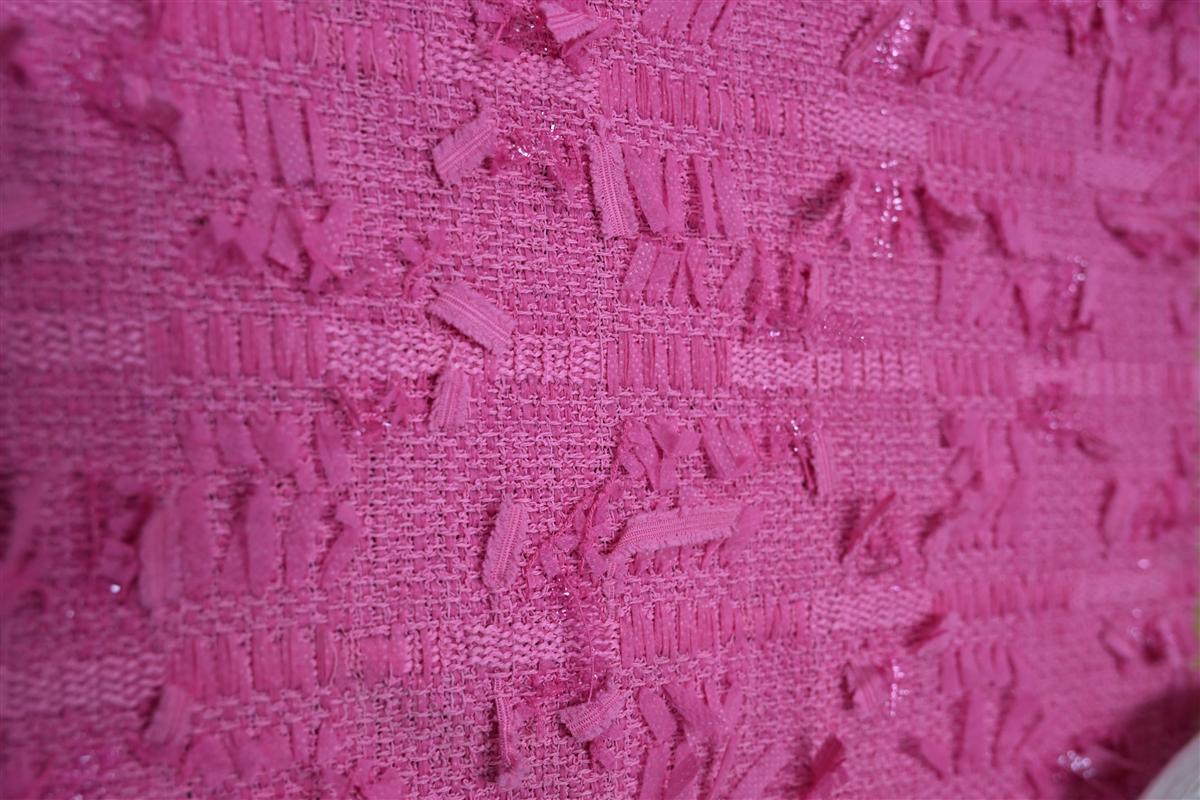
Pure new wool tweed runs 2–3 times the price of a wool-acrylic blend. The cost driver isn’t just fiber — it’s the scouring, carding, and finishing required to stabilize a 100% virgin wool yarn. A 70/30 wool-acrylic composition, spun to the same micron and twist, slashes $4–6 per meter off your FOB pricing while holding drape and hand feel for runs up to 500 jackets.
- Spec: 70/30 wool-acrylic blend reduces per-meter cost 30–40% vs. 100% virgin wool. At 350–450 GSM, the fabric still meets ISO 6330 shrinkage ≤5% and ISO 105 colorfastness when the acrylic is long-staple, not filler-grade.
- Quality tolerance: Any blend ratio deviation over ±5% shifts dye uptake and pilling resistance. Insist the mill provides a third-party yarn composition certificate — not just a hangtag — before you approve the sample.
- Risk: Without verified composition, a ‘wool blend’ may contain reprocessed wool or short-staple acrylic that pills within 20 wears and bleeds color onto trims. The $4–6/m you thought you saved gets wiped out by chargebacks and reorder delays.
A mill that spins its own bouclé and slub yarns in-house can lock in your specified blend and avoid spot-market fiber substitutions. This is where sample approval becomes your control point: cross-check the submitted yarn test report against the physical swatch before you sign off on the 300-meter bulk order. If the certificate shows a 65/35 ratio when you specified 70/30, reject it — the tolerance has already drifted beyond what a bulk dye lot can correct.
Weave Density & Weight Per Meter (GSM)
Under 300 GSM: jacket won’t survive the first season.
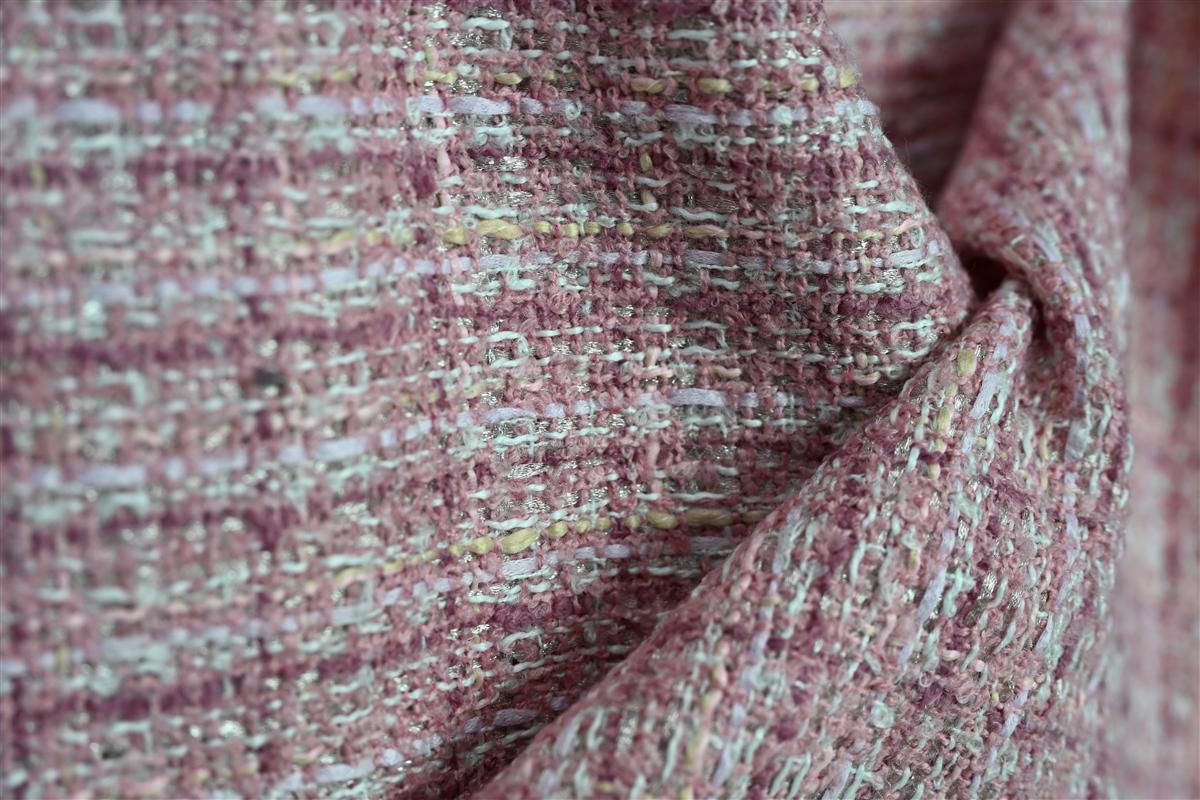
Weave density and weight aren’t abstract specs — they determine whether a garment holds its architecture or collapses into a shapeless mess. When I audit a mill, the first two numbers I request are the yarn count and the ends per inch. If the supplier can’t produce a pick glass and a GSM cutter within five minutes, I walk.
- Ideal GSM: 350–450 for structured outerwear: A Chanel-style tweed jacket demands this weight to maintain drape and prevent sagging at the hem and collar. I’ve rejected entire 1000m lots that measured 280 GSM — the fabric felt fine as a swatch but hung like a cheap cardigan once cut and sewn.
- Ends per inch: 18–22: Jacket-grade tweed needs a tight sett. At 15–16 ends, the weave opens up, pills within weeks, and distorts after dry cleaning. A density below 18 ends per inch is a non-negotiable line for any outerwear program.
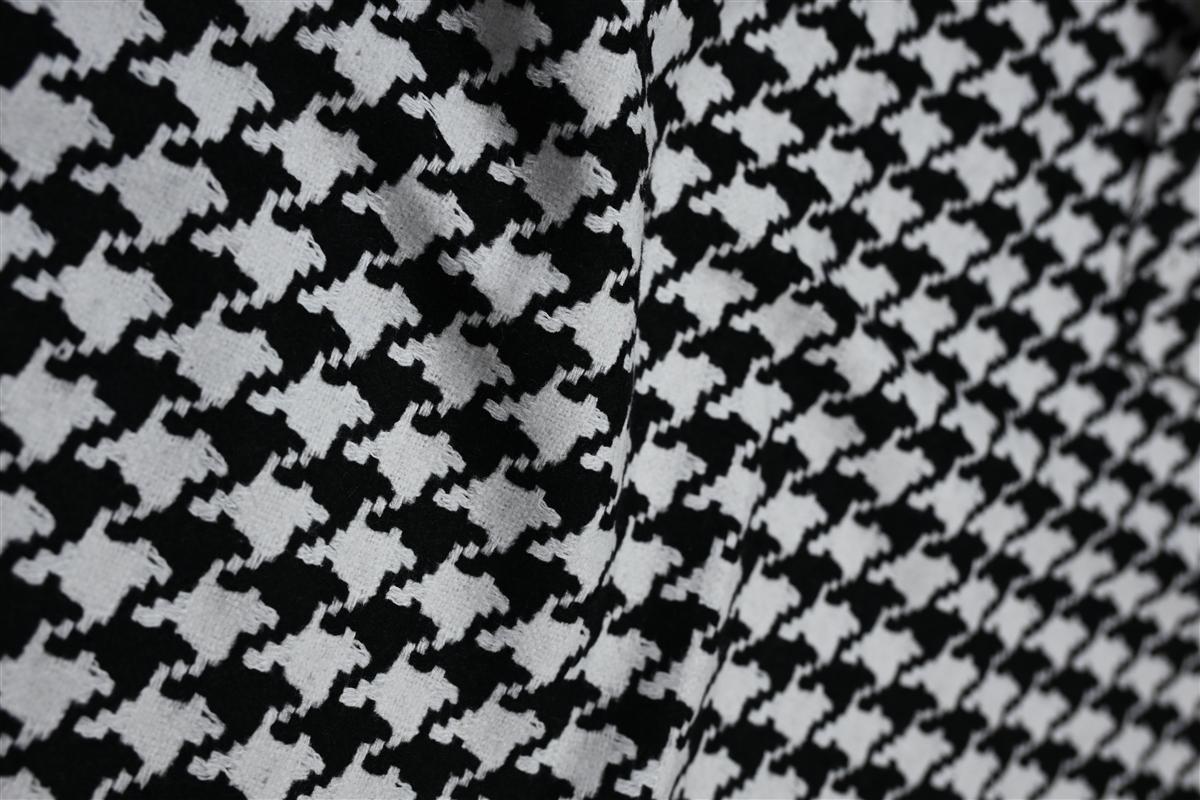
- Overcheck alignment: Overcheck weaves require exact pick counts. A single skipped thread per repeat creates a visible bar across the roll — a rejection-level defect we catch by checking the selvedge every 100 meters. If your supplier doesn’t do this, you’ll find the flaw only after bulk cutting.
Colorfastness & Shrinkage Testing
A 1-meter sample hides the sins of a 300-meter bulk run.
I’ve audited mills on three continents, and the #1 piece of advice that blogs give—’just check the hand feel of the sample’—is dangerously wrong. A manufacturer can steam, press, and stabilize a 1-meter sample to feel like luxury armor, but if the bulk run hasn’t been properly finished, that same fabric will shrink 8% and bleed dye onto your trims the first time the garment sees a cleaning sponge. I’ve seen a substantial order go straight to a landfill because the pre-production sample passed the eye test but failed the wash test.
You need hard data, not intuition. Most catastrophic fabric failures originate not from the weave but from cardboard-quality dye lots and unstable finishing—issues you can only catch with two specific certificates.
- Shrinkage Threshold (ISO 6330 Certification): The global benchmark for wool tweed stability is a maximum 5% shrinkage after a cold water wash. If a supplier cannot provide an ISO 6330 wash-test certificate for the specific dye lot you are buying, reject the offer. Unstabilized wool-acrylic blends can easily exceed 10% shrinkage, turning a structured jacket into a cropped disaster.
- Colorfastness Certification (ISO
- The Consistency Clause: A supplier who can produce batch-tracked ISO reports for your 1,000m order respects your cost-per-meter KPI. If a mill can deliver a 100m stock lot with these specs in 7 days, like the Wenzhou facility running 30-50% under Italian prices, you’ve found a partner who protects your unit economics rather than just selling you a pretty swatch.
MOQ Flexibility & Reorder Stability
Stock 100m and custom 1000m: Why flexibility separates real mills from traders.
Most mills won’t tell you the truth: their MOQ isn’t about your collection needs—it’s about their loom efficiency. If a supplier demands 3000m for every repeat order, you’re not a partner; you’re subsidizing their production planning. When you’re launching a capsule or testing a new tweed colorway, tying up significant capital in fabric before a single jacket sells is a cash-flow killer. That’s why a supplier with a clear tiered structure—100m in-stock service and 300m custom development—passes the first real sourcing test.
- 100m in-stock standard tweeds: Ships in 3–7 days; zero development cost. This lets you validate a design’s market fit with minimal inventory exposure. You avoid the classic trap of eating 2000m of dead stock because a buyer changed their mind.
- 300m custom MOQ: The threshold where you still control exclusive textures without inflating per-meter cost. A mill that asks for 3000m+ for custom work is essentially telling you they can’t handle short-run efficiency—and you’ll pay for their waste.
- Repeat order consistency: Verify that subsequent runs match the approved lab dip and hand feel. Ask: “Do you retain a reference swatch from every dye lot and production run?” Mills that don’t archive this data will inevitably shift color and texture by the third order.
Here’s where speed intersects with stability: if a mill can’t go from your spec sheet to a physical sample in 7 days, their development pipeline is already bottlenecked. The industry average hovers around 4 weeks; a 7-day sampling window tells you they have in-house specialist spinning and controlled dye lots—not outsourced piecemeal. That matters because a rushed sample that looks flawless at 1m often betrays its inconsistency when the bulk 1000m run shows up with a half-shade lighter melange or a softer hand. A 7-day turnaround isn’t just fast; it’s proof they’ve already standardized the yarn blends, dye recipes, and weave settings that guarantee replication.
The same logic applies to reorders. A mill that depends on spot market yarns will deliver a beautiful first batch, but when you reorder 10 months later, the dye affinity changes because the wool micron variation shifted. You mitigate this by sourcing from mills that spin their own fancy yarns and maintain GRS-certified recycled polyester integrations under strict lot control. Ask for a shrinkage test report (ISO 6330 standard, ≤5%) and colorfastness certification (ISO 105) for each production lot. These documents separate the mills that treat tweed as a commodity from those that treat it as an engineered textile.

Sampling Lead Time & Communication
The sample isn’t the test.
Every sourcing guide tells you to request samples before committing to a mill. That advice is about as useful as telling a chef to taste the food. One brand lost a substantial amount on a bouclé order because the pre-production sample was flawless—tight weave, perfect color saturation, beautiful hand feel. The 1000m production run arrived with a loose, slubby hand and a shade that leaned three tones warmer. The sample didn’t fail. The sampling process did. What matters is what the mill’s sampling cadence and communication reveal about their production discipline.
After auditing tweed mills across multiple countries,
- The 7-day ceiling is real, not aspirational.: Any mill that quotes a sampling lead time over 7 days is signaling a bottlenecked R&D pipeline. A factory-direct operation with in-house yarn spinning can pull a custom bouclé swatch from spec sheet to physical sample within a week. Mills that take 3–4 weeks are usually subcontracting the yarn or running sample orders through the same queue as bulk production. That means your reorders will face the same delay. A dedicated sampling line hits the spinning frame within 24 hours of spec approval—anything less means the supplier doesn’t control their upstream.
- 1m cuts show color. 10m production samples show consistency.: A 1m hand-cut swatch proves nothing about the mill’s ability to maintain dye lot consistency across a full roll. Always escalate to a 10m production sample before any order over 500m. This is where quality tolerance gaps emerge—if the 10m cut has visible selvedge tension differences or the weight varies more than 5% from the spec GSM, the mill cannot hold tolerances at scale. I’ve rejected suppliers purely on their inability to produce a uniform 10m sample. It’s the cheapest rejection you’ll ever make.
- FedEx overnight for the final seal isn’t optional.: Your production calendar doesn’t pause for a three-day courier delay. The approved final seal sample needs to be in your hands—physically signed off—before the cutting room starts. Mills that balk at overnight shipping or treat the final seal as a formality are the same ones that will argue about shade band discrepancies later. A supplier with real confidence in their output wants that seal signed fast. They know it protects both sides when FOB pricing terms are finalized and the container is booked.
Here’s the uncomfortable truth most articles won’t tell you: if a mill’s samples are late, their production will be late. If their communication during the sampling phase is slow or evasive, it will be catastrophic during a bulk quality dispute. The sampling window is your cheapest and fastest supplier audit. Use it ruthlessly.
Conclusion
Most guides will tell you the first sample approval seals the deal. I’ve learned, across multiple countries of supplier audits, that the pre-production sample is a promise—the bulk run is the proof. A factory that can’t replicate hand feel and color across 1,000 meters destroys your cost per meter calculation faster than any FOB pricing negotiation can fix it. The five-factor checklist I’ve outlined here—from yarn composition to shrinkage certification—isn’t academic. It’s the difference between a collection that launches on time and a warehouse of unsellable jackets.
Your next move is a direct comparison against a measurable standard. On your next supplier call, ask for their ISO 6330 wash test report and confirm their quality tolerance for shade lot variation across reorders. Then, check their actual stock depth and sampling timeline against the benchmark of 100m ready-stock and sub-7-day swatch delivery. You can browse Fursone’s in-stock tweed weights and compositions to see how a factory-direct program measures up against these specs right now.
Frequently Asked Questions
What are the factors influencing selection of fabric?
The five decisive factors are yarn composition, weave density (GSM), colorfastness and shrinkage, MOQ flexibility, and sampling lead time. Missing any one can turn a promising swatch into a production disaster. Always verify shrinkage test reports before committing to bulk.
Where does Chanel source their tweed?
Chanel historically sources its signature tweeds from Linton Tweeds in France, using exclusive bouclé yarns and metallic blends. Other luxury houses work with similar specialty mills for custom. For a comparable aesthetic without the heritage pricing, factory-direct mills offer rapid custom sampling.
What makes tweed special?
Tweed’s textured, multicolored yarns and tight woolen-spun weaves create depth, warmth, and natural water resistance. It’s the interplay of slubs, neps, and blend composition that gives it character. Character comes from the yarn blends and weave density, not just the fiber type.
What are different types of tweed?
Key types include Harris Tweed (protected-origin pure wool), Donegal (colorful slubs), and bouclé tweed (looped texture for Chanel-style jackets). Each varies in weight, fiber, and surface effect. A structured jacket needs at least 350 GSM to hold its shape.
Is 100% wool always better than a blend?
Not necessarily. A wool-blend can improve durability, reduce cost, and maintain drape while 100% wool offers heritage breathability. A 70/30 wool-acrylic blend often matches pure wool’s hand feel at 30–50% lower cost if composition is verified.
Authoritative References

Related Insights

How to Compare Fabric Quotes from Three Mills: A Side-by-Side Method
Three mills return three quotes for the same fabric brief, and the spread between them...

CNY Capacity Planning: Booking a Fabric Mill Around Chinese New Year
Every year, fabric buyers lose the same three weeks to the same event: Chinese New...

Second-Source Strategy: How Brands Qualify a Second Tweed Mill
Single-sourcing a signature fabric feels efficient right up to the season it fails: the mill’s...