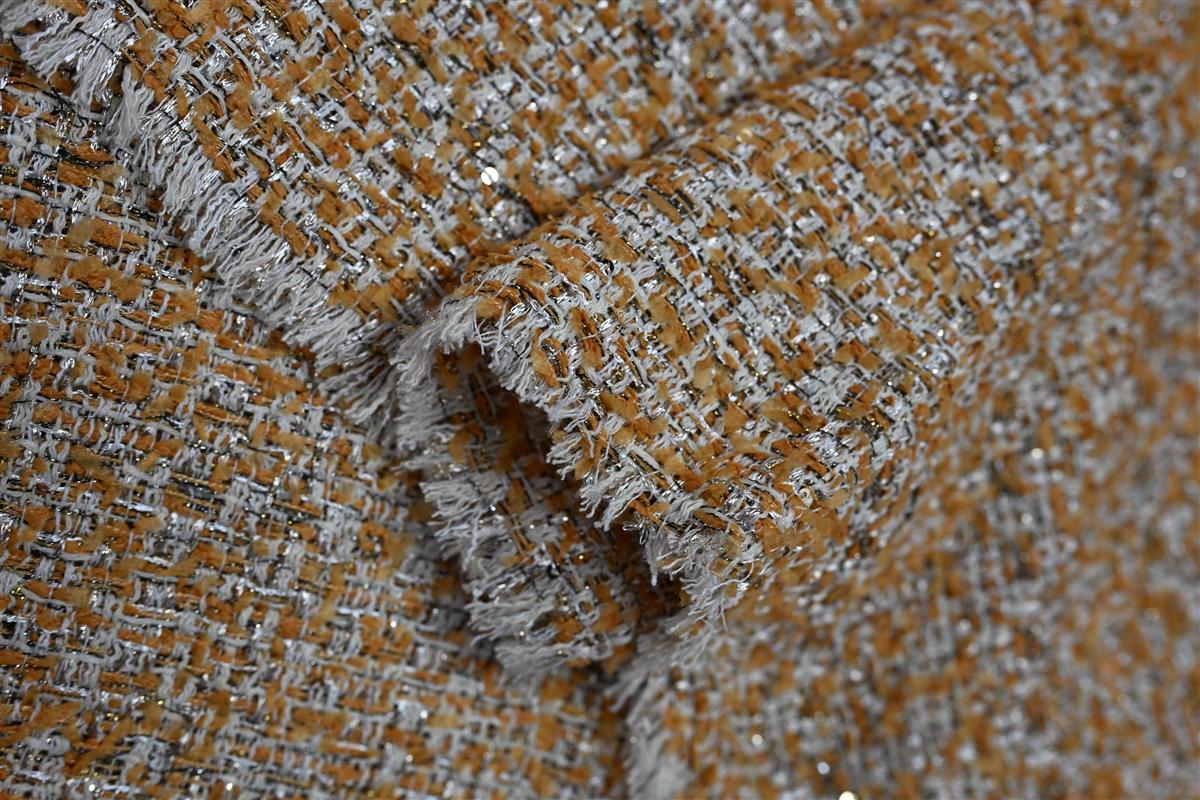
Sourcing Chanel style tweed fabric for a first capsule collection almost always starts with the same internal argument: do you need the real wool-rich boucle, or will a well-engineered viscose-blend tweed give you the same visual punch? You look at a heavyweight boucle swatch and feel the heft — 400 gsm and up, dense enough for a coat. Then you check the price per meter and realise a single jacket in that fabric can eat a third of your material budget. This is where a lot of emerging designers freeze. Get the fabric choice wrong, and you have a garment that looks under-structured on a hanger. Get it right, and you unlock that elusive maison aesthetic without the maison invoice.
The quiet advantage that changes the math is how Chinese manufacturers build affordable tweed. A 350-gsm boucle with 30% wool / 70% viscose can carry the exact same surface texture as a European cloth costing several times as much. The look lives in the fancy yarns that make up a small share of the total fibre — the rest is a stable, cost-friendly core. Some mills also bond a thin polyamide mesh to the fabric back, which stops the loose weave from distorting during cutting without adding a stiff fusible. That kind of detail does not show up in a photo. It shows up when you sew the first toile and the fabric actually behaves. Pair that with a supplier that holds a wide range of neutral base shades and will ship you a lab-dipped swatch in under two weeks, and the question stops being “can I afford luxury” and starts becoming “which weight and hand-feel actually serves the silhouette”.
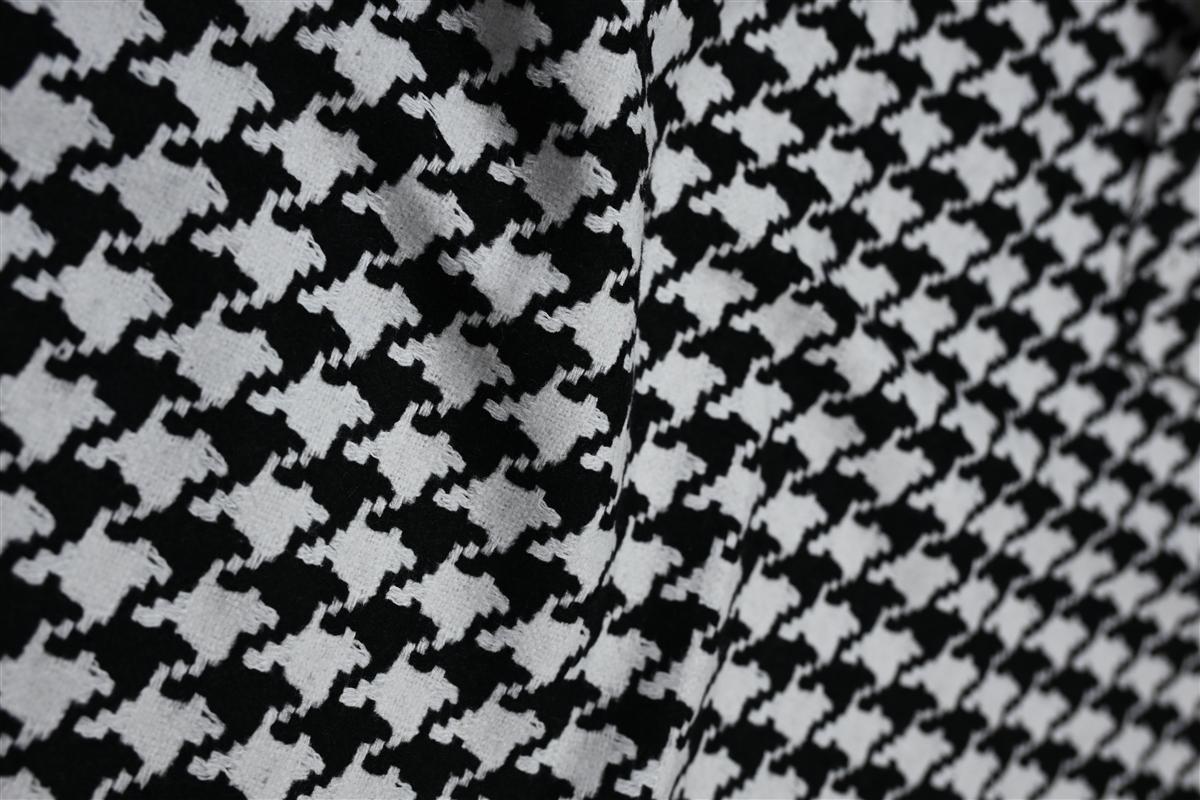
Identify Authentic vs Imitation Tweed
A polyester ‘tweed’ melts into a hard bead.
Novice designers burn cash on fabric that photographs well but fails on the cutting table. The term ‘tweed’ gets slapped onto anything with a nubby surface, and online swatch photos hide the truth. You need a 30-second verification protocol that works across every supplier and every price point. The burn test, a hands-on drape assessment, and a precise GSM check will catch most misrepresented stock before you commit to a production run.
Pull a few yarns from the swatch and hold a lighter to them. Pure wool smolders slowly, smells exactly like burning hair, and leaves a dark, crushable ash that turns to powder between your fingers. Polyester ignites faster, drips as it burns, produces black chemical smoke with a sweet or acrid odor, and cools into a hard, uncrushable plastic bead. A wool-rich blend will show both behaviors — ash from the wool, beads from the synthetic content. If the supplier claims 70% wool and the sample burns like a plastic factory, reject it. No exceptions.
Drape separates authentic tweed from stiff imposters. Drape a half-meter of fabric over your forearm. Real wool tweed — especially bouclé constructions — molds to the arm with a soft, springy structure. It holds a gentle curve without collapsing. Polyester-heavy imitations either hang limp like a curtain or resist shaping entirely, bouncing back flat the moment you release tension. This stiffness transfers directly to the finished garment. A jacket cut from rigid imitation tweed will stand away from the body at the shoulders and refuse to settle into the silhouette you designed.
- Lightweight: 200–280 GSM: Suitable for unlined spring jackets, vests, and layering pieces. Drapes easily but requires a cotton interlining for structure. Anything below 200 GSM is too flimsy for tailored garments.
- Midweight: 280–400 GSM: The sweet spot for classic Chanel-style jackets. Enough body to hold a shaped seam and chain-weighted hem without stiffness. Most bouclé tweed for women’s suiting lands in the 320–370 GSM band.
- Heavyweight: 400–450 GSM: For秋冬 coats and structured outerwear. At this weight, the fabric self-supports without heavy interfacing. Expect a firmer hand feel and longer pressing time during construction.
Chinese viscose-polyester-wool blends win on breathability for warm climates in ways pure wool cannot match. Viscose, a cellulose fiber, wicks moisture and allows airflow that 100% wool blocks. The 50% viscose / 30% polyester / 20% wool composition — the standard entry-level Chinese tweed blend — holds a better Martindale pilling rating (ISO 12945-2) than pure wool, which can pill visibly with wear. Cost sits far below European wool tweed pricing. For a designer shipping to Dubai, Singapore, or Los Angeles, the blend that breathes better and costs far less is not a compromise. It is the smarter engineering choice.
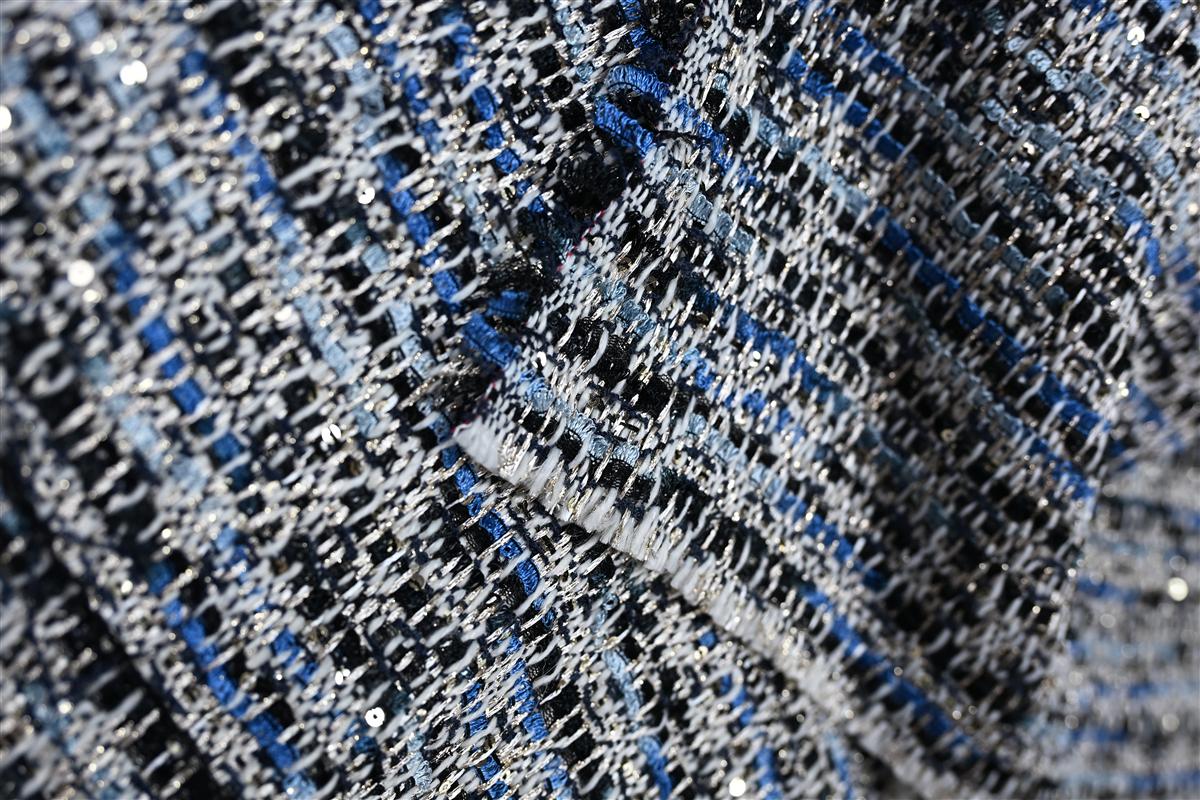
MOQ Breakthrough – Ordering as Low as 100m
100m gives you 33 jackets — enough for a capsule collection and stock replenishment.
The biggest sourcing barrier for a first collection is minimum order quantity. European tweed mills usually require large minimums per color. That’s a substantial commitment before you’ve sold a single garment. Chinese factories in Wenzhou have restructured the model to let you start with 100 meters per shade. Here’s how.
Low MOQ works because mills keep an inventory of pre-spun fancy yarns and stock a wide range of neutral base shades in their yarn warehouse. Instead of spinning a custom blend from scratch, they weave from existing yarn stock on shared looms between larger production runs. You get the look without paying for exclusive setup. The trade-off: you pick from in-stock colors rather than a fully custom palette. For custom shades, the MOQ rises to 1,000 meters — still well below the European custom minimum.
- Stock MOQ: 100 meters per shade, using in-stock yarns. Shipment in 3–7 days after order confirmation.
- Custom Color MOQ: 1,000 meters per shade. Requires lab dip approval — add 7–14 days for sampling before production.
- European Comparison: Italian and French mills typically demand large minimums for stock support and even more for custom. That’s a substantial outlay.
- 100 meters (stock color): a low per-meter cost. Yields about 33 jackets, keeping fabric cost per jacket modest.
- 300 meters (custom color match): a lower per-meter cost. Yields about 100 jackets, reducing fabric cost per jacket.
- 1,000 meters (full custom program): the best per-meter cost. Yields about 333 jackets, minimizing fabric cost per jacket.
At 100 meters, you’re ordering approximately 33 jackets (3 meters per jacket, standard size 38). Annualize that: the fabric cost per unit stays low, so material cost is a small share of retail. Even with lining, buttons, and CMT, total unit cost stays modest. That gives you margin room for marketing and wholesale discounts, something hard to achieve with premium European tweed.
An insider reality: the 100m tier isn’t just about saving capital. It’s a strategic tool to test a silhouette in market before committing to deep inventory. Many emerging brands run two 100m orders in different colorways, gather sell-through data, then scale the winner to 1,000m. That risk-hedging pattern is why Chinese low-MOO sourcing has become standard for indie luxury.
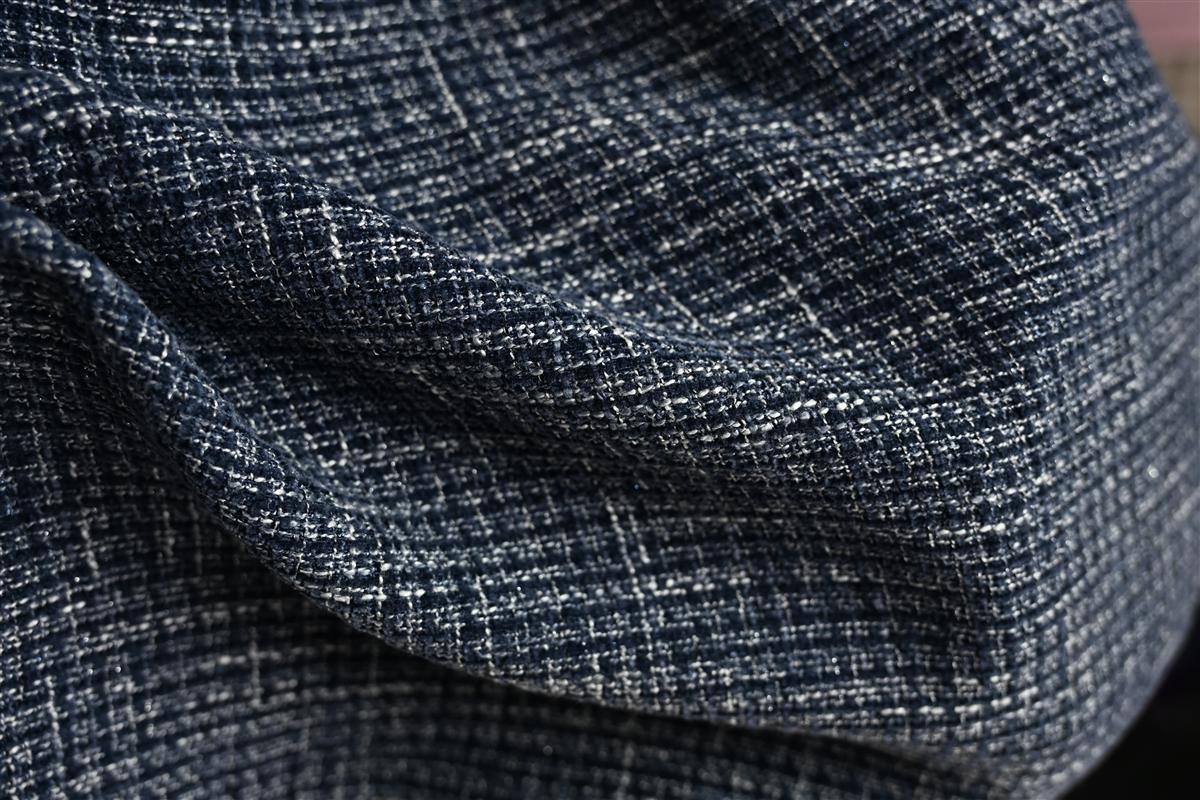
Construction Secrets for a Perfect Jacket
Loose boucle tweed can shift during cutting without proper stabilizing.
You can source an affordable tweed that looks identical to a premium European original, but if you cut and sew it the same way you’d handle a stable wool suiting, you will get a garment that torques, sags, and looks cheap after three wears. The real difference between a boutique finish and a craft-fair disaster isn’t the fabric cost — it’s the handling protocols. Chinese production managers who specialize in loose-weave boucle use three non-negotiable steps that most online sewing tutorials never mention. Apply these to your first capsule and you eliminate the risk of distortion before your garment reaches a hang rail.
- Cotton flannel interlining (flat-lined, not fused): Fusible interfacing destroys the drape of open-weave tweed by locking the yarns into a rigid plastic matrix. The alternative: flat-line each body panel with a lightweight cotton flannel (150–180 gsm) before you assemble. Lay the flannel against the wrong side, pin along the grainline, and treat the two layers as one. This adds body without stiffness, and the cotton fibers bite into the loose warp and weft to block on-grain shift during construction. When a jacket is returned to you with stretched armholes, more often than not the root cause is the cutter skipped this layer to save time.
- Steam press for full shrinkage before the marker: Boucle tweed with viscose or wool blends will release 2–4% in length and width the first time it meets steam. If you cut un-shrunk fabric, a finished size 42 jacket becomes a size 40 after one dry-clean cycle. The fix is industrial but simple: run the entire roll through a steam table or use a gravity-feed iron at 130–150°C with a damp cotton press cloth. Hold each section for 12–15 seconds, let the fabric rest flat for 6 hours, and only then spread it for marking. Any boutique studio can do this without buying extra machinery — skip it, and you bake permanent shrinkage into every unit you sell.
- Chain stitch hem instead of blind hem: A blind hem locks the hem into a fixed position, which fights the natural weight of a 350 GSM tweed. The result is a jacket that pulls at the back vent or puckers along the hemline after sitting. A single-thread chain stitch (ISO 301 type, 2.5 mm stitch length) works with the fabric’s own hang. The stitch structure has built-in elasticity, so the hem floats with movement instead of resisting it. This is the same detail heritage tailors use on hand-finished tweed coats, except a chain-stitch machine at a low-MOQ factory costs a fraction of hand-stitching. Implement this on your first run and you will see the hem lie dead flat on the body without pressing.
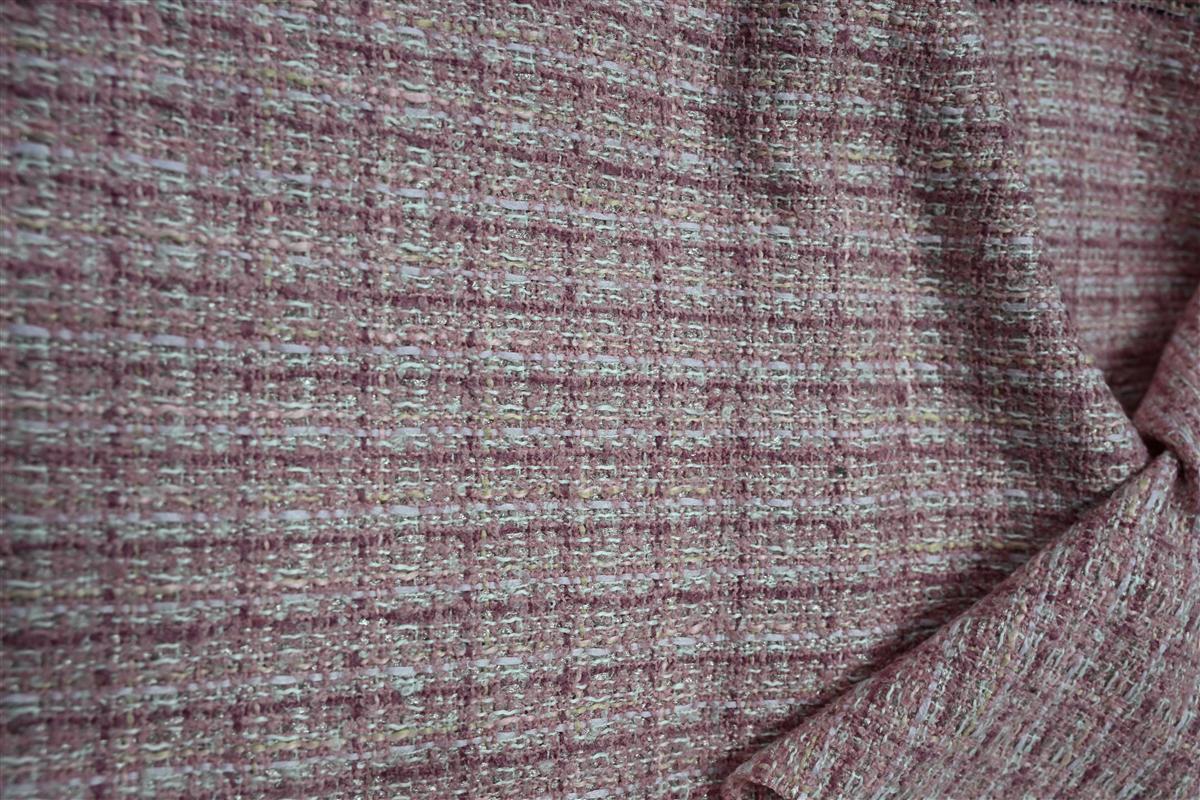
Cost vs European Mills – The Real Numbers
The fabric price gap isn’t a small discount — Chinese mills can cost a fraction of European heritage pricing, and the math only works one way for a first collection.
A Chanel-style boucle tweed from a Wenzhou mill runs at a fraction of European pricing — the Boucle Tweed Classic at 350 GSM, 30% wool / 70% viscose, with a 100m minimum. The visual equivalent from an Italian or French heritage mill commands premium prices for named-house qualities. The fiber composition differs: Chinese mills use a polyester-viscose core wrapped in wool-rich surface yarns, while European mills run predominantly wool through the full cross-section. On a finished, interlined, and trimmed jacket, the visual gap is slight — measurable under a microscope, invisible on a rack.
- Material cost per meter: China a fraction of Europe. A 10-jacket run costs far less in fabric from China than from Europe.
- MOQ per color: China 100m (stock shades), Europe large minimums. European mills will not set up a dye lot for small orders.
- Sample turnaround: China 7-14 days from concept to physical swatch. Europe 4-6 weeks, often requiring an external dyehouse queue.
- Custom shade development: China 2 weeks with in-house yarn lab. Europe 6-8 weeks minimum for a first lab dip.
- Stock shade availability: Chinese mills maintain a wide range of neutral base shades in ready inventory. European mills operate make-to-order — you wait for the loom.
- Shipping to US/EU: China 4-6 weeks ocean freight for custom orders. Europe 8-12 weeks for equivalent custom production runs.
The MOQ difference is the single largest operational advantage for a small brand. A designer making 10 jackets needs roughly 30 meters of fabric. Ordering a large European minimum means most of it becomes dead stock and a cash burn that kills a capsule collection before it launches. Chinese mills run shared-loom scheduling with stock yarn programs — neutral base shades sit in inventory, and you pull 100 meters in any of them without a surcharge. European mills abandoned that inventory model decades ago. It’s better for their working capital. It’s catastrophic for yours.
Sampling speed compounds the advantage. A Chinese factory with in-house yarn spinning, dyeing, and weaving can take a Pantone reference or a physical swatch and produce a custom lab dip plus a handloom sample in 7 to 14 days. Three rounds of iteration — standard for a designer dialing in the exact shade — takes three weeks. A European mill relying on external dyehouses and a booked sample loom queue will quote 4 to 6 weeks per round. Three rounds burns an entire season. For a brand launching spring/summer and finalizing fabrics in January, the Chinese timeline means samples arrive in February. The European timeline means samples arrive in April — after your production window closes.
Free swatches are standard from Chinese suppliers — existing shade cards, stock references, and up to 3-5 custom lab dips ship at zero cost within days. European mills routinely charge for a swatch set and may refuse to send anything without a purchase order or a registered business on file. This is not a difference in hospitality. It’s a difference in buyer qualification. European mills use cost as a filter to disqualify small buyers. Chinese mills use accessibility as a funnel to build long-term volume. If you’re sourcing for a 20-piece capsule, the European model simply does not want your business.
The brand cachet argument is the one place European tweed holds a genuine edge. A ‘Fabricated in Italy’ tag carries weight at a luxury retail price point. That provenance signals heritage to a luxury consumer who expects it. For an emerging brand selling jackets at accessible price points, that provenance signals nothing that the customer can verify by touching the garment. A properly constructed jacket in a 350 GSM wool-viscose boucle — steam-shrunk before cutting, stabilized with a cotton interlining, finished with bound seams — reads as luxury regardless of the mill’s postal code. Spend less on the fabric and invest the savings into Bemberg lining, genuine horn buttons, and a skilled sample maker. That is where perceived value is built. The fabric’s country of origin will not be the reason a customer buys or returns your jacket. The fit, drape, and finish will.
| Metric | Fursone (Wenzhou) | European Heritage Mill | Advantage | Insider Note |
|---|---|---|---|---|
| Fabric Price per Meter | A fraction of European pricing | Premium heritage pricing | Major cost reduction for identical aesthetic | Close visual match to luxury bouclé via surface yarn engineering |
| Minimum Order Quantity (MOQ) | 100 meters per color | Large minimums per shade | Lower financial risk; test 10 jackets vs. 50+ | Ready stock shades; no need for exclusive dye runs |
| Sampling Turnaround | 7 days (swatch) / 14 days (sample) | 4 – 6 weeks | Faster concept-to-sample cycle | Rapid sampling uses in-house stock yarns, no loom wait |
| Jacket Material Cost (3m/jacket) | Low (fabric + lining) | High | Major savings on COGS for capsule collections | Hidden laminating & interlining techniques deliver structure |
| Custom Color & Exclusivity | Free color matching from 100m; custom-spun yarns | Custom shade requires large commitment | Designed for emerging brands’ budgets | Proprietary spinning prevents market duplication |
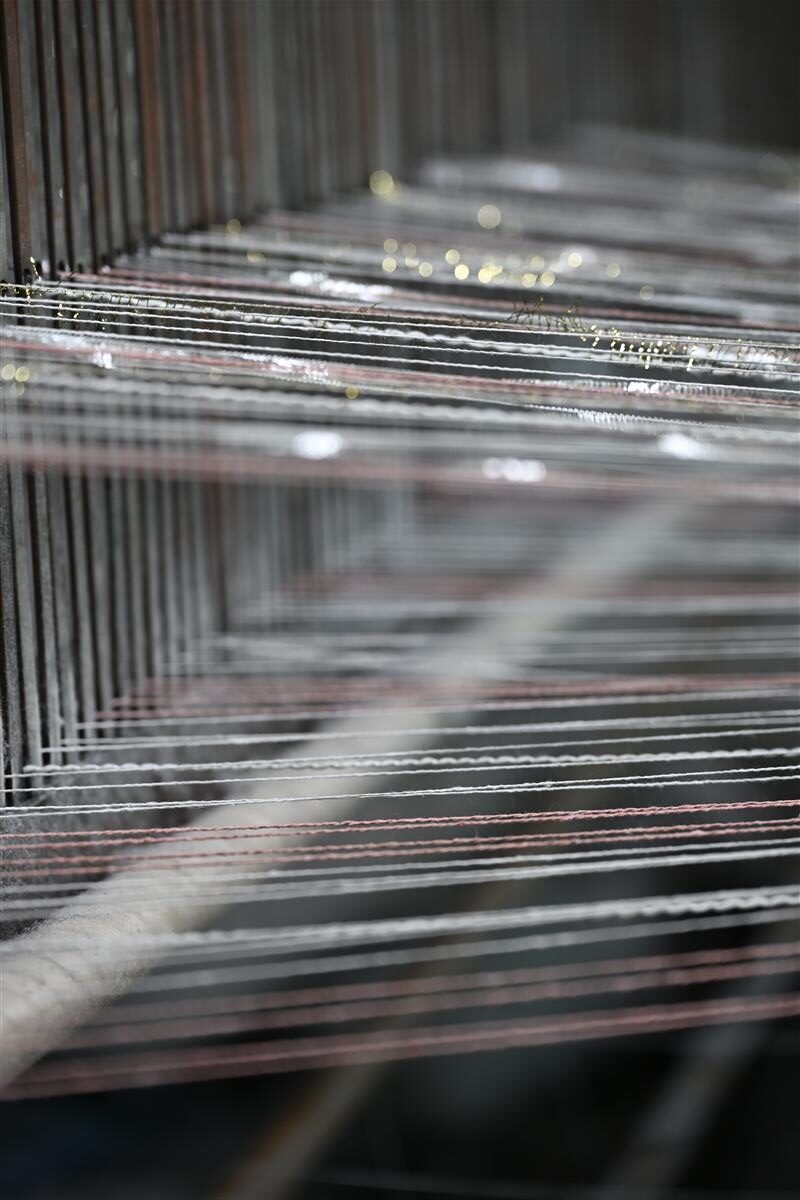
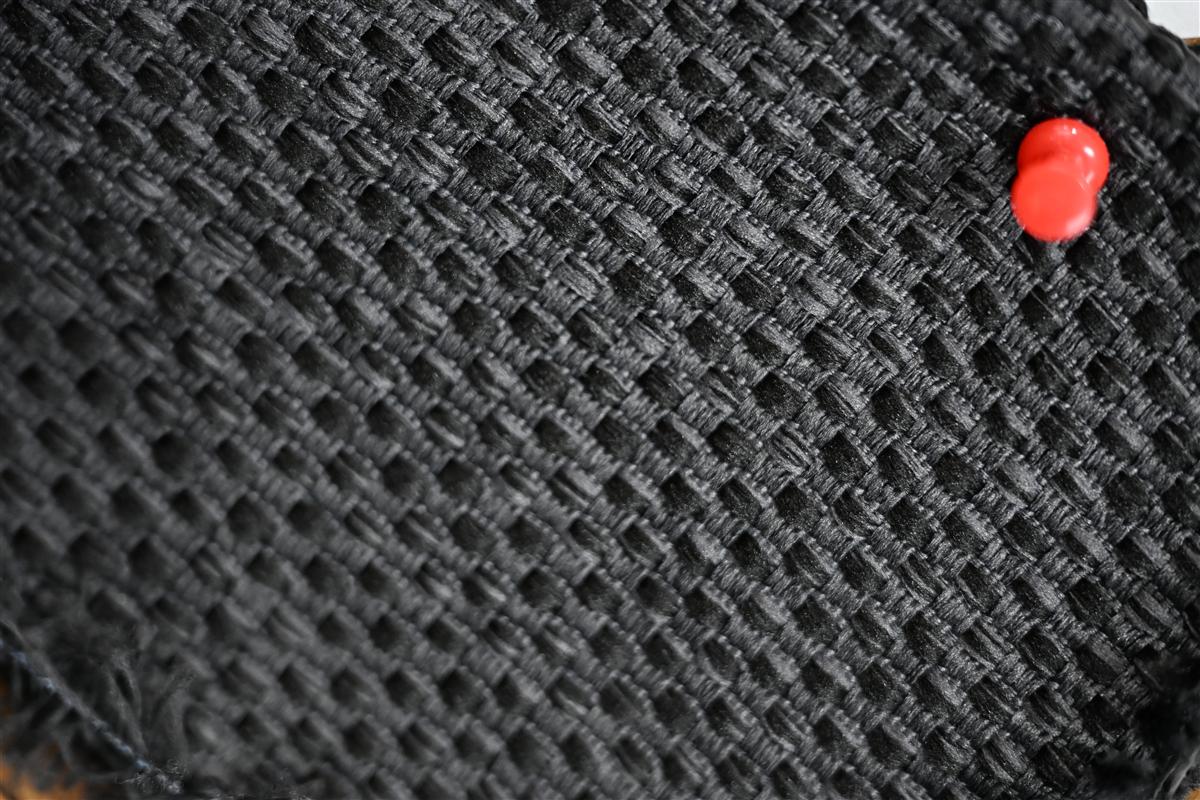
Avoiding Common Tweed Sourcing Mistakes
One skipped step can turn good fabric into scrap.
As an emerging designer, your material budget is tight. A sourcing mistake doesn’t just waste fabric—it wastes your limited sample-making time and can delay your capsule launch by weeks. The following five errors are the most common among first-time tweed buyers. Each comes with a direct fix.
- Ordering Without Swatches: Your screen distorts color and texture. Always request physical swatches before buying bulk—reputable mills offering low MOQ tweed fabric in China provide them free or at nominal cost, with 7-14 day turnaround.
- Choosing Pure Wool Without Considering Climate: 100% wool tweed feels luxurious but traps heat and moisture in humid or transitional weather. For most regions, a 50/30/20 viscose/polyester/wool blend or 30/70 wool/viscose (like our Boucle Tweed Classic) gives the same hand-feel with breathability and reduced pilling.
- Ignoring Weave Direction When Cutting: Boucle and tweed have a nap and directional weave. Cutting against the grain can cause twisted seams and a jacket that hangs unevenly. Always mark the warp direction on your pattern pieces before cutting.
- Not Ordering Extra 10% for Test Garments: Every new fabric requires a test jacket to dial in needle size, tension, and interlining. Add 10% to your order quantity for sampling and shrinkage—this small buffer prevents re-ordering and color-lot mismatch later.
- Forgetting to Check Colorfastness Before Washing: Even ‘dry clean only’ tweeds can bleed when processed. Request ISO 105-C06 and ISO 105-B02 test certificates from your supplier. A fabric that fails these tests will ruin linings and trim after one professional cleaning.
Conclusion
The choice between Chanel-style tweed and heavyweight bouclé comes down to drape, structure, and the construction tricks you apply before the first cut. A 350 GSM bouclé with a hidden polyamide backing stabilizes cheaper yarns so they hang like far more expensive fabric. A looser tweed weave, pre-shrunk with steam and backed with cotton flannel interlining, holds its shape through production without puckering at the seams. Get those details right, and the fabric source stops mattering to anyone who touches the finished jacket.
Order swatches across the weight range you are considering. Compare 280 GSM against 400 GSM in your own hand, under your own studio lighting. Browse the current tweed and bouclé inventory to request a sample set before you commit yardage.
Frequently Asked Questions
What is the difference between tweed and boucle?
Tweed is a woven fabric structure, while boucle is a yarn with looped texture. Chanel-style fabrics often weave boucle yarns into a tweed-like construction for that signature nubby hand. Confirm the yarn composition before selecting your fabric.
Does Chanel use boucle or tweed?
Chanel primarily uses boucle fabric for its jackets, not traditional tweed. The term ‘Chanel tweed’ is a marketing name for a wool-blend boucle, historically sourced from Linton Tweeds. Always check the fiber content, not just the name.
Which tweed is best for a Chanel-style jacket?
A medium-weight boucle with cotton interlining, around 280–350 GSM, works best. It delivers the structured drape and artisan texture of a classic Chanel-style jacket without excessive bulk. Request a swatch to test drape before ordering yardage.
Is tweed still in style in 2026?
Yes. Tweed remains central to luxury heritage and slow-fashion trends in 2026, seen on runways of Chanel and emerging designers. Incorporate tweed through modern silhouettes to stay current.
What are the disadvantages of boucle?
Boucle frays easily and can distort during cutting, necessitating stabilizers like cotton flannel. Its open texture also snags on jewelry and rough surfaces. Always use proper underlining and seam finishes to prevent issues.
Authoritative References
Related Insights
Boucle Knit vs Woven Boucle: Which Construction for Which Garment
Walk into any fabric sourcing meeting about boucle and one question comes up before all...
What Is Metallic Tweed? Yarn Types, Weave Structure, and Care
metallic-tweed-bridal-fabric-case-study/” rel=”noopener”>Metallic tweed fabric merges traditional wool weaving with reflective metal-thread yarns, producing a textile...
Boucle vs Chenille: Texture, Weight, and Cost Differences
The boucle vs chenille fabric question usually surfaces when a designer holds both swatches and...